
A DWI arrest can be overwhelming, but you don't have to face it alone. You're on the shoulder, lights in the mirror, and an officer wants you to blow into a machine. You hesitate, or you say no, and someone says "no refusal."
That phrase scares people because it sounds like the choice is already gone. It isn't. The Texas DWI no refusal law does not give officers unlimited power to take your blood. It runs through three separate paths: a license penalty if you refuse, a short list of mandatory-draw situations, and a warrant a magistrate has to sign.
If you're looking for a Houston DWI lawyer or a Texas DUI attorney after a stop, the useful question is narrower than "can they force a test?" It is what happened between your refusal and any blood draw, and whether each step was lawful. Your case can still be protected.
Facing a Texas No Refusal Stop
You have been asked to step out of your car. An officer requests a breath sample, and you decline or are unsure whether you must agree. The stop continues, and the next steps matter to your case.

No refusal describes an operation in which officers can seek a blood-search warrant after someone declines a breath test. The label does not itself authorize a blood draw. In an ordinary case, officers need legal authorization before taking blood by force.
Consider a stop on a holiday weekend. An officer reports seeing a car weave, smells alcohol, and asks the driver to perform roadside coordination tests. After an arrest, the officer requests a breath or blood specimen. If the driver refuses, the officer may contact an on-duty magistrate and ask for a warrant. The refusal remains part of the record, but it does not automatically end the effort to obtain a specimen.
What still belongs to you
You do not have to argue on the roadside. Your account of what happened can help your lawyer assess whether each step was lawful.
- Your refusal is a fact, not a verdict. Declining a voluntary specimen may prevent a consensual test, but it can also lead to a separate license case.
- A warrant has limits. In an ordinary case, an officer must swear to supporting facts, and a magistrate must sign the warrant before a forced draw.
- The timeline matters. When the stop and warnings occurred, and who took the blood, can matter alongside the lab result.
A refusal may avoid a consensual test, while still leaving the State able to seek a warrant. Those are separate legal paths, not proof that officers can draw blood whenever they choose.
As soon as you can, write down when the stop happened, what the officer asked you to do, and whether anyone read a warning before requesting a breath test or blood draw. Your lawyer can compare that timeline with the warnings, warrant, and collection records. If you are facing Texas DWI charges, those details give your defense a concrete place to start.
Key Terms Every Texas Driver Should Know
After a Texas DWI arrest, the same terms can appear in a license notice, a warrant application, and a criminal case. Knowing what each one means helps you separate the consequences of refusing a test from the legal basis for collecting a specimen.
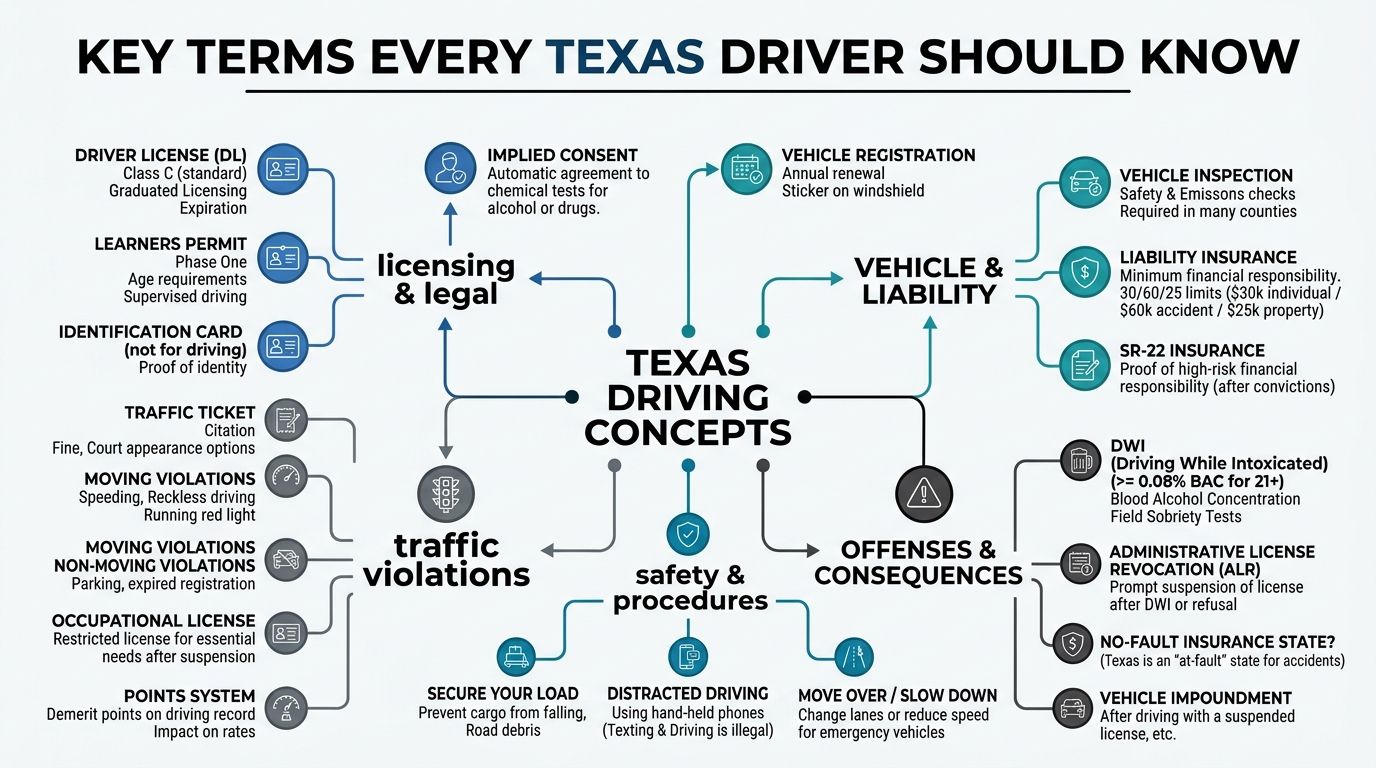
Implied consent
Implied consent refers to Texas's rules for requesting a breath or blood specimen after a DWI arrest. Driving on public roads does not mean an officer can automatically force a test. You may refuse a voluntary specimen, though refusal can carry driver-license consequences and may be mentioned in court. In some cases, it also leads an officer to seek a warrant.
The distinction matters: an administrative penalty for refusing is separate from the legal authority needed to take a specimen without your agreement. A refusal does not itself decide whether a later blood draw was lawful.
BAC
BAC means blood-alcohol concentration, the amount of alcohol measured in a blood sample. Under Texas Transportation Code § 49.01, an adult is legally intoxicated when the alcohol concentration is 0.08 or more. The State may also try to prove intoxication by showing a loss of the normal use of mental or physical faculties.
A BAC result is evidence, not a ruling on how it was obtained. Your lawyer can review whether the stop, warrant, collection, and testing followed legal requirements.
Field sobriety test
A field sobriety test is a roadside coordination check, such as walking in a straight line, standing on one leg, or following an object with your eyes. The officer uses observations from these exercises as evidence. They are not a chemical measurement, and performance can be affected by conditions at the scene, including the road surface and flashing lights.
Administrative license suspension
An administrative license suspension is a driver-license proceeding handled by the Texas Department of Public Safety, separate from the criminal charge. A refusal or failed test can start this process. The criminal case and the DPS license proceeding are separate cases that may proceed on different schedules, so an outcome in one does not automatically resolve the other. This suspension is also called a DWI license suspension.
These terms describe different parts of the case: implied consent concerns the testing request, field sobriety exercises provide roadside evidence, BAC refers to a chemical result, and an administrative suspension affects your driving privileges. Understanding those distinctions helps you and your lawyer assess what happened and which decisions may be challenged.
How No Refusal Operations Actually Work
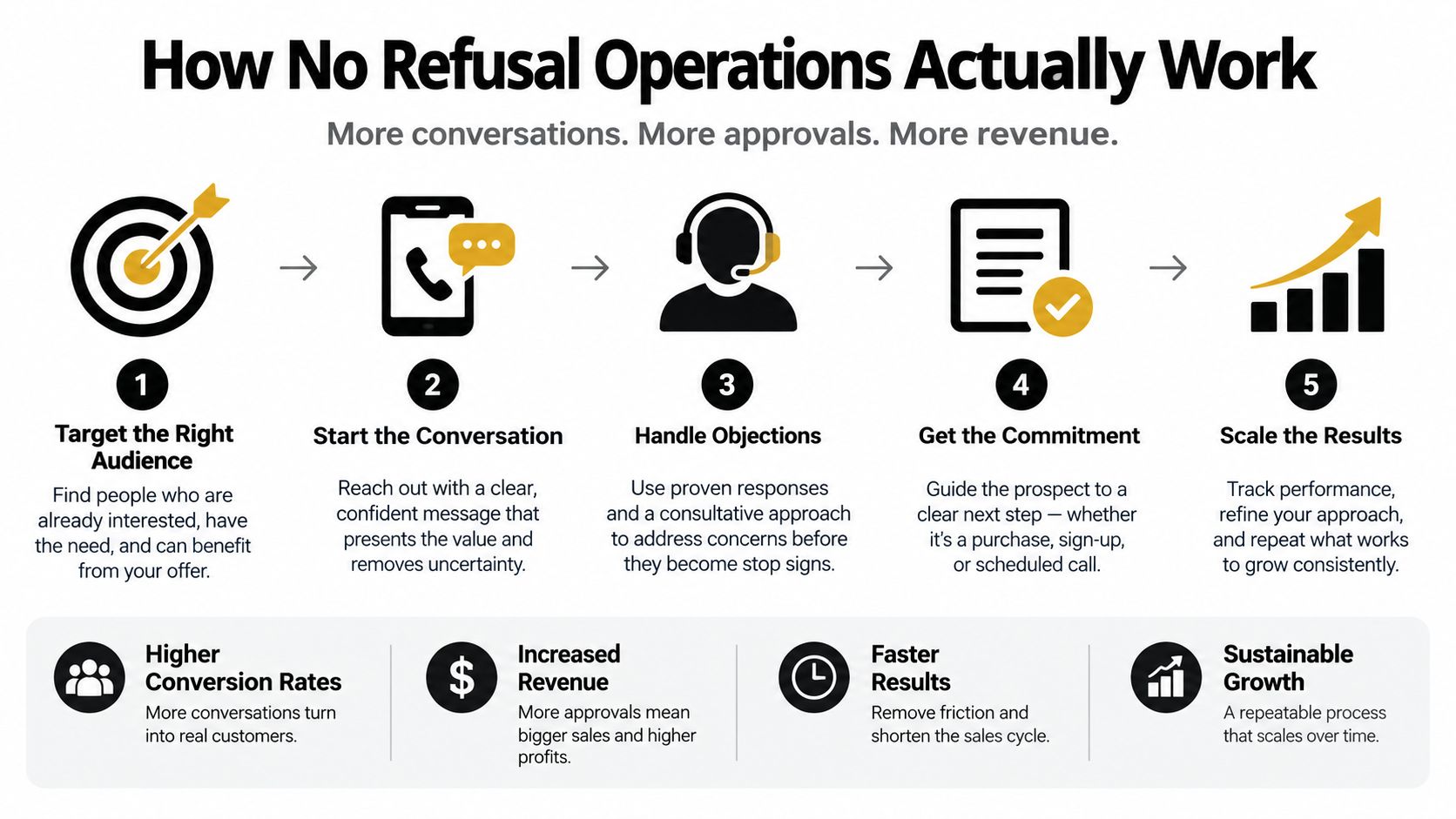
At a Texas no-refusal weekend, an officer may ask you for a breath test, and a judge may be available to review a warrant application if you refuse. The operation does not make every refusal lead to a blood draw. It adds a faster process for seeking judicial authorization.
Texas agencies developed these operations after chemical-test refusals became common. The National Highway Traffic Safety Administration reported a statewide refusal rate of approximately 50%. Several jurisdictions began No Refusal Weekends in 2005, using judicially issued blood-search warrants when suspected impaired drivers declined breath testing.
The practical effect was that a refusal could still be followed by a blood result, if a judge approved a warrant. Refusal could also bring a separate license consequence. Those are distinct parts of the process, not proof that officers can draw blood whenever someone says no.
What one county's weekends showed
The NHTSA report described a Montgomery County weekend when 12 DWI suspects refused breath testing and went through the warrant process. Blood testing showed that each tested suspect in that group had a BAC above Texas's statutory limit, and the group averaged 0.19, compared with the generally applicable 0.08 limit, according to the NHTSA report.
The same NHTSA report said Montgomery County's refusal rate fell from roughly 50% before the initiative to as low as 10% in 2010. Drivers subject to blood-test warrants averaged 0.19, compared with 0.13 among drivers who voluntarily took breath tests, the report stated.
These figures help explain why agencies arranged for magistrates, nurses, and prosecutors to be available during holiday weekends. A warrant could turn a refusal into a blood sample, but only through legal authorization. The infographic illustrates the sequence; the key point for your case is whether officers followed it correctly.
A short video walk-through shows how these operations are staffed and how the steps may unfold.
What the numbers do not prove
A county average does not predict your test result or establish that your stop was lawful. For your case, the details matter: what led the officer to stop you, what the warrant affidavit said, and whether a neutral magistrate signed the warrant before the blood draw.
No-refusal operations bring together testing requests, warrant paperwork, and judicial review. A refusal alone does not answer whether a blood draw was authorized. A defense lawyer can examine the timeline and documents between your refusal and the collection of your blood, including whether the required legal steps were followed.
Three Legal Pathways for a Blood or Breath Specimen
"No refusal" is a nickname, not a single statute that forces blood from every driver who says no. Texas law uses three pathways. Only one of them is the usual path for an ordinary first or second arrest.
Texas implied consent is the starting point, not the finish. Under Transportation Code §724.011, a person arrested for DWI is treated as having consented to breath or blood testing. You generally keep the ability to refuse, subject to administrative license-suspension consequences. Section 724.013 then draws the line. A specimen may not be taken after refusal unless an exception in §724.012 applies, as explained in this review of blood-draw objections and the 2009 amendments.
The 2009 mandatory-draw list
Legislative amendments effective September 1, 2009 expanded situations where an officer must seek a specimen even after a refusal. The listed situations included:
- A child in the vehicle: a DWI arrest involving a child passenger.
- A felony-level history: a suspected felony DWI based on qualifying prior convictions.
- Certain prior convictions: a prior intoxication-assault conviction, or a prior child-passenger DWI conviction.
- An injury crash: a crash in which another person suffered bodily injury and was transported for medical treatment.
Those same 2009 changes recognized attorney-magistrates as authorized to issue evidentiary blood warrants in DWI cases. That is a warrant path with a judge's signature. It is not the same thing as a mandatory draw that the statute itself requires.
If none of those aggravating facts fit your arrest, automatic compulsion is the wrong mental model. For many first- and second-time allegations, officers try to get a search warrant from a neutral magistrate quickly, often the same night.
Side-by-side view
| Pathway | Legal Basis | When It Applies | Driver Consent Needed |
|---|---|---|---|
| Administrative refusal consequences | Implied-consent warning and DPS license rules | You decline a requested breath or blood specimen after a DWI arrest | No specimen from consent; refusal itself can suspend the license and be mentioned at trial |
| Mandatory-draw exceptions | Transportation Code §724.012, expanded in 2009 | Child passenger, qualifying priors, suspected felony DWI, or a crash with bodily injury and medical transport | No, if the listed circumstance is actually present |
| Magistrate warrant | Search-warrant affidavit and a neutral magistrate, including an attorney-magistrate | Ordinary cases, and many no-refusal operations, once probable cause is sworn | No, once a valid warrant is signed; consent is not the source of authority |
If your arrest is a first DWI in Texas with no child in the car and no injury crash, the third row is usually the one to study. The State still has to earn the warrant. Your refusal did not sign it for them.
A refusal can bring a license suspension of at least 180 days, and the officer must warn you that the refusal may be used in the prosecution, under the specimen statutes in Transportation Code Chapter 724. That warning is a license and evidence issue. It is not, by itself, a court order to draw blood.
How Officers Obtain a Blood Draw Warrant
A warrant is a short stack of papers with a strict order. If a step is missing, the blood result is not automatic evidence.
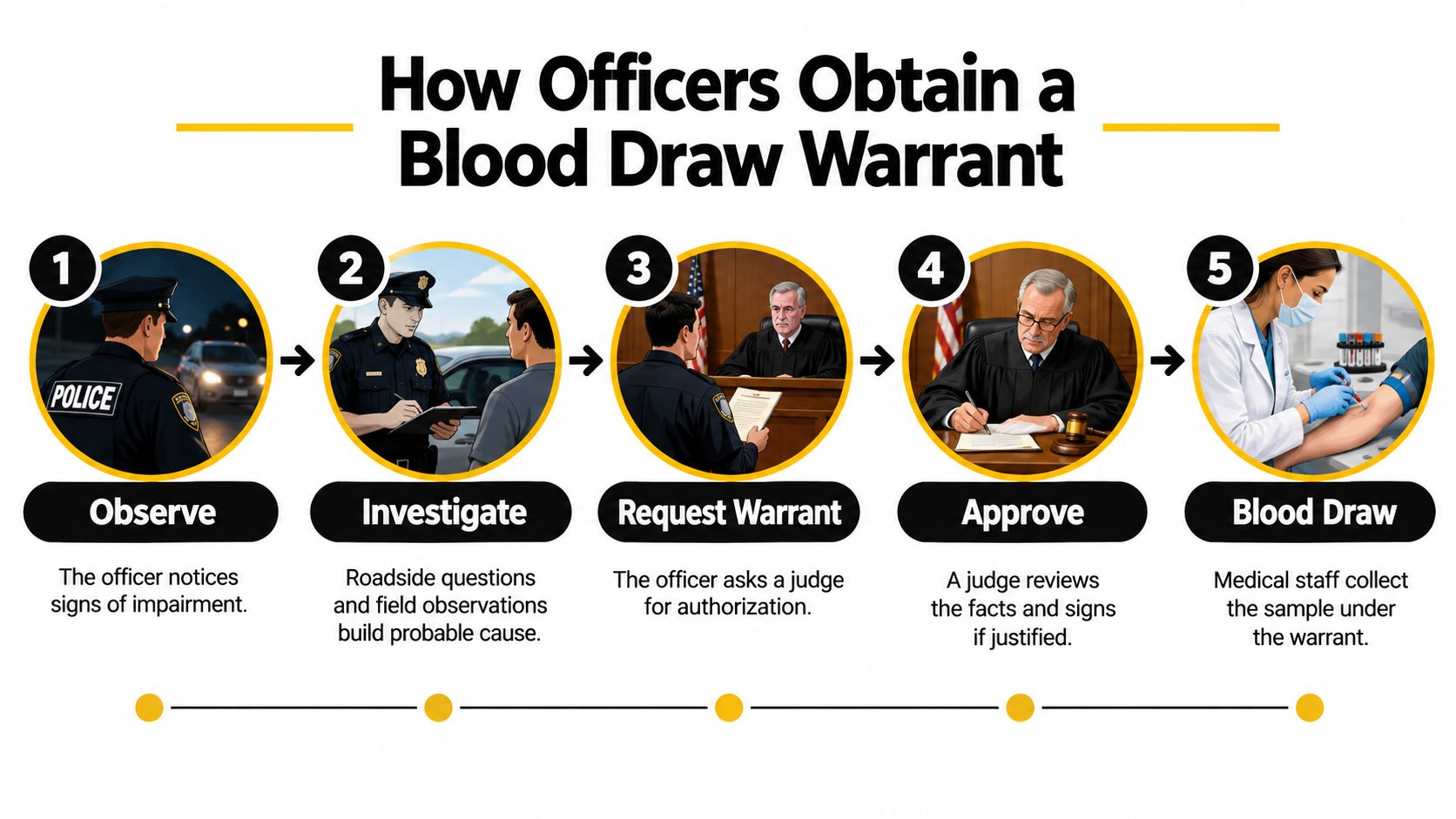
From the warning to the signature
The DIC-24 statutory warning is the script officers use before a specimen request. It tells you that refusing a requested specimen may be admissible in a later DWI prosecution. It also tells you the officer may apply for a warrant authorizing a specimen. Declining a voluntary test does not necessarily prevent chemical testing, because the officer may seek judicial authorization.
That form is also a record. A lawyer compares it with the arrest report, the warrant application, and the test records. The refusal, standing alone, is not conclusive proof that you were intoxicated.
- Observe and arrest. The officer claims signs of impairment and makes a DWI arrest. Those observations have to be specific enough to support probable cause later.
- Read the warning and record the refusal. You hear the DIC-24 consequences. Your answer, and the time, should appear in the report.
- Write the affidavit. The officer swears to facts, not conclusions. "He looked drunk" is weaker than what was seen, said, and done.
- Ask a neutral magistrate. In these operations that person may be an attorney-magistrate. The magistrate is supposed to review the affidavit, not rubber-stamp a holiday checklist.
- Draw only what the warrant allows. Medical staff collect the specimen after the signature. The person named, the sample authorized, and the method should match the order.
Why the clock matters
No-refusal staffing is built to compress that sequence, sometimes into a short overnight window. Speed is not the same thing as accuracy. A defense review looks at the gap between your refusal and the needle. Was the affidavit finished before the draw, or cleaned up afterward? Did the magistrate have the facts, or only a template? Was the vial labeled to you?
A lawyer should compare the warning, the arrest report, the warrant application, and the lab records rather than treating the refusal as the whole case.
You don't need to reconstruct this from memory alone. Ask for copies. The order of the pages often tells the story the roadside conversation never did.
Your Rights and How Unlawful Searches Get Challenged
A refusal does not end your case, and a signed warrant does not make every later step untouchable. Texas's no-refusal framework is not a blanket rule for warrantless blood draws. Under §724.013, a specimen generally may not be taken after a refusal unless a §724.012 exception applies. For everyone else, the Fourth Amendment still sits between the officer and the needle.
The Texas Court of Criminal Appeals has explained a point that confuses a lot of drivers. Once a valid warrant is issued on probable cause, implied or express consent becomes legally unnecessary. The warrant, not the implied-consent statute, supplies the authority for the blood seizure. You can read that warrant-versus-consent line in the text and notes around Transportation Code §724.012.
What Crider changed about the vial
In Crider v. State, the Court of Criminal Appeals held that when a neutral magistrate authorizes a blood draw based on probable cause to believe the person committed DWI, the warrant also authorizes chemical analysis of that blood when the testing rests on the same probable cause. A solid warrant can cover both the seizure and the lab work.
The reverse matters just as much. A defect in probable cause, warrant scope, or execution can affect whether the alcohol or drug number comes into evidence. Texas appellate authority also recognizes that some warrantless draws survive suppression under exigent circumstances, but only when the specific facts, and the State's proof, show that getting a warrant was impractical. Dissipation of alcohol is not a magic emergency in every file.
What counsel actually reads
Challenging Breath and Blood Tests in Texas DWI Cases fits a no-refusal defense here. Chemical-test evidence can be questioned. It is not accepted just because a machine or a lab produced a number.
A careful review usually includes:
- The affidavit's four corners: what the officer swore before the draw, not what was added later.
- The timeline: arrest, warning, refusal, call to the magistrate, signature, and needle.
- Magistrate neutrality and statutory fit: whether a mandatory-draw exception was claimed without the facts, or a warrant was used without real probable cause.
- Execution and scope: qualified collection, preservation, and a specimen that matches the person and the procedure the warrant allowed.
- Chain of custody and lab support: labels, storage, and whether the analysis the State wants was authorized.
A Franks hearing on a DWI blood warrant is one tool when the affidavit itself contains a false statement, or leaves out facts the magistrate needed. It is not filed in every case. It is filed when the paperwork can't support the story the officer told.
Refusing may avoid a consensual sample. It does not necessarily prevent testing, and it may create separate license and evidentiary consequences. Unlawful searches, thin affidavits, and warrants that reach past their own words can still be challenged. That is rights protection, not a technicality.
What to Do After a No Refusal Stop
Texas treats the criminal DWI case and your driver license as separate matters. DPS explains that administrative action may begin when you fail or refuse a breath or blood test during a DWI stop. The agency also recognizes that you may receive one suspension for a DWI conviction and another suspension for a refusal or failed test from the same arrest.
That license process is commonly handled through an Administrative License Revocation, or ALR, hearing. Winning, dismissing, or finishing the criminal charge does not automatically end the license consequences. The two files can move on different calendars.
A short list for the next few days
Don't wait for a court date to start the license file. The ALR hearing process has its own notice and its own deadline to request a hearing.
- Mark the arrest date: deadlines run from the arrest and from the notice you received, not from when you feel ready.
- Keep every DPS paper: the DIC-24, temporary permit, and any suspension notice are the license case.
- Save the criminal paperwork too: warrant, affidavit, and lab records answer different questions than the ALR notice.
- Have someone compare the records promptly: arrest date, notice, refusal or test result, and DPS history show which challenges and deadlines you still have.
A Houston DWI lawyer can read those pages against the three pathways already discussed, including whether your stop was an ordinary warrant case or something the statute treats as mandatory. Out-of-state drivers and people facing a first DWI in Texas often assume either that blood was automatic or that a refusal erased the BAC. Neither assumption is safe. A prompt review is.
The Law Office of Bryan Fagan, PLLC helps Texans sort the refusal warning, the warrant, and the separate DPS license case after a no-refusal stop. You can request a free consultation or case evaluation and get 24/7 support from a team that handles these files across Houston and other Texas counties. Visit Law Office of Bryan Fagan, PLLC to talk through your arrest date, your paperwork, and the next deadline.
