 Skip to content
A DWI arrest can be overwhelming, but you don't have to face it alone. You may be sitting at home after an officer obtained a warrant and took your blood without your consent, wondering whether the test result has already decided your case. It hasn't. The affidavit used to obtain that warrant may contain errors, omissions, or statements that can be challenged.
A Franks hearing on a DWI blood warrant in Texas is one of the most focused tools available when the State relies on a warrant affidavit that wasn't truthful. The hearing doesn't guarantee suppression, and it isn't a general attack on the officer's credibility. It tests whether a specific statement was knowingly false or recklessly made, and whether the warrant still survives after that statement is removed.
Understanding Your Rights After a DWI Blood Arrest
You're pulled over late at night, asked questions, and subjected to a field sobriety test. After your arrest, the officer requests a breath or blood specimen. You decline, or you're physically unable to make a meaningful choice because you're injured or receiving medical care. The officer then presents an affidavit to a magistrate and obtains a warrant for your blood.
That sequence can feel final, but a warrant isn't automatically valid merely because a magistrate signed it. Texas courts apply the Franks-hearing standard created by the United States Supreme Court in 1978. Under that standard, a defendant may obtain an evidentiary hearing after making a substantial preliminary showing that the affidavit included a false statement knowingly, intentionally, or with reckless disregard for the truth, and that the statement was necessary to probable cause. Texas courts apply this framework to DWI blood-draw warrants. Texas appellate authority explains the Franks standard for warrant challenges.

The terms that shape your case
Implied consent means that driving in Texas carries conditional consent to chemical testing after a lawful DWI arrest. A refusal can lead to an administrative license-suspension case, but refusal doesn't necessarily prevent officers from seeking a warrant for a blood sample. Texas Transportation Code Chapters 724 and 524 address refusal cases and qualifying chemical-test results, including a result at or above 0.08 BAC, as explained in this overview of Texas implied consent and ALR hearings.
BAC, or blood alcohol concentration, is the alcohol concentration measured in a biological sample. A blood result may become important evidence, but the State still has to establish that the sample was lawfully obtained and properly connected to your case.
A field sobriety test is a roadside evaluation of physical or divided-attention tasks used by officers when investigating suspected impairment. It isn't the same as a blood test, and its observations may be examined for environmental conditions, instructions, medical limitations, and whether the officer accurately recorded what happened.
An administrative license suspension, commonly called an ALR suspension, is separate from the criminal DWI prosecution. That separation matters because you may need to defend your driving privileges while the criminal case continues.
Why the blood warrant deserves individual review
A Franks motion focuses on the facts used to justify taking your blood. It may examine claims about your driving, statements, coordination, alleged refusal, field observations, timing, or the circumstances supporting probable cause. The practical question is narrow but powerful: did the affidavit present a truthful basis for the warrant?
The warrant challenge should fit inside a broader defense plan. Your lawyer may also examine the traffic stop, arrest decision, field sobriety evidence, chain of custody, laboratory work, and whether the State can prove impairment without the blood result.
The Legal Standard for Challenging a Blood Warrant
A Franks hearing isn't a shortcut around the warrant process. The court won't order one merely because you disagree with the officer's account or believe the magistrate should have heard more information. You must identify a specific statement and support the claim with facts showing why it was false and why the problem mattered to probable cause.
The modern framework began with Franks v. Delaware in 1978. Texas courts use the same demanding approach for search warrants, including DWI blood warrants. A defendant must offer proof and show that, once the challenged material is removed, the remaining affidavit fails to establish probable cause. Texas courts describe the three-part inquiry in DWI blood-warrant litigation.
Three questions the judge must address
The court generally works through these questions:
-
Was the statement false? The defense must point to a particular sentence or factual assertion. A statement that's merely debatable, incomplete, or based on an honest mistake may not satisfy this requirement.
-
Was the statement made knowingly, intentionally, or recklessly? Negligence or ordinary carelessness usually isn't enough. The defense must develop facts suggesting the affiant knew the statement was untrue, deliberately included it, or disregarded an obvious reason to doubt it.
-
Was the statement necessary to probable cause? The court removes the challenged material and reads what remains. If the remaining facts still provide a fair basis to believe blood testing would reveal evidence of intoxication, the warrant may stand.
That final question is where many motions fail. A false statement doesn't automatically invalidate the warrant. The court must conduct the post-excision survival analysis, meaning it strips out the challenged statement and asks whether the affidavit survives on its remaining facts.
Practical rule: Don't frame the motion as “the officer got something wrong.” Frame it as “this specific statement was false, the officer's conduct shows the required state of mind, and the corrected affidavit no longer supports probable cause.”
Mistake versus reckless disregard
Suppose an officer records the wrong street name because the scene was confusing and corrects the error in the report. That may be an error, but it doesn't automatically show intentional or reckless falsity. A stronger motion would identify a contradiction between the affidavit and reliable contemporaneous evidence, then explain why the officer had reason to know the affidavit's version was inaccurate before requesting the warrant.
This distinction makes a Franks hearing different from a broad credibility dispute. The issue isn't whether every detail in the investigation was perfect. The issue is whether the affiant placed material false information before the magistrate.
The warrant application itself also deserves a separate four-corners review. Even without outside evidence, a court may consider whether the affidavit, as written, established probable cause. A Franks motion goes further only after the defense meets the preliminary threshold. Readers who are also facing a license case should understand What Is an ALR Hearing in Texas?, particularly the difference between the civil license-suspension proceeding and the criminal DWI case.
For additional context about when officers seek judicial authorization for a blood sample, review when police need a DWI blood draw warrant. The timing and factual basis can determine which parts of the affidavit deserve the closest scrutiny.
Preparing Your Motion and Gathering Evidence
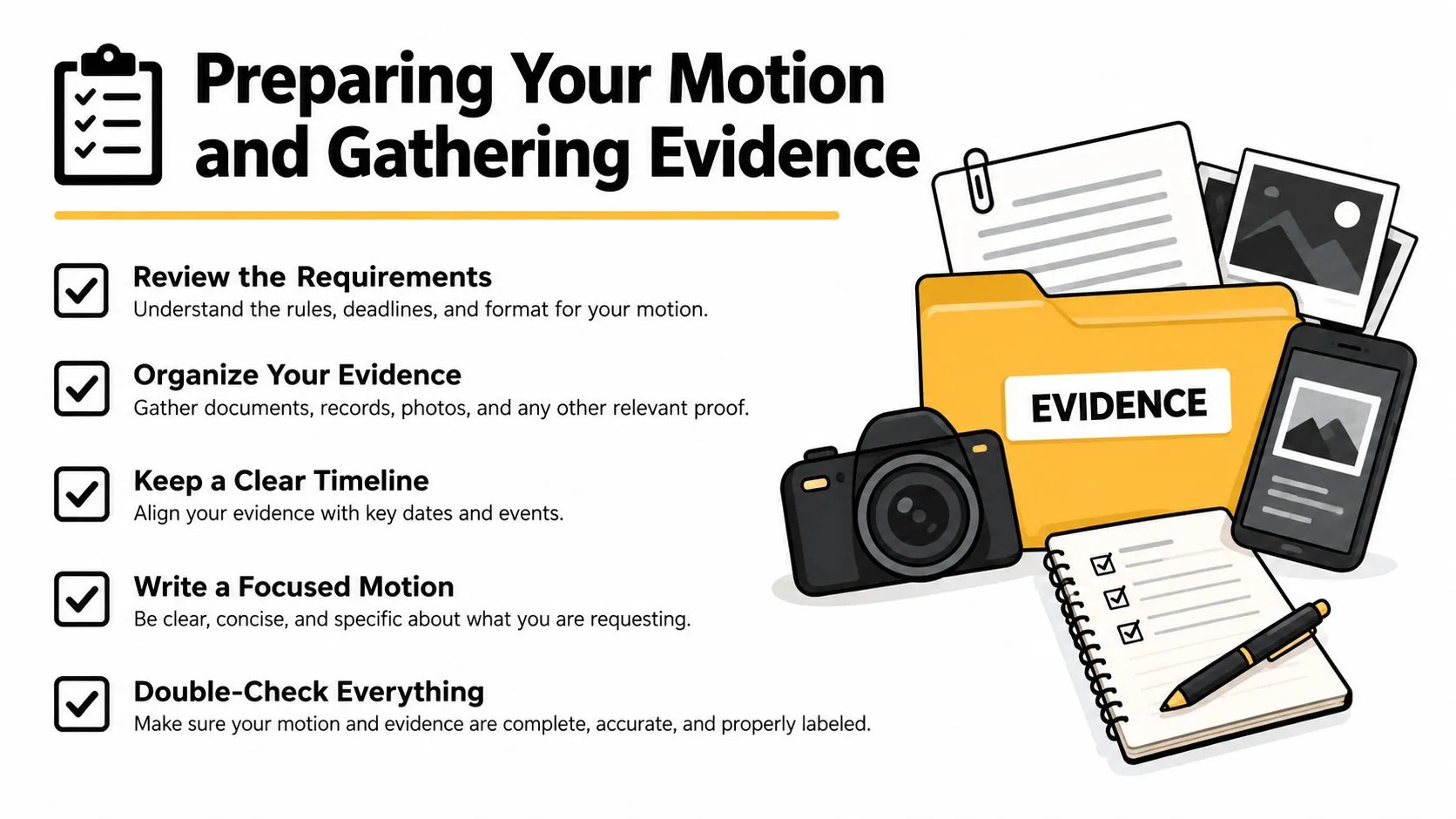
A successful motion starts with evidence, not suspicion. Your attorney should obtain the blood-warrant affidavit and examine it sentence by sentence. Each factual assertion should be compared with the police report, body-camera footage, dispatch records, medical records, witness accounts, and other materials that existed when the warrant was requested.
The preparation has two goals. First, show why the statement is false. Second, show why the affiant's conduct was more than an innocent mistake. That second part often requires examining what the officer knew, when the officer knew it, and whether available records made the affidavit's version obviously doubtful.
Build the offer of proof carefully
The preliminary showing should give the judge a concrete reason to hold an evidentiary hearing. A useful preparation process includes:
-
Isolate the language: Copy the exact sentence or passage from the affidavit. Avoid attacking the document generally.
-
Identify the contradiction: Match the challenged statement with a video timestamp, medical record, dispatch entry, witness statement, or another reliable source.
-
Explain the officer's knowledge: Show why the affiant knew, or should have recognized, that the statement was questionable at the time of the warrant application.
-
Reconstruct the affidavit: Prepare a version with the challenged material removed. This lets the court see whether probable cause depends on the disputed fact.
-
Separate strong points from weak ones: A motion can lose credibility if it treats minor wording choices as deliberate lies. Focus on discrepancies that affect the justification for the blood draw.
For example, an affidavit may say you refused chemical testing, while body-camera footage shows that you agreed but officers moved directly to a warrant request. That discrepancy could matter, but the legal analysis still depends on what the officer intended, whether the statement was material, and whether the rest of the affidavit independently supported probable cause.
Your lawyer should also account for omissions. If the affidavit leaves out a fact that would have undercut probable cause, the defense may argue that the omission was intentional or reckless and material. The court still has to test the corrected affidavit rather than suppressing evidence automatically.
The broader Texas DWI discovery process can help identify the documents and recordings needed for this comparison. Separate questions about Field Sobriety Tests and How They Are Challenged may also matter because the affidavit may rely heavily on roadside observations that are more contestable than they first appear.
A careful review should consider refusal evidence, hospital records, and the post-arrest timeline. Texas training materials explain that officers may provide the DIC-24 warning and request a specimen, and that certain circumstances can require officers to seek a blood sample, including an intoxication crash involving death or serious bodily injury, DWI with a child passenger, or reliable information about certain prior DWI-related convictions. Texas DWI enforcement materials describe these blood-sample circumstances.
Navigating the Hearing and Interplay with ALR
The court's first task is to decide whether your motion makes the required preliminary showing. A judge may review the affidavit, defense exhibits, witness statements, and the State's response before deciding whether to allow the defense to go behind the affidavit. This is the gatekeeping stage, and a vague claim that the officer was wrong usually won't be enough.
If the court finds the threshold satisfied, the case moves into an evidentiary hearing. The affiant may testify, the defense can present supporting evidence, and counsel can cross-examine the officer about the exact information used to obtain the warrant. The hearing is focused. It isn't a full trial on whether you were intoxicated.
The warrant hearing is only one courtroom battle
A blood-warrant challenge can overlap with other suppression issues, but each issue has its own legal basis. One motion may challenge the truthfulness of the affidavit. Another may contest the traffic stop, the arrest, the execution of the warrant, the handling of the sample, or the laboratory process.
The evidence developed in one proceeding may help shape the others, but a favorable ruling in an ALR case doesn't automatically suppress blood evidence in the criminal case. Likewise, a successful Franks motion doesn't resolve every question about your license. A coordinated strategy keeps the proceedings distinct while preventing important facts from being overlooked. This comparison of an ALR hearing and the criminal case explains why the two proceedings must be handled separately.
Protect the license deadline
Texas DPS says you may request an ALR hearing within 15 days after being served notice of suspension. Texas DPS provides the ALR hearing deadline and process. Missing that deadline can affect your ability to contest the administrative suspension even while the criminal DWI charge remains pending.
That deadline should be addressed immediately after arrest. Your lawyer can evaluate whether the suspension is based on an alleged refusal or a qualifying chemical-test result, while separately investigating the warrant affidavit and the blood draw.
A coordinated review should answer practical questions:
- Did officers request a specimen before or after the arrest?
- Did you refuse, agree, or communicate in a way that the recording clarifies?
- Was a warrant requested, signed, and executed in the correct sequence?
- Did the affidavit accurately describe the observations and timeline?
- Does the criminal case depend on the blood result more heavily than the ALR case does?
The answers may affect negotiation, suppression litigation, license strategy, and trial preparation. They also help your lawyer decide whether a Franks motion is worth pursuing or whether another challenge offers a stronger path.
Likely Outcomes and Defense Strategies
The most important point is that a Franks hearing has two distinct decisions. The first asks whether the affidavit included a knowingly or recklessly false material statement. The second asks whether the warrant survives after the judge removes that statement.
That second decision is the underserved part of this analysis. A court may agree that an affidavit contains an inaccurate statement and still admit the blood evidence if the remaining facts establish probable cause. A challenge succeeds only when the corrected affidavit fails that test. A recent Texas appellate decision illustrates the strict preliminary-showing requirement and the importance of the remaining probable-cause analysis.
When the blood evidence is suppressed
If the defense proves the required falsity and intent, and the affidavit cannot support probable cause after excision, the court can suppress the blood evidence. That may significantly change the prosecution because the State can no longer rely on the challenged chemical result in the same way.
Suppression doesn't automatically dismiss every DWI charge. The State may still have testimony about driving, physical observations, statements, a field sobriety test, refusal evidence, video, or other admissible proof. But removing a central chemical result can change the negotiation posture and the trial risks for both sides.
When the warrant survives
If the alleged statement was immaterial, the court may deny relief even after finding some inaccuracy. The same is true if the remaining affidavit establishes probable cause. In that situation, fighting DWI in Texas requires a broader strategy rather than repeating the same warrant argument.
The defense may turn to:
-
Stop and arrest issues: Whether the officer had a lawful basis to stop you or probable cause to arrest.
-
Execution problems: Whether officers followed the warrant's terms and collected the sample in a lawful manner.
-
Chain of custody: Whether the State can reliably connect the specimen tested by the laboratory to the sample taken from you.
-
Laboratory evidence: Whether testing procedures, records, controls, and expert testimony support the reported result.
-
Timeline evidence: Whether the timing of driving, arrest, draw, and testing creates a meaningful dispute about what the result proves.
-
Trial proof: Whether the State can establish intoxication or impairment beyond the blood result.
The strategic trade-off is straightforward. A Franks motion can expose a serious defect and create a path to suppression, but a weak motion may distract from stronger issues. The affidavit should be tested against the actual evidence before counsel invests in an extensive hearing.
Contact Our Houston DWI Lawyers Today
A blood warrant case demands early attention because the defense depends on records that can become harder to obtain or interpret as time passes. The affidavit, body-camera video, dispatch material, hospital records, specimen paperwork, and laboratory file should be reviewed together, not as isolated documents.
You also need to protect the administrative side of the case. The ALR process is separate from the criminal prosecution, and the Texas DPS deadline can arrive before you understand the full scope of the evidence. A lawyer should identify that deadline promptly while developing the criminal defense.
What a focused defense review should address
A practical case evaluation should examine:
-
The warrant affidavit: Which statements supported probable cause, and which can be tested against objective records?
-
The officer's account: Does the affidavit match the body-camera footage, reports, dispatch information, and medical documentation?
-
The preliminary showing: Can the defense identify a specific false statement, offer concrete proof, and explain why the statement was material?
-
Post-excision survival: Does probable cause remain after the court removes the challenged material?
-
Alternative challenges: Are there stronger arguments involving the stop, arrest, warrant execution, chain of custody, testing, or timeline?
-
License protection: Has the ALR deadline been addressed, and does the administrative case require a separate strategy?
A Houston DWI lawyer should be able to explain not only how to file a motion, but also when the motion makes strategic sense. The same careful approach applies if you're searching for a Texas DUI attorney, defending a first DWI in Texas, protecting a commercial license, or dealing with a DWI arrest outside Houston.
The Law Office of Bryan Fagan, PLLC handles DWI defense issues that include blood and chemical-test challenges, ALR proceedings, field sobriety evidence, and criminal court litigation. A focused consultation can help you understand whether the affidavit contains a viable Franks issue and what other defenses should be developed if the warrant survives.
Don't wait for the blood result to define your future. A prompt review can preserve evidence, protect your license options, and give you a clearer defense plan without fear-based promises. You deserve a careful explanation of what happened and what can still be challenged.
The Law Office of Bryan Fagan, PLLC offers case evaluations focused on DWI blood warrants, Franks motions, ALR deadlines, and the evidence supporting your arrest. Visit Law Office of Bryan Fagan, PLLC to request a free consultation and discuss the next step in protecting your rights.

