
A DWI arrest can be overwhelming, but you do not have to face it alone. You may be home with release papers on the kitchen table, worried about getting to work and wondering what happens because a child was in your car.
A child-passenger allegation deserves careful attention, but an arrest isn't a conviction. Your attorney should separate what the police alleged from what the evidence proves, examine your prior record, and protect your opportunity to challenge a license suspension.
What the State Must Prove and How to Challenge It
The required facts aren't assumptions
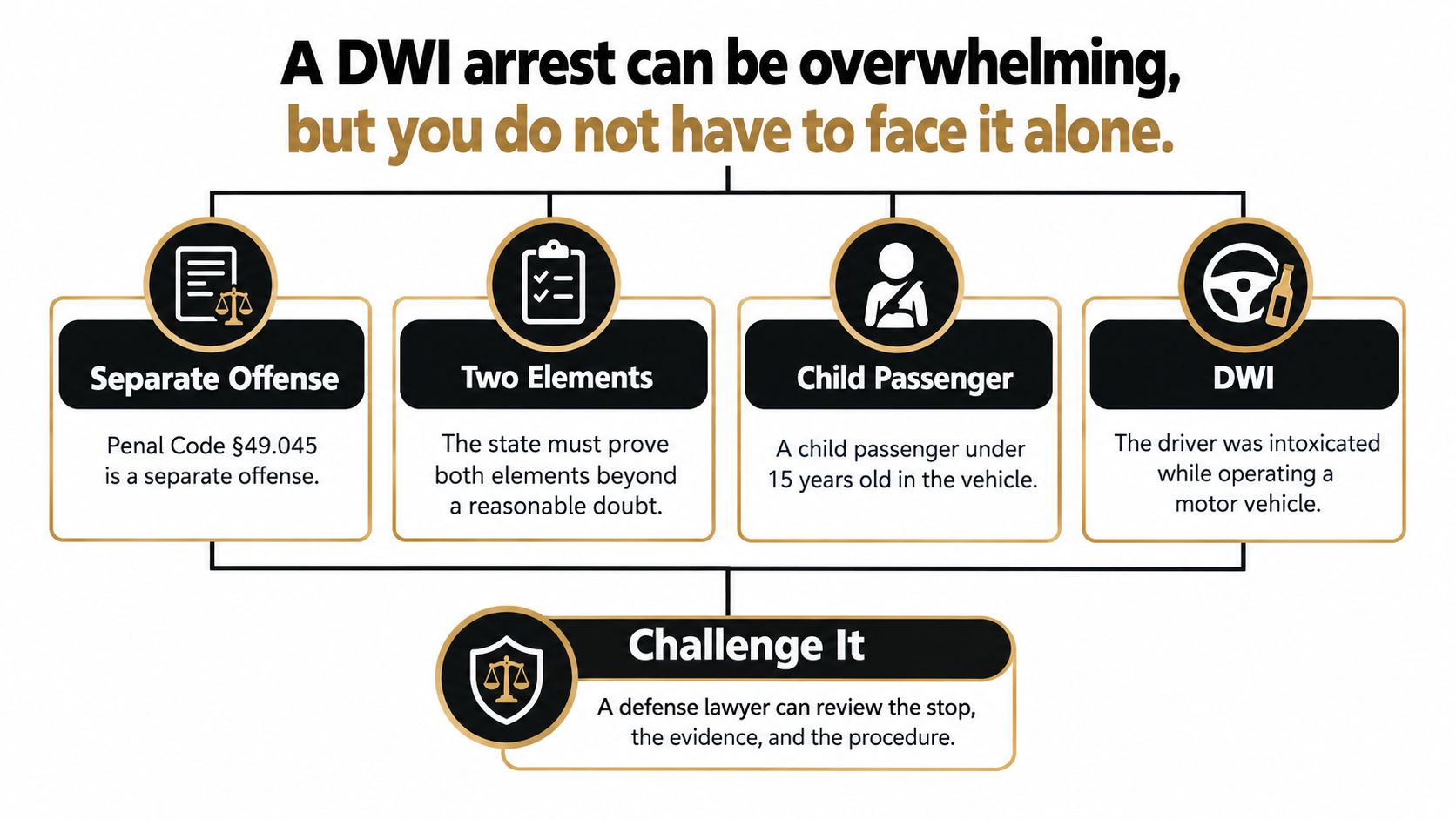
Under Texas Penal Code §49.045, prosecutors must prove that you were intoxicated while operating a motor vehicle in a public place and that the vehicle contained a passenger younger than 15, meaning a passenger aged 14 or younger qualifies, while someone already 15 doesn't.
Think of the charge as a recipe with required ingredients. Proof that a child was riding with you doesn't establish intoxication, and an alcohol test doesn't establish who was driving or whether the passenger met the age requirement. The state must prove the offense beyond a reasonable doubt.
The prosecution doesn't have to establish that the child was injured, related to you, or intentionally endangered. A safe arrival or a properly secured car seat may provide context, but neither answers whether the statutory elements are present.
This visual separates the accusation into the facts your defense lawyer needs to examine.
What intoxication and testing mean
Intoxication can mean losing the normal use of your mental or physical faculties because of alcohol, drugs, or both. Prosecutors can also rely on the statutory alcohol-concentration standard; they don't always need evidence of visibly poor driving.
BAC means blood or breath alcohol concentration measured through testing. A result is evidence to examine, not a substitute for proving the entire case. Our explanation of what intoxicated means under Texas law describes why the prosecution's theory matters.
A field sobriety test is a roadside exercise or observation used to assess possible impairment. Common examples include the walk-and-turn, one-leg stand, and horizontal gaze nystagmus test, in which an officer observes eye movement. Injuries, balance problems, lighting, footwear, and unclear instructions can affect how performance should be interpreted.
Implied consent means the law treats a qualifying arrested driver as having agreed to breath or blood testing, subject to statutory requirements. It isn't permission for officers to disregard constitutional protections.
Elements of §49.045 and the defense questions for each
| Element | What the state must prove | Defense questions to examine |
|---|---|---|
| Intoxication | Loss of normal use from alcohol, drugs or both, or the statutory alcohol-concentration standard | Was the test timed, calibrated and properly given? Does it reliably describe your condition while driving? |
| Operating a motor vehicle | You were operating the vehicle | Who was driving, and what evidence shows it? |
| Public place | The driving occurred in a public place | Where exactly did the driving occur, and is the location documented? |
| Passenger under the statutory age threshold | The passenger met the age requirement when the offense occurred | Does a birth certificate, school record or witness establish age? |
| Lawful stop and arrest | Reasonable suspicion for the stop and probable cause for the arrest | Do dash-cam video, dispatch logs and officer reports support the officer's decisions? |
The last row concerns whether evidence was lawfully obtained, rather than an additional element of the child-passenger offense. Your lawyer may ask the court to exclude evidence when an unlawful stop, arrest, or search affected its collection.
The Texas Legislature's child-passenger DWI statute makes this a separate state jail felony, unlike an ordinary first-offense DWI, which is generally a misdemeanor. That distinction explains why a first DWI in Texas can still require felony-level defense.
A defense checklist grounded in evidence
- Review the stop and arrest. Did reasonable suspicion support the stop and probable cause support the arrest?
- Compare testing with video. Were field sobriety tests administered and scored correctly?
- Inspect breath-testing records. Was the test properly timed and observed, and was the instrument calibrated?
- Examine the blood-draw authority. Was there a valid warrant, valid consent, or another legally sufficient basis?
- Trace the specimen. Does the chain of custody show who collected, stored, transported, and analyzed it?
- Verify the passenger's age. Can reliable records or testimony establish it?
Practical rule: Preserve the evidence before trying to explain away the allegation. Your lawyer needs the original records, not just your recollection of what an officer said.
Mitigation matters too. A clean prior record, verified treatment participation, a safe transportation plan, and documented responsibility can support negotiations without conceding guilt.
Your attorney's evidence file should include dash-cam video, dispatch logs, officer reports, laboratory records, and proof of the child's age.
Penalties at a Glance for Child-Passenger DWI
Punishment ranges by child-passenger DWI scenario
| Scenario | Classification | Key notes |
|---|---|---|
| Child passenger under the statutory age threshold, no eligible prior | State jail felony under the child-passenger statute | 180 days to 2 years in state jail and a fine of up to $10,000 |
| Child-passenger case with a proven eligible prior | Third-degree felony under Texas Penal Code §49.09 | 2 to 10 years in prison and a fine of up to $10,000 |
| Child-passenger case with serious bodily injury or death | Separate, more serious offense under other Penal Code sections | Charged under separate statutes; outside this table's scope |
Use the row that fits the alleged facts, but don't treat the booking label as the final answer. The base child-passenger offense can apply even if you have no prior DWI conviction. Whether a prior conviction changes the classification is explained in the next section.
These ranges describe possible legal exposure, not a prediction of the sentence. Probation, also called community supervision, may be available depending on the facts, your record, and the sentencing rules that apply. Your lawyer should explain the legal maximum and the options your evidence and record support.
Other factors that affect the case
An injury allegation requires a separate analysis. Intoxication assault and intoxication manslaughter have their own elements and penalties; an accident alone does not establish either offense.
A sentencing range is a boundary, not a forecast. The outcome depends on the evidence, the charge, and the facts presented to the court.
Felony consequences can reach beyond confinement. Employment applications, professional licensing, firearm rights, and family-court disputes may require attention. Tell your attorney if you have a commercial driver's license, work in a regulated profession, or have an active custody case.
Charging decisions and plea negotiations may affect which scenario applies, but a reduction is not automatic. Early review can help identify legal defenses and practical reasons to seek a different resolution.
How a Prior DWI Changes a Child-Passenger Case
A child's presence establishes the basis for the separate felony allegation. A qualifying prior conviction can create another, distinct increase in exposure.
Texas Penal Code §49.09 expressly includes the child-passenger offense among charges that can become a third-degree felony when the state proves an eligible prior conviction. That's why the label on your initial paperwork may not tell you the full sentencing picture.
Similar stops can produce different cases
Consider drivers stopped under otherwise similar circumstances, each with a qualifying child passenger. One has no eligible prior conviction and faces the base child-passenger classification. The other has an older DWI conviction that prosecutors can establish and use for enhancement.
The present-day driving evidence could look nearly identical, yet the prior record changes the potential punishment. The difference is that police arrested the second driver before.
A prior arrest means someone was taken into custody or accused. A prior conviction means the earlier case resulted in a qualifying judgment. A dismissed charge isn't interchangeable with a conviction, although your attorney must inspect the actual disposition rather than rely on memory or a background-check label.
Verify the prior before negotiating
- Obtain the exact judgment and sentence. These documents establish what happened in court, which may differ from the original accusation.
- Confirm the offense, date, and court. Similar names and incomplete databases can create confusion about which record belongs to you.
- Check whether the offense qualifies. Counsel should compare the disposition with the enhancement statute, including any special issues involving another jurisdiction.
- Review the charging papers. Determine whether prosecutors formally alleged the prior and whether they have adequate proof connecting you to it.
The guide to DWI enhancement based on a prior conviction in Texas explains why record verification should happen before you evaluate a plea offer.
Your prior history may also affect licensing, employment decisions, and family-law strategy. Give counsel the whole record, including cases you believe were sealed or dismissed. A complete account helps your attorney identify what prosecutors can use and what needs correction.
Other Laws That Run Alongside This Charge
| Track | What it addresses | What you should coordinate |
|---|---|---|
| Child protection | The child's safety and household circumstances | Criminal defense and family-law advice |
| Criminal prosecution | The child-passenger allegation and related offenses | Evidence challenges, charging decisions, and plea terms |
| Driver licensing | Administrative action against driving privileges | Notices, hearing requests, and license status |
A child-passenger DWI can involve separate proceedings at the same time. Each track has its own purpose: criminal court addresses alleged offenses, child-welfare investigators assess the child's safety, and licensing authorities handle driving privileges. A result in one proceeding does not automatically settle the issues in another.
Child protection and related criminal allegations
An arrest involving a child can prompt a child-welfare investigation under the Texas Family Code. Investigators may examine transportation arrangements, supervision, and whether a safety plan is needed. Their process can affect custody, visitation, or placement independently of the criminal case.
Before giving a substantive statement to a child-welfare investigator, speak with counsel. Respond to contact and follow any court orders, but get legal advice before answering questions. Cooperation does not require you to make an uninformed statement.
Prosecutors may also pursue related allegations, such as an open-container violation or another impaired-driving offense. Each allegation has separate facts and legal requirements, so a defense to the child-passenger charge does not automatically resolve the others.
A separate school-crossing-zone DWI circumstance added by Senate Bill 826 became effective September 1, 2025, and concerns driving during the reduced-speed period. The state must establish the relevant location and timing; a school being nearby does not answer those questions.
The license proceeding has a different purpose
Transportation Code Chapter 724 provides the implied-consent framework for post-arrest breath or blood testing and refusal-related administrative consequences. In a particular case, the circumstances of the warnings, consent, any warrant, specimen collection, and analysis may matter when the evidence is challenged.
A refusal may lead to a license proceeding while the criminal evidence remains disputed. The criminal case and the administrative process follow different rules and timelines. See the section on Administrative License Consequences and the 15-Day Deadline for the hearing-request deadline.
Keep each notice and share it with counsel. Use one calendar for criminal-court dates, ALR deadlines, and family-court dates, and update it whenever a new notice or order arrives.
Administrative License Consequences and the 15-Day Deadline
A driver arrested for DWI with a child passenger may be dealing with two separate cases: the criminal charge and a civil action affecting driving privileges. If the notice arrives while you are arranging criminal defense, the ALR deadline still runs. An Administrative License Revocation hearing, or ALR hearing, is the process for challenging a proposed suspension. It does not decide whether you are guilty of the criminal charge.
The Texas Department of Public Safety ALR program gives a driver 15 days from notice to request a hearing. Hearing scheduling commonly takes 30 to 60 days after a request. The request deadline is separate from the expected wait for a hearing.
ALR deadlines and suspension lengths
| Issue | Deadline or length |
|---|---|
| Request an ALR hearing | 15 days from notice, under the Texas Department of Public Safety ALR program |
| Hearing scheduling | Commonly 30 to 60 days after request, under the Texas Department of Public Safety ALR program |
| Suspension after a failed test | 90 days for a first-time case, as described by the Texas Department of Public Safety ALR program |
| Suspension after a refusal | 180 days for a first-time case, as described by the Texas Department of Public Safety ALR program |
Those first-time suspension periods are not a prediction of your individual outcome. Prior administrative actions, the grounds alleged, and other licensing issues can affect the analysis. The ALR matter is separate from the criminal case, so a dispute about the criminal evidence does not by itself resolve the license proceeding.
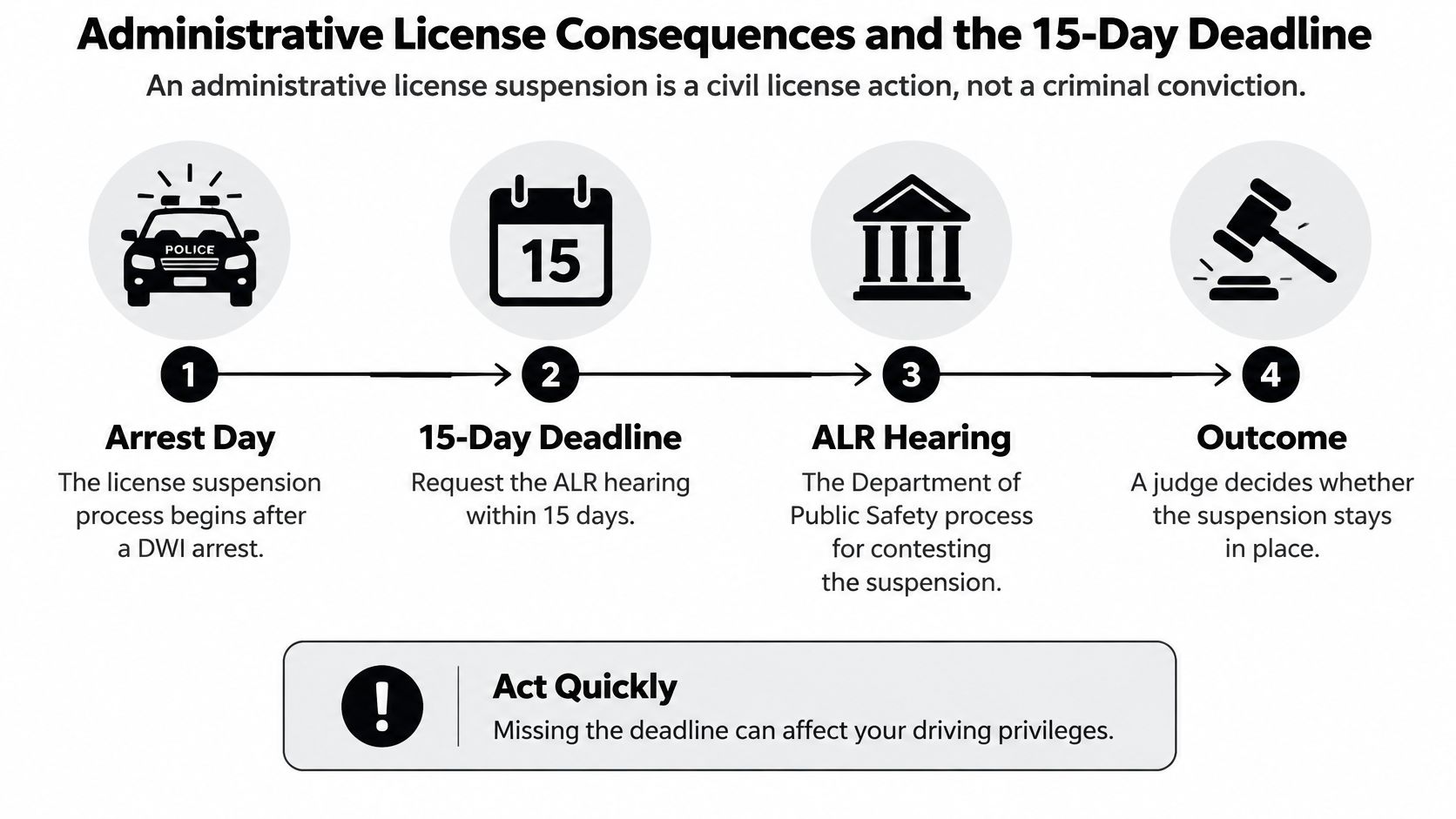
Missing the 15-day window forfeits the hearing right, so calendar the deadline first. Read the notice as soon as it arrives, record when and how you received it, and keep the envelope or electronic delivery details. Ask counsel to confirm the deadline that applies to your notice rather than relying on the date of a criminal court appearance.
A hearing request should include your name, date of birth, license number and state, arrest date and county, arresting agency and officer, and whether you failed or refused testing. Keep proof that it was submitted, then monitor your mail for the hearing notice. At the hearing, counsel can examine issues such as reasonable suspicion, probable cause, detention or arrest, and the alleged refusal or test failure. The Texas ALR hearing process guide explains the process and preparation.
A criminal defense appointment does not automatically request an ALR hearing. Confirm who is responsible for filing the request and obtain confirmation that it was submitted. Waiting for the prosecutor to file the criminal case can leave the separate license deadline behind.
Plea Options and Courtroom Paths
After an arrest, court obligations usually begin with release conditions and required appearances. Read the bond documents carefully. Depending on the court's orders and the circumstances, conditions may include ignition interlock, alcohol monitoring, or limits on contact.
At arraignment, the court addresses the charge and your plea. During discovery, your lawyer reviews the state's evidence, checks for missing records, and considers whether to challenge evidence obtained unlawfully.
Common resolution paths and their trade-offs
| Outcome | What it means | Trade-off to weigh |
|---|---|---|
| Dismissal or no-file | The state drops or declines the charge | A favorable outcome, though eligibility to clear the record needs separate review |
| Reduction to a lesser DWI charge | Prosecutors agree to a lesser offense | Lower exposure, but a conviction may remain on your record |
| Deferred adjudication | In an eligible case, the court defers adjudication under conditions | The child-passenger offense itself is ineligible; a different eligible disposition requires separate analysis |
| Trial | A judge or jury decides whether the state proved guilt beyond a reasonable doubt | The evidence is challenged in court, but the outcome is uncertain |
Deferred adjudication is not ordinary probation. Completing supervision does not automatically erase this felony charge, so treat any proposed resolution according to its actual terms.
Choosing a path based on your evidence
Plea discussions may turn on the prior record, test reliability, proof of the passenger's age, and whether the state can establish an enhancement. Those details matter because the child's presence and a prior conviction play different roles in the charge and its potential level. Your lawyer should explain the factual basis for an offer and what conviction it would leave behind.
The decision can involve a real trade-off: a reduced charge may still mean a conviction, while rejecting it and going to trial can leave you facing greater felony exposure. At trial, the central question is whether the state can prove the required elements, including the child-passenger allegation and any applicable enhancement. The defense can challenge weaknesses in that proof; it does not have to prove innocence.
The Texas DWI Defense Lawyer resource discusses defense under the general Texas DWI statute. A child-passenger allegation needs additional analysis beyond that general framework.
Plea talks should be guided by the strength of the evidence and the consequences of each option, not promises that the charge will be dismissed. A prior conviction can affect felony exposure, while the child's presence alone does not necessarily determine whether the offense becomes a third-degree felony.
Confirm the Deadlines Before You Act
Bring the suspension notice, any court paperwork, and records from a prior DWI case to your first consultation. Those documents can help counsel see which issues need attention and what information is still missing.

Your immediate action list
- Bring the notice showing when you received it. The date may help counsel assess the ALR issue alongside the criminal case.
- Request prior-case records. Bring the exact judgment and sentence, rather than relying on a background-check summary. A prior conviction can affect how the child-passenger allegation is charged.
- Write a private timeline for counsel. Record the location, timing, passengers, child's age, testing, and anything officers said. Preserve messages and receipts without editing them.
- Prepare questions for a free consultation. Ask how counsel will assess the criminal allegation and licensing issues together, and who will handle hearings and evidence review.
A Houston DWI lawyer or local counsel familiar with courts in Dallas–Fort Worth, Austin, or San Antonio can explain local procedures without promising a particular result. If family-law concerns are involved, ask whether coordination with family-law counsel may be needed.
The Texas felony DWI guide discusses repeat-offense and child-passenger concerns. The firm's DWI defense overview provides additional context for discussing your options.
You do not need every answer before calling. Explain your immediate concerns, share the documents you have, and ask for a plan based on your case.
The Law Office of Bryan Fagan, PLLC offers free consultations and represents clients in child-passenger DWI cases, including evidence challenges, ALR hearings, and criminal court proceedings across its Texas service areas. Visit Law Office of Bryan Fagan, PLLC to request a case evaluation and discuss practical steps concerning your license, record, and family.
