
Under Texas Penal Code §49.01, intoxicated means either losing the normal use of your mental or physical faculties because of alcohol, drugs, or another substance, or having an alcohol concentration of 0.08 or more. The State can rely on either route; it doesn't need to prove both.
You may be looking at release paperwork, waiting for a blood result, or wondering why an officer arrested you when you felt capable of driving. The useful next step isn't guessing whether you looked intoxicated. It's identifying what the State must prove, what evidence exists, and which deadlines affect your license.
What Intoxicated Means Under Texas Law
A driver can blow under 0.08 and still end up charged with DWI. That surprises people, and it matters, because a defense built entirely around the chemical number leaves the officer's impairment observations untouched. An arrest is an accusation, not a finding that the State has proved its case.
Section 49.01 gives prosecutors two doors into an intoxication case. One is the alcohol concentration result: 0.08 or more. The other is impairment, meaning the loss of normal use of your mental or physical faculties from alcohol, drugs, or another substance. The State can argue either one, and a jury can convict on either one. A clean breath test does not close the impairment door.
Police reports and jail paperwork sometimes describe the 0.08 route as legal intoxication. That shorthand names one path, and it does not exclude drug impairment or loss of faculties. A driver can also have alcohol in their system and still retain normal use of their faculties, which is why the impairment question turns on what the evidence shows about you specifically.
The definition isn't the entire charge
Section 49.01 supplies definitions. A DWI prosecution also requires the State to show you operated a motor vehicle in a public place while intoxicated. Your attorney should examine those facts rather than treating the chemical test as the whole case.
The statutory language applies statewide, including Houston, Dallas-Fort Worth, Austin, and San Antonio. Local court procedures may differ, but the meaning of intoxication stays the same from county to county.
The criminal charge is only one clock running against you. Your license faces a separate process with its own deadline, and that deadline does not wait for the criminal case to finish.
Start with the allegation: Ask whether the State claims an unlawful alcohol concentration, substance-related impairment, or both.
For a driver searching "Penal Code 49.01 what intoxicated means in Texas," the practical question is how the definition fits the evidence in your file. Keep your test report, release documents, and license notice together. Each answers a different question, and none of them should be read alone.
Two Routes to Intoxication in Texas
Alcohol concentration thresholds by specimen type
| Specimen | Measured as | Intoxication threshold | Typical source of the result |
|---|---|---|---|
| Breath | Grams of alcohol per 210 liters of breath | 0.08 or more | Breath instrument at the station |
| Blood | Grams of alcohol per 100 milliliters of blood | 0.08 or more | Blood draw analyzed by a lab |
| Urine | Grams of alcohol per 67 milliliters of urine | 0.08 or more | Urine sample analyzed by a lab |
These specimen measurements and the 0.08-or-more threshold come from Texas Penal Code §49.01.
BAC means blood alcohol concentration, although people often use the abbreviation loosely when discussing breath results too. For blood, 0.08 means 0.08 grams of alcohol per 100 milliliters, under the statutory measurement shown above. Breath and urine use their own specimen volumes; a report's number makes sense only when you identify the specimen and units.
A breath-station result and a hospital blood draw also come from different processes. The breath instrument produces a measurement through its testing system. A blood sample must be collected, identified, stored, transferred, and analyzed by laboratory personnel. An attorney checks the records for the process that was really used.
The numerical route
The alcohol-concentration route works somewhat like a posted speed limit. A properly established measurement can answer the numerical question without requiring prosecutors to prove that you stumbled, slurred your speech, or drove erratically.
But a printed result isn't self-explanatory. The defense should examine:
- Test validity: Whether the instrument or laboratory method produced a reliable measurement.
- Specimen identity: Whether the records connect the tested specimen to you.
- Collection and handling: Whether collection, labeling, storage, and transfer support confidence in the result.
- Timing: Whether the result supports the allegation about your condition while operating.
A calm roadside appearance doesn't automatically defeat this route. Conversely, a concerning result doesn't eliminate questions about collection or analysis. The practical explanation of the legal alcohol limit in Texas can help you distinguish the threshold from the evidence needed to establish it.
The loss-of-faculties route
The impairment route is closer to evaluating careless driving than reading a speed display. Prosecutors must connect a substance to the loss of normal mental or physical faculties.
The Texas Legislature's statutory definition includes alcohol, controlled substances, drugs, dangerous drugs, combinations of substances, and another substance introduced into the body. That breadth explains why a case may proceed without an alcohol result.
Relevant allegations can include difficulty dividing attention, unusual speech, poor coordination, or loss of vehicle control. The defense must examine what happened and whether something other than substance-related impairment explains it.
For example, a driver with a result below the numerical threshold may still face an impairment allegation based on swerving and balance problems. A driver above the threshold may still challenge a mislabeled or mishandled sample. Neither situation can be evaluated by looking at the number alone.
Pull the specimen type, measurement units, collection time, and result from your paperwork. Then ask which statutory route the prosecution intends to use. For the broader sequence of proceedings, The Texas DWI Court Process From Arrest to Resolution describes what to expect at each stage of a Texas DWI criminal case.
How Prosecutors Build an Intoxication Case
Evidence prosecutors use and where it breaks down
| Evidence | What it is used to show | Common weakness |
|---|---|---|
| Driving behavior before the stop | Weaving, speeding, or late braking that prompted the stop | Fatigue, road conditions, or distraction may explain the behavior |
| Officer observations | Odor of alcohol, slurred speech, bloodshot eyes, admissions | Subjective interpretation and differences between the report and video |
| Standardized field sobriety tests | Clues on HGN, walk-and-turn, and one-leg-stand exercises | Not a BAC measurement; conditions, instructions, or medical limitations may affect performance |
| Breath test | Alcohol concentration at the station | Observation procedures, instrument maintenance, and calibration |
| Blood test | Alcohol or drug levels reported by a laboratory | Specimen handling and the interval between driving and collection |
| Drug evaluation or toxicology | Substances potentially affecting normal faculties | Presence alone doesn't establish impairment while driving |
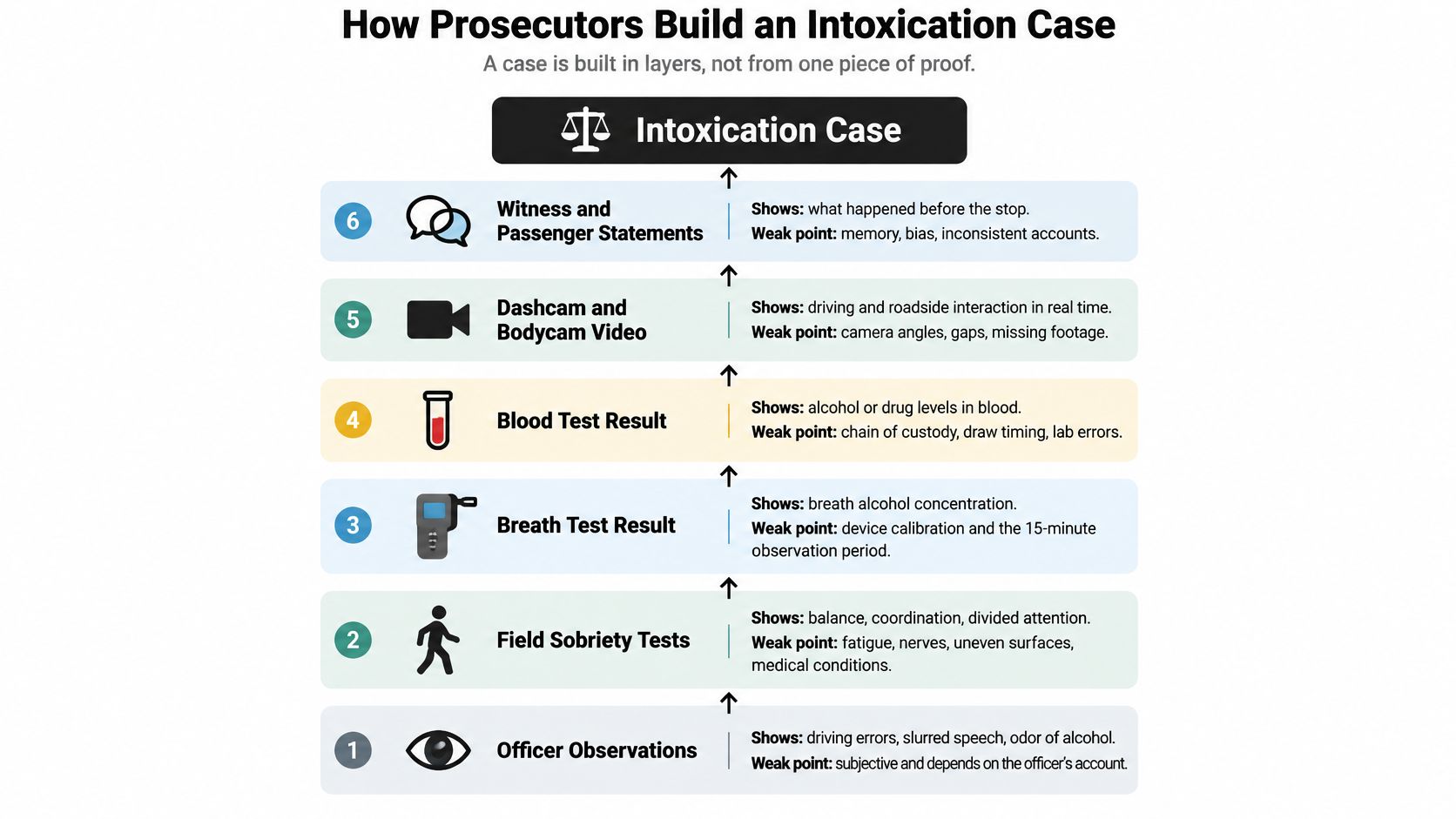
Prosecutors build a case in layers. Your attorney's task is to test each layer and determine whether the pieces support the same account of what happened.
This diagram shows how those evidence layers fit together.
Start with the driving and roadside encounter
The first question is what prompted the stop. Was the alleged lane movement recorded? Did the officer describe a specific traffic violation? Was a witness's description detailed enough to identify your vehicle?
Next come observations during the encounter. An officer may describe an odor, your eyes, your speech, or something you said about drinking. Those details deserve careful review, but they don't all establish the same thing. An odor may suggest alcohol consumption without resolving how alcohol affected your faculties.
Your lawyer should compare the written report with dashcam and bodycam footage. A report might describe confusion while the recording shows you asking a reasonable question about unclear instructions. The opposite can happen too, which is why reviewing the actual recording matters more than relying on memory.
Separate roadside exercises from chemical testing
A field sobriety test is an officer-administered roadside evaluation used to look for possible impairment. It isn't a BAC measurement.
Standardized exercises include horizontal gaze nystagmus, often called HGN, the walk-and-turn, and the one-leg stand. HGN concerns observed eye movement; the walking and standing exercises involve balance, coordination, and following instructions while performing a task.
Breath and blood testing add a different category of evidence. Drug evaluations and toxicology may add still more, but an attorney must connect each item to the relevant time and allegation.
A persuasive case requires more than several concerning facts. Those facts must fit together and support the allegation about your condition while driving.
Say a witness reports weaving, an officer later notes slurred speech, and a chemical sample is collected after roadside testing. Place each event on a timeline. Then identify what documents, video, or testimony support it, and where the record is incomplete.
For a closer look at those comparisons, review intoxication evidence in Texas DWI cases. Focus on documented inconsistencies, not just the number of evidence categories listed in the report.
Common Defenses to Intoxication Charges
A defense tests the State's proof and never requires you to admit the accusation. Because prosecutors can proceed on the impairment route alone, without reaching 0.08, the strongest challenges target a specific legal or factual weakness and support it with records, recordings, or qualified analysis.
- Unlawful stop: Counsel examines whether the officer had reasonable suspicion supported by specific facts rather than an unsupported impression.
- Weak arrest grounds: The defense compares what the officer knew before arrest with the claimed basis for probable cause.
- Unreliable roadside testing: A slope, poor lighting, unclear instructions, footwear, or physical limitations may undermine the officer's interpretation.
- Breath-testing problems: Maintenance records, calibration information, and observation procedures may expose reliability concerns.
- Blood-collection problems: Counsel checks consent, warrant authority, any applicable exception, and the specimen's chain of custody.
- Timing gaps: Delayed testing or alleged post-driving consumption may weaken the connection between the result and operation.
- Medical or dietary explanations: Documented conditions may explain particular observations or justify investigating a possible testing interference.
A blood draw stands or falls on the legal authority behind it: valid consent, a warrant, or a recognized exception covering your situation. Your attorney identifies which authority the State relied on and whether its requirements were met, rather than treating a missing signature as a guaranteed defense.
A diagnosis carries weight only when your records connect it to a specific observation, so the useful question is whether the documentation supports a concrete alternative explanation. The guide to medical conditions that can mimic intoxication in Texas DWI cases can help you identify information to bring to counsel.
Drug cases require a causal connection
Texas doesn't establish a minimum drug concentration comparable to the 0.08 alcohol threshold; the Texas appellate opinion addressing substance-related intoxication explains that the State must prove substance-caused loss of normal faculties, without proving a particular drug amount or identifying the precise responsible substance in a mixed-substance case.
That makes causation, not merely detection, central to the defense. A metabolite or prescribed medication in a laboratory report isn't by itself proof that you were impaired when operating. A valid prescription does not by itself defeat an impairment allegation either.
Your attorney should compare medication timing, observed behavior, medical treatment, and specimen collection. The goal is to determine what the toxicology result can establish about the relevant period.
Match the strategy to the evidence
A supported challenge may lead to excluded evidence, dismissal, a negotiated reduction, or a different sentencing option. Deferred adjudication and alternative sentencing require a separate eligibility review; they aren't available in every case. License consequences also move on their own administrative track while the criminal case proceeds, so defense planning should account for both timelines.
If this is your first DWI in Texas, the First-Offense DWI in Texas guide provides useful context. Don't choose a plea strategy before counsel has reviewed the evidence and explained the consequences.
ALR Hearings Move Separately From Criminal Court
Your ALR hearing request deadline runs separately from your criminal court date. The suspension process starts from the arrest and the paperwork that follows it, not from anything that happens in front of a judge, and it applies whether the State builds its intoxication theory on a 0.08 result or on claimed loss of normal faculties. Drivers who plan to fight the number sometimes let the license window close while they wait for the criminal case to develop.
ALR triggers and the suspension each one carries
| Trigger | Threshold or action | Who it applies to | Typical first-time consequence |
|---|---|---|---|
| Breath or blood test result | 0.08% or more | Noncommercial driver | Driver-license suspension under applicable DPS rules |
| Breath or blood test result | 0.04% or more | Driver operating a commercial motor vehicle | Commercial-driver disqualification under applicable DPS rules |
| Refusing or failing to complete a breath or blood test | Refusal or incomplete test | Drivers subject to the applicable testing requirements | Driver-license suspension or commercial-driver disqualification |
| Refusing or failing field sobriety tests | Refusal or failure as described by DPS | Drivers covered by the applicable circumstances | Driver-license suspension or disqualification, subject to review of the reported conduct and legal basis |
The Texas DPS Administrative License Revocation program identifies these testing circumstances, including the 0.08% noncommercial and 0.04% commercial-vehicle thresholds, and describes ALR as a civil process separate from criminal prosecution.
Administrative license suspension means the loss of driving privileges through the administrative process rather than a criminal conviction. A commercial-driver disqualification concerns commercial driving privileges and deserves its own review.
Implied consent is the statutory framework under which driving in Texas counts as consent to specified chemical testing in qualifying circumstances. The lawfulness of any particular search, test request, or blood draw remains a separate question, one your attorney can challenge on its own facts.
Protect the notice deadline first
Criminal court and the DPS process arise from the same encounter, but each applies its own rules, moves at its own speed, and reaches its own decision.
The following diagram illustrates that separation. Your actual notice and case circumstances control the applicable dates.
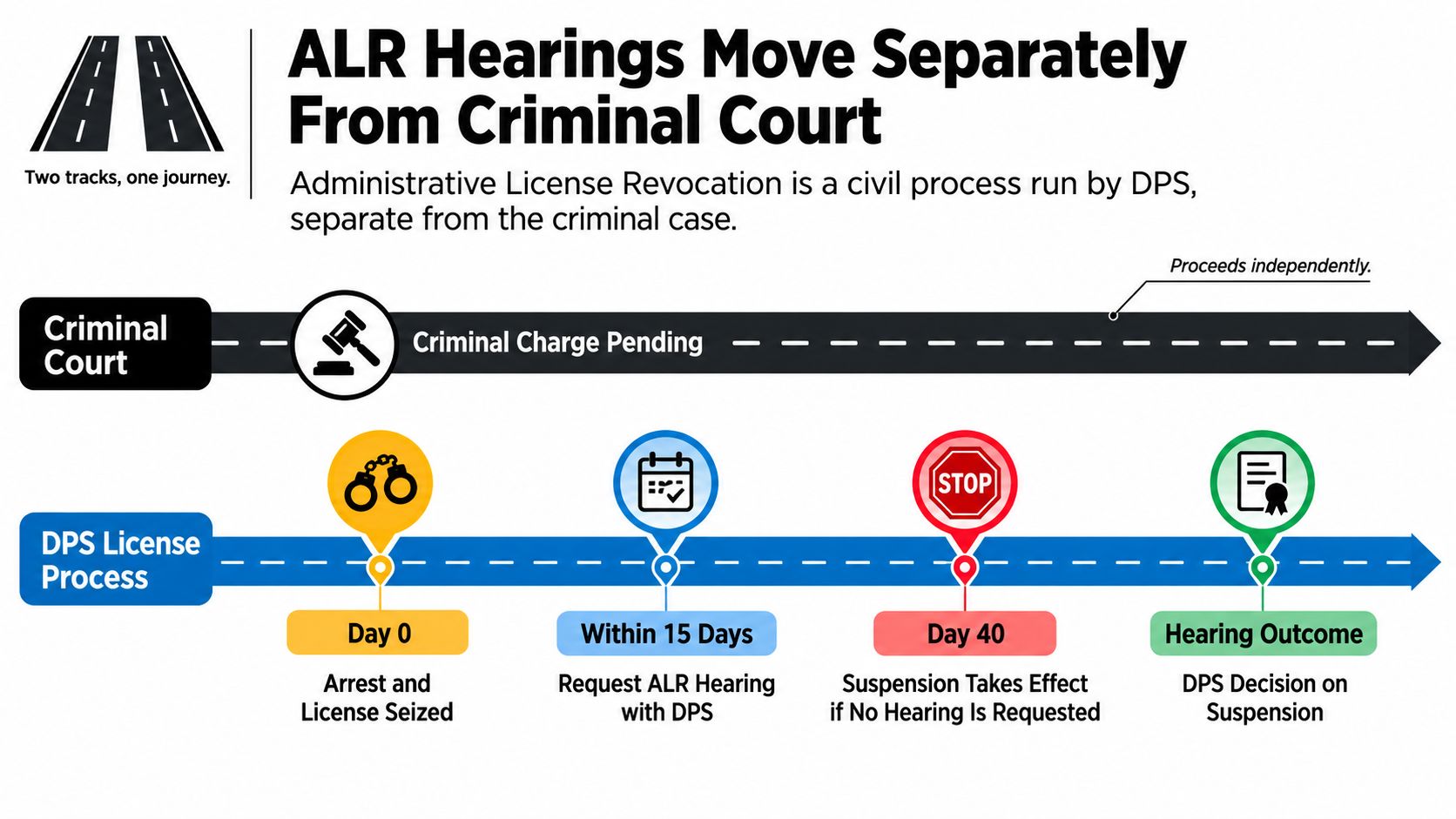
After arrest, locate any notice of suspension or temporary driving document. Record when and how you received it, have counsel confirm the hearing-request deadline, and keep proof of a timely request. Don't wait for your criminal court date to address your license.
At an ALR hearing, the issues depend on the alleged trigger. Counsel may examine the stop, arrest grounds, operation, testing request, reported refusal, or qualifying result. A case built on a 0.08 reading puts the testing procedure and the result under review; a case built on claimed impairment puts the stop, arrest grounds, and observed conduct under review. The hearing isn't a criminal trial, and its scope isn't identical to the criminal case.
License priority: Keep the notice and its envelope together. The date of receipt can matter as much as the date printed on the document.
Keep the consequences distinct
A DWI license suspension can affect work, childcare, and medical appointments before the criminal charge is resolved. Don't assume a pending court case permits you to drive, and don't assume a favorable development in court automatically resolves every DPS issue, including a suspension already in effect.
Criminal exposure is separate and may include fines, confinement, probation conditions, and other consequences depending on the charge and history. Ask counsel for a case-specific explanation rather than applying a generic penalty chart to your situation.
For additional context on the license process, watch the following video.
Common Questions About Intoxication in Texas
What does operate mean?
Operation isn't limited to an officer seeing the vehicle move. Courts evaluate the circumstances, so a parked vehicle with a running engine can raise an operation issue, but sitting in the driver's seat doesn't automatically settle it.
Section 49.01 doesn't supply a general definition equating operation with mere physical control. Tell counsel where the vehicle was, whether the engine was running, who held the keys, and what witnesses or recordings show about how it arrived there.
How long does a Texas DWI case take?
There isn't a reliable case-specific timetable without reviewing the court and evidence status. Scheduling, laboratory records, video production, contested motions, and the choice between negotiation and trial all affect the process.
Ask your attorney what is currently outstanding and what the next setting is intended to accomplish. Don't use the criminal calendar to estimate when you must respond to license paperwork.
Can I keep driving during a suspension?
Some drivers may qualify for an occupational or otherwise restricted driving authorization. Eligibility depends on the applicable suspension, driving record, vehicle use, and governing requirements.
Ask about this early if you need transportation for work or essential responsibilities. Don't drive based only on an application, an informal assurance, or your assumption that a restriction has ended.
What happens after arrest in criminal court?
The process generally moves from booking and release conditions to court appearances, evidence review, and a negotiated resolution or trial. Bond may be set during the initial process, and you must follow the conditions attached to release.
At arraignment, the charge and plea are addressed, although local scheduling and appearance procedures differ. Counsel can advise and advocate for you through negotiations, pretrial motions, and trial, while explaining when your personal attendance is required.
These answers are general information, not individualized legal advice. Also ask about record-clearing options only after counsel identifies the actual disposition; dismissal, deferred adjudication, expunction, and nondisclosure aren't interchangeable outcomes.
Confirm Your Options With a Texas DWI Attorney
You don't have to sort out the deadlines and evidence alone. A useful consultation starts with your documents and a clear account of events, and it should cover both doors into an intoxication case: the 0.08 allegation and the officer's impairment observations, along with the ALR clock that runs separately from your court dates.
Prepare for a focused case review
- Protect the license deadline first. Save the suspension notice, note when you received it, and ask counsel to confirm how and when to request an ALR hearing.
- Write down your timeline. Include drinks or medication doses, meals, driving, the stop, roadside exercises, medical care, and specimen collection.
- Preserve supporting material. Gather prescription records, receipts, passenger names, and any dashcam or phone video without editing the originals.
- Keep case discussions private. Don't post your account online or debate the evidence with witnesses; discuss the facts confidentially with your attorney.
- Retain every document. Keep copies of release conditions, court notices, officer paperwork, and DPS correspondence.
- Request a free consultation. Ask for a review of the stop, arrest grounds, observations, roadside testing, and chemical evidence.
A consultation with a Houston DWI lawyer should cover which allegation needs attention first and which records are still missing. If you contact a Texas DUI attorney, confirm that the review addresses the actual charge on your paperwork, because DUI and DWI are distinct offenses under Texas law.
Ask for a written plan with trial risks and resolution options
A strong consultation produces a specific plan: preserve evidence, review legal challenges, protect your driving options, and weigh trial risks against any proposed resolution. For a repeat allegation, bring the earlier case documents and review the Second-Offense DWI in Texas guide so the enhanced exposure is part of the discussion.
Ask direct questions and expect concrete answers:
- Which intoxication theory fits your case: the chemical test result, the impairment observations, or both?
- Who handles the ALR hearing, and what is the deadline for requesting it?
- Who reviews the laboratory records and any video of the stop?
- What resolution options exist for your charge, and what does each path cost you at trial?
- How will you receive updates as the case moves forward?
Law Office of Bryan Fagan, PLLC serves Houston, Dallas–Fort Worth, Austin, and San Antonio, offering free consultations and 24/7 support for drivers facing DWI allegations. The firm reviews the arrest, intoxication evidence, ALR issues, and criminal court options. Visit Law Office of Bryan Fagan, PLLC to request a free case evaluation and discuss a practical defense plan for your circumstances.
