 Skip to content
A DWI arrest can be overwhelming, but you don't have to face it alone. You may be sitting in a holding cell, leaving a hospital, or trying to understand why an officer took your blood after saying the law required it. The phrase mandatory blood draw after McNeely Texas 724.012 describes a real legal conflict, but it doesn't mean every blood sample is automatically admissible.
Texas law identifies situations in which officers must seek a specimen. The Fourth Amendment still controls how officers obtain it. That difference can give your defense attorney a meaningful opportunity to challenge the blood evidence, protect your license, and reduce the consequences of a DWI accusation.
Navigating a Texas DWI Arrest and Blood Test Demands
You're pulled over, asked to perform roadside tests, handcuffed, and told that a blood sample is required. Many people assume they have no rights left at that point. That assumption is wrong.
Implied consent means Texas law treats a person arrested for an intoxication-related driving offense as having agreed to chemical testing by driving on Texas roads. It isn't the same as unlimited permission for police to take blood. A person may still refuse, although refusal can create separate administrative license consequences. Officers generally need voluntary consent, a warrant, or a valid constitutional exception before compelling a blood draw.
A blood alcohol concentration, or BAC, is the amount of alcohol measured in a person's blood. A field sobriety test is a roadside coordination and divided-attention evaluation, such as walking, balancing, or following instructions. Neither term answers the central question in a blood case: whether officers lawfully obtained the sample and whether a court should allow the prosecutor to use it.
Practical rule: Never assume that an officer's statement that a draw is “mandatory” ends the legal analysis.
What the arrest scene can reveal
Consider a driver involved in a serious crash. An officer may believe the driver was intoxicated, learn that another person needs medical treatment, and direct medical personnel to take blood. The statute may tell the officer to require a specimen. A defense lawyer still examines whether the officer had probable cause, whether a warrant was available, how long the process took, and whether a genuine emergency prevented the officer from seeking judicial approval.
That review isn't a technical exercise. The prosecution may rely heavily on the laboratory result, but a court may exclude it if the search violated the Fourth Amendment. The defense also examines the traffic stop, the officer's observations, the field sobriety testing, the arrest decision, and every statement made before the draw.
The Texas DWI criminal case and the administrative license process also move on separate tracks. A favorable ruling in one doesn't automatically resolve the other. You need a plan for both from the moment you're released.
Understanding the Triggers in Texas Transportation Code 724.012
Transportation Code §724.012 is not a blanket rule for every DWI arrest. It focuses on defined circumstances involving serious harm, certain child passenger offenses, and repeat-offender allegations. The statutory language directs an officer to require a specimen when the listed conditions exist, but the command doesn't eliminate constitutional review.
The first question is factual: did the arrest fit a statutory trigger? Officers must connect the arrest to an intoxication-related Chapter 49 offense and apply the facts described by the statute. A routine first DWI stop without an applicable aggravating circumstance isn't automatically a mandatory-draw case.
Statutory triggers for mandatory blood draws
| Trigger Condition | Statutory Requirement | Common Scenario |
|---|---|---|
| Death or serious bodily injury | The officer reasonably believes an intoxication-related crash caused death or serious bodily injury, and the statutory conditions for obtaining a specimen apply | A collision leaves another person with severe injuries |
| Injury requiring medical treatment | The officer reasonably believes the crash caused an injury and the injured person was transported to a medical facility for treatment | An injured passenger is taken to a hospital |
| Child passenger offense | The officer has probable cause for the applicable intoxication-related offense involving a child passenger under 15 | A driver is arrested after allegedly driving intoxicated with a child in the vehicle |
| Repeat-offender category | The statute includes certain repeat-offense circumstances, including a widely cited formulation involving two or more prior convictions | An arrested driver has qualifying prior intoxication convictions |
The statutory language and its required conditions deserve close attention. A refusal, a collision, the officer's belief about causation, and the nature of any injury can all affect whether §724.012 applies. The defense should compare the officer's report with dispatch records, medical records, body-camera footage, crash photographs, and witness accounts.
Read the statute alongside a focused explanation of when police need a DWI blood draw warrant, but don't treat a statutory trigger as the end of the inquiry. The key issue is whether the State can prove a lawful basis for the search itself.
The child passenger and repeat-offender provisions can also change the potential classification of the charge. Those allegations may expose a person to more serious criminal consequences than a first DWI, which makes early review especially important. For a stage-by-stage overview, The Texas DWI Court Process From Arrest to Resolution describes what to expect at each stage of a Texas DWI criminal case.
How the McNeely Decision Changed Warrantless Blood Draws
The central mistake in many Texas blood-draw cases is treating the word “shall” in §724.012 as if it were a judicial warrant. It isn't. A statutory instruction to an officer and a constitutional authorization to search someone's body are different things.
In Missouri v. McNeely, the Supreme Court held that alcohol's natural dissipation from the bloodstream doesn't create a per se exigency that always justifies a warrantless blood draw in a DWI case. The decision requires courts to examine the circumstances of the individual arrest, including whether officers reasonably could obtain a warrant before drawing blood. You can review the Court's decision in Missouri v. McNeely.

Exigency requires facts, not a slogan
Exigent circumstances are emergency conditions that may make it unreasonable for officers to wait for a warrant. A serious crash, urgent medical duties, an unstable scene, or other time-sensitive facts may matter. Alcohol dissipation by itself isn't an automatic answer.
After McNeely, Texas courts and practitioners had to reevaluate the State's mandatory-draw framework. Texas appellate decisions described §724.012 as a mandatory blood-draw statute, but Texas courts also emphasized that implied-consent and mandatory-draw statutes don't independently replace the Fourth Amendment warrant requirement. The statute can direct officers to seek a specimen while still leaving the draw vulnerable to constitutional challenge.
That distinction is where defense work becomes practical. Counsel reconstructs the minutes surrounding the stop and draw. The defense asks whether a magistrate was available, whether officers used available warrant procedures, whether an officer was occupied with medical or crash responsibilities, and whether probable cause developed before or after the blood was taken.
The statute may require officers to pursue a blood specimen. It doesn't give them permission to ignore the Constitution.
The result isn't that every warrantless draw gets suppressed. A court still considers the totality of the circumstances. But a claim that “the statute required it” is not enough by itself. If officers had a reasonable path to a warrant and chose not to use it, the defense may have a strong basis for a suppression motion.
Criminal Penalties and Administrative License Revocation Consequences
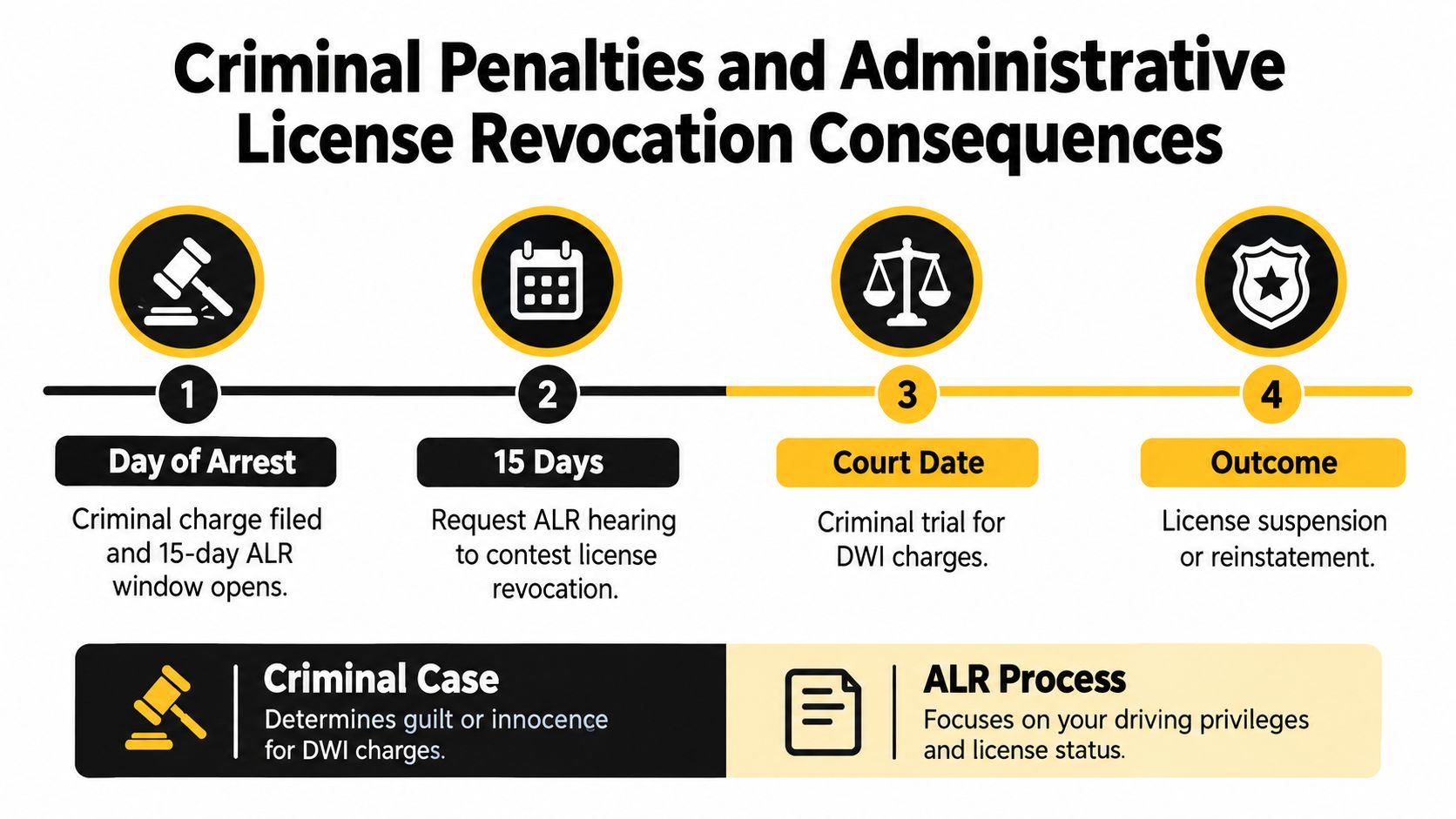
A Texas DWI arrest creates two separate legal proceedings. The criminal case is handled in court and concerns the charge, evidence, and possible sentence. The administrative license revocation, or ALR, process is handled through the Texas Department of Public Safety and concerns your driving privilege.
A DWI license suspension can proceed even while the criminal case remains unresolved. Texas DPS explains that, when a driver consents to a blood test, DPS doesn't issue a suspension notice until the BAC result is received. The ALR process remains separate from the criminal charge, as explained in Texas DPS guidance on the ALR program.
The deadline that cannot be ignored
DPS materials state that you must request an ALR hearing within 15 days of the suspension notice. A late request is denied, and the suspension proceeds. The request is not the same as defending the criminal charge, and winning the criminal case doesn't automatically erase a missed ALR deadline. Review the DPS ALR hearing requirements immediately after receiving notice.
The criminal case follows its own path. It may include bond conditions, discovery, review of body-camera and chemical-test evidence, court settings, motions, plea negotiations, and trial. The State may rely on the blood result, officer testimony, crash evidence, statements, video, or field sobriety observations. If the blood evidence is excluded, the case doesn't automatically disappear, but the prosecution may lose a significant part of its proof.
Different test results create different issues
A refusal and a compelled blood draw present different defense questions. A refusal can create ALR exposure. A blood draw creates a search-and-seizure issue, including the basis for the draw, the warrant process, and the handling of the sample. Consent requires its own review, especially if an officer presented the test as unavoidable.
A first DWI in Texas can still affect your license, employment, insurance, and professional responsibilities. More serious allegations, including serious-injury crashes, child passenger offenses, or repeat convictions, can increase the criminal stakes. Treat both proceedings as urgent, not as paperwork that can wait until the first criminal court date.
Strategic Defense Tactics to Challenge Blood Evidence
A “mandatory” label doesn't make blood evidence invulnerable. A Houston DWI lawyer should test every link between the stop, the arrest, the statutory trigger, the blood draw, and the laboratory report.
The first defense task is to identify the legal basis officers used. Did they claim consent? Did they obtain a warrant? Did they rely solely on §724.012? Did they argue exigent circumstances after the fact? The answer should come from reports, recordings, warrant applications, dispatch logs, medical records, and testimony, not from a general statement in a police narrative.
The timeline often decides the constitutional question
Recent Texas materials identify the operational gap that many mandatory-draw discussions overlook. Warrant timing, on-scene crash conditions, and the speed at which probable cause developed in serious-injury or felony cases can determine whether the blood evidence survives suppression, as discussed in Texas materials on post-McNeely blood-draw issues.
A defense attorney should build a minute-by-minute timeline:
- Traffic stop: Was there reasonable suspicion to prolong the detention or begin the DWI investigation?
- Probable cause: What facts supported the arrest, and when did officers learn them?
- Statutory trigger: Did the crash, injury, child passenger allegation, or prior-conviction information fit §724.012?
- Warrant opportunity: Could officers reasonably contact a magistrate before drawing blood?
- Draw procedure: Who took the sample, where did it happen, and was the method medically reasonable?
- Evidence handling: Did the State document sealing, transport, storage, testing, and every transfer?
The defense can file a motion to suppress when officers conducted a warrantless, nonconsensual search without a valid exception. Counsel can also challenge an unsupported warrant affidavit, an unlawful traffic stop, an overextended detention, the voluntariness of alleged consent, and the sample's chain of custody. A targeted review of blood-draw chain-of-custody challenges in Texas DWI cases can help explain why laboratory accuracy doesn't cure an unlawful collection process.
The State may argue that a serious crash made immediate action necessary. That argument should be tested against the actual scene. If officers had time to perform routine tasks, transport the driver, or wait for medical information while a warrant process was available, those facts may undermine a blanket exigency claim.
The result of suppression
Suppression doesn't decide guilt by itself. It determines whether the judge allows a specific piece of evidence into the case. If the BAC result is central and the court excludes it, the prosecutor must reassess the remaining proof. That can change negotiations, trial strategy, and the practical value of other defense challenges.
Immediate Steps to Protect Your Rights After an Arrest
The first days after release are about preservation. Evidence disappears, memories fade, and the ALR deadline runs whether you're ready or not.

Contact counsel promptly. Speak with a DWI defense attorney before discussing the facts with anyone connected to the investigation. A Texas DUI attorney can separate the criminal defense plan from the ALR response.
Mark the ALR deadline. Check the date on the DPS suspension notice and protect the 15-day hearing-request deadline described by DPS. Don't assume your lawyer or the criminal court will handle it automatically.
Write your own account. Record where you were, what you ate or drank, who was present, what the officer asked, what you said, whether you were injured, and when the blood draw occurred. Don't guess. Mark uncertain details as uncertain.
Preserve independent evidence. Save messages, photographs, receipts, location information, dashcam footage, and names of witnesses. Ask counsel how to request records before businesses overwrite video or devices delete files.
Stay quiet online. Don't post explanations, jokes, photographs, or arguments about the arrest. Don't contact alleged victims or witnesses about what they should say. Give the details to your attorney privately.
If you believe the State's blood result is wrong, tell counsel about your medical history, medications, injuries, treatment, and any independent testing. You can also review the right to an independent blood test in a Texas DWI case with your attorney. Independent evidence may expose timing, handling, or interpretation problems that a police report doesn't show.
Bond conditions matter too. Follow every court instruction, avoid new arrests, attend required settings, and ask counsel before making decisions that could affect your license or criminal case. An occupational license may be available in some circumstances, but eligibility and procedure depend on the facts and the current court orders.
Securing Strategic DWI Defense in Texas
The post-McNeely question isn't whether officers used the word “mandatory.” The question is whether the State can prove a lawful search under the facts that existed at the time. That requires reviewing the statutory trigger, probable cause, warrant timing, claimed exigency, consent, draw procedure, and laboratory chain.
You deserve a defense plan built around your records, not a generic explanation of DWI law. Counsel should obtain the video and reports, examine the warrant process, compare the crash evidence with the statutory language, and decide whether to pursue suppression, challenge the charge, negotiate a reduction, or take the case to trial.
The Law Office of Bryan Fagan, PLLC represents people facing DWI allegations in Houston, Dallas-Fort Worth, Austin, San Antonio, and surrounding Texas counties. Its DWI practice addresses field sobriety and chemical-test challenges, ALR hearings, criminal court proceedings, first-time and repeat offenses, felony allegations, and related driving offenses. The firm also describes free consultations and support throughout the process, but your case still requires an individualized legal assessment.
You don't need to solve the constitutional questions alone. If officers took your blood after invoking §724.012, preserve the paperwork, protect the ALR deadline, and have a lawyer examine whether the statute's command matched what the Fourth Amendment allowed.
The Law Office of Bryan Fagan, PLLC offers free consultations to review the warrant, consent, statutory trigger, crash timeline, and blood-test procedures in your Texas DWI case. Visit Law Office of Bryan Fagan, PLLC to request a case evaluation and take the next step toward protecting your license and your future.

