
Yes. Under Texas Transportation Code Section 724.019, if you gave a specimen at an officer's request, you have the right to an additional blood test by a medical professional of your choosing, but you must request it within a reasonable time not exceeding 2 hours after arrest.
A DWI arrest can be overwhelming, especially when you're sitting in a station or jail trying to understand what happens to your blood or breath sample. You may be wondering whether the State's result is the only evidence available. It isn't. Texas law gives you a narrow opportunity to obtain an independent blood sample that may help your defense.
What Happened to Your Blood Sample After a Texas DWI Arrest
You're pulled over, arrested, and asked to provide a breath or blood specimen. You comply, but almost immediately you wonder whether the result will be accurate. You may also ask whether you can get your own test performed by someone who isn't working for law enforcement.
Yes, you can request an independent blood test in Texas. Section 724.019 applies when you've submitted to a specimen requested by a peace officer. The law gives you a right to have an additional blood specimen taken by a qualified medical professional of your choosing, but the request must be made within a reasonable time, and that period cannot exceed 2 hours after your arrest. Texas DWI guidance on choosing a breath or blood test explains why this deadline matters.
Why a second sample can matter
Blood alcohol concentration, commonly called BAC, can change after driving. A sample collected close in time to the State's sample may show a different result, including a lower BAC at a legally important time. That doesn't automatically win a case, but it can give your Houston DWI lawyer another piece of evidence to examine.
The independent sample may also help identify questions about how the State's evidence was collected, preserved, or analyzed. Its value isn't limited to producing a different number. It may support a broader challenge to the reliability of the prosecution's testing.
A DWI arrest creates urgent decisions, but it doesn't decide your case. Prompt action and informed legal advice can preserve options.
The rest of this guide explains who qualifies, who may draw the sample, what police must do, what they don't have to do, and how a defense attorney can use the evidence. It also covers the administrative license process, the criminal case, and the consequences of a first DWI in Texas.
How Texas Law Defines Your Independent Blood Test Right
Texas Transportation Code Section 724.019 is easier to understand when you separate it into its individual requirements. The right applies to a person who has already submitted to a specimen requested by a peace officer. In other words, this statute concerns a counter-sample after you provide the State with a breath or blood specimen.
The statutory right: After submitting to an officer-requested specimen, you may request an additional blood specimen taken by a physician, qualified technician, chemist, or registered professional nurse of your choosing, within a reasonable time not exceeding 2 hours after arrest.
Who may take the sample
The independent blood draw isn't performed by just anyone. The statute identifies a physician, qualified technician, chemist, or registered professional nurse as the person who may take the additional specimen. Your choice of qualified professional matters because the defense may later need to establish who collected the sample, when it was collected, and how it was handled.
Think of the independent test as a second medical opinion. If a doctor gives you a serious diagnosis, you may seek another qualified doctor to review the situation. The second opinion doesn't erase the first one, but it can reveal a different interpretation or a problem with the original process. The independent blood sample serves a similar function in a DWI case.
How implied consent fits in
Implied consent means Texas law treats a person who drives on Texas roads as having agreed, under the statutory framework, to submit to chemical testing after a lawful DWI arrest. It doesn't mean police can automatically force a blood draw in every case. The law distinguishes between the State's testing authority and your ability to obtain an independent sample.
BAC means blood alcohol concentration, the amount of alcohol measured in a blood specimen. The State may use BAC evidence to support a DWI charge, while your independent sample may provide evidence to compare with that result.
Police must give you a reasonable opportunity to contact a qualified medical professional, but they don't have to transport you to a hospital, laboratory, or other medical facility. That practical limitation makes early communication important. A defense resource on challenging breath and blood tests in Texas DWI cases also addresses how chemical-test evidence can be questioned.
The Two-Hour Clock and When Mandatory Blood Draws Apply
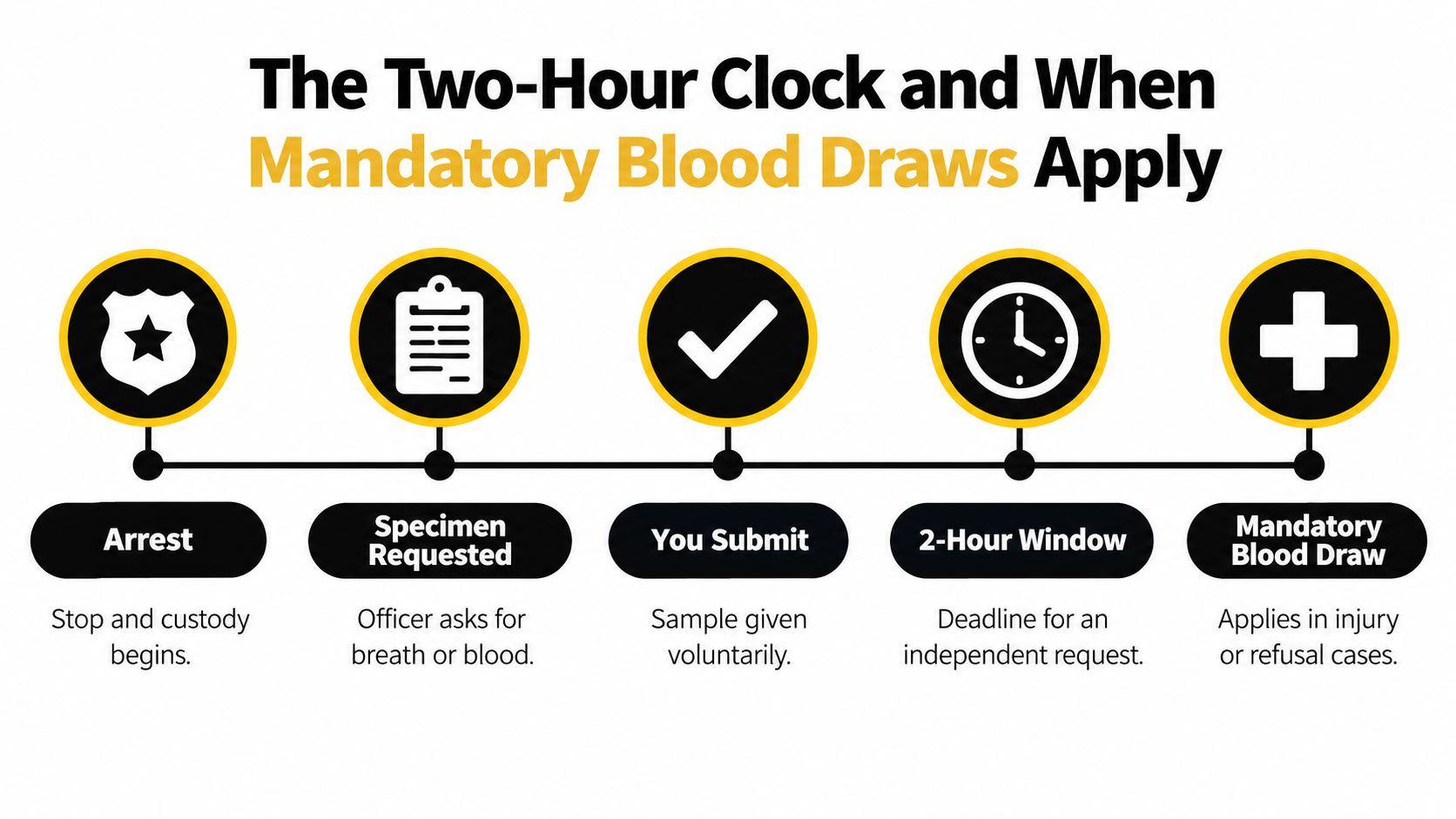
The most important practical fact is the deadline. Suppose your arrest occurs at 11:30 p.m. You submit to the specimen requested by the officer. You should make your request for an independent blood draw as soon as possible, not wait until the end of the available period. The law sets the outside limit at 2 hours after arrest, so the clock runs from the arrest rather than from the moment you receive a copy of the State's result.
A simple timeline
- Arrest: Custody begins, and the deadline starts running.
- Specimen requested: The officer asks for a breath or blood specimen.
- You submit: You provide the requested specimen.
- Independent request: You clearly ask for an additional blood sample.
- Draw arranged: A qualified professional of your choosing takes the sample within the permitted period.
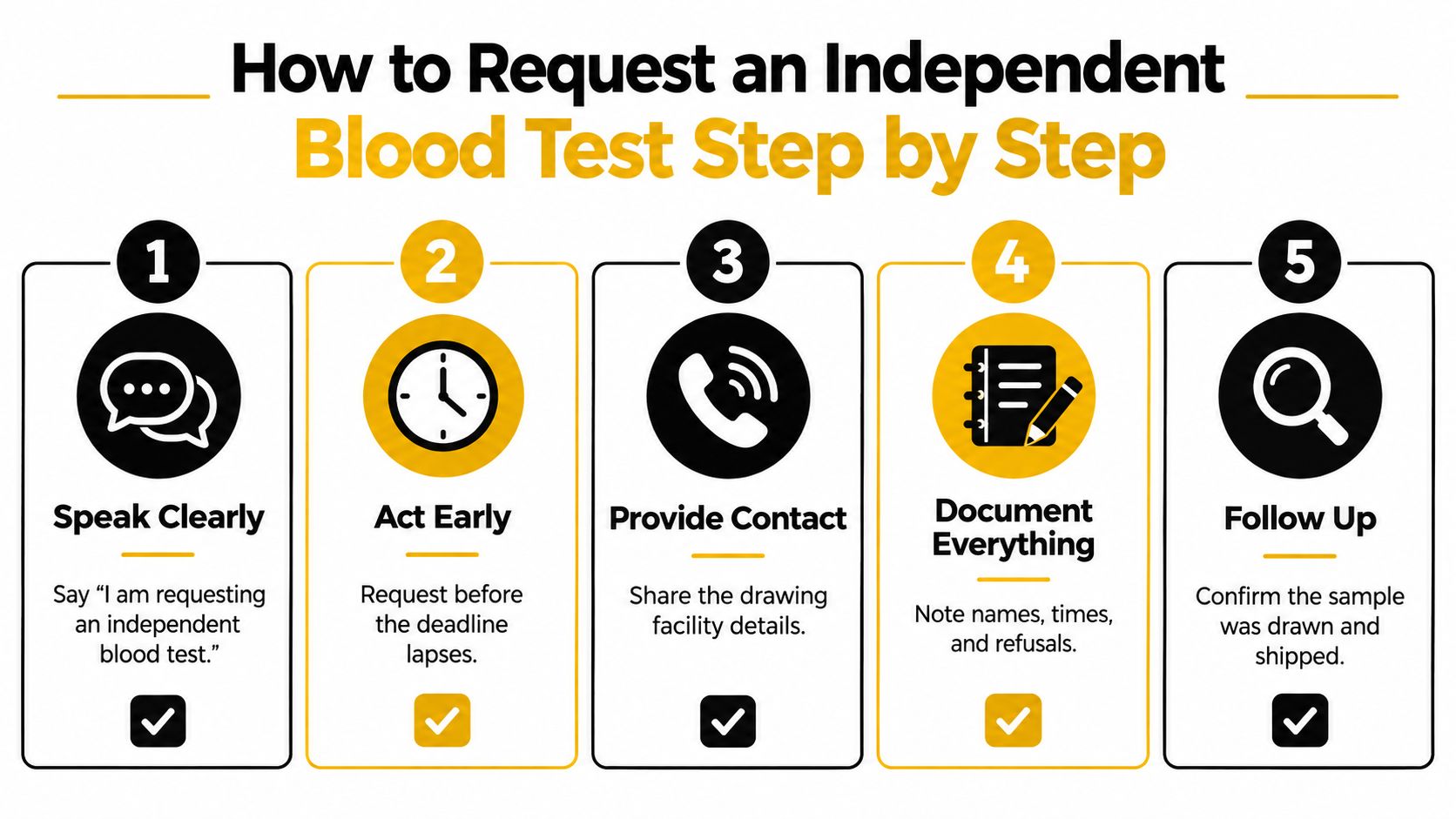
Use direct language. You might say, “I am requesting an independent blood test under Texas Transportation Code Section 724.019.” Ask to contact a physician, qualified technician, chemist, or registered professional nurse. Record the time of your request if you can, along with the name of anyone who receives it.
When officers can compel testing
Texas Transportation Code Section 724.012 creates a separate framework for mandatory blood collection without consent. The statute applies in specified situations, including DWI crashes involving death or serious bodily injury, DWI with a child passenger, and certain repeat-offense situations involving reliable information of 2 prior DWI-type convictions. The Texas State Office of the Public Insurance Counsel traffic conference material describes this statutory structure.
These rules don't mean every DWI arrest permits a forced blood draw. They show that Texas law gives the State expanded testing authority in high-risk situations while preserving the narrow counter-sample right under Section 724.019. If police seek authority for a blood draw, a lawyer can examine the legal basis and the procedures used, including issues discussed in this guide to a Texas DWI blood draw warrant.
How to Request an Independent Blood Test Step by Step
The request should be clear, early, and specific. Do not assume that a vague statement such as “I want another test” will create a clear record of your statutory request. State that you're asking for an independent blood test under Section 724.019.
Use direct request language
You can adapt this sentence:
“I am requesting an independent blood test under Texas Transportation Code Section 724.019. I want a qualified medical professional of my choosing to take the sample, and I want a reasonable opportunity to contact that person.”
Then take practical steps:
- Request the test promptly. State the request while the deadline remains open. Ask that the time of your request be documented.
- Identify a qualified professional. Contact a physician, qualified technician, chemist, or registered professional nurse who can perform the draw.
- Ask for communication access. Police must provide a reasonable opportunity to contact a qualified professional, but they don't have to transport you to the facility.
- Arrange transportation or the facility. If you're released, you may need to arrange transportation and coordinate the draw yourself. Don't drive if you may be impaired or your license status is uncertain.
- Preserve the records. Keep receipts, the professional's name, the draw time, laboratory paperwork, and the result. Give the material to your DWI attorney.
A short written checklist can help when you're stressed:
- Time: Note the arrest time and request time.
- Names: Record officers, jail staff, medical professionals, and laboratory contacts.
- Procedure: Ask where the blood will be analyzed and how the sample will be preserved.
- Documents: Keep every receipt, report, and result.
- Legal review: Contact a DWI lawyer as soon as possible.
After the immediate window closes, your lawyer can still investigate the State's evidence. Counsel may request a retained split sample, chromatograms, calibration logs, chain-of-custody records, and other laboratory materials. Those records may reveal problems even when an independent draw wasn't completed. A related resource discusses Texas DWI blood-test refusal issues.
The following video provides another general explanation of blood-test issues:
Weighing the Benefits and Risks of Independent Testing
An independent sample can strengthen a defense, but it isn't automatically favorable. The result may be lower, similar, or higher than the State's result. Your attorney should evaluate the entire evidentiary picture before deciding how to use it.
Where the sample can help
A sample taken close in time to the State's test may provide a useful comparison. It can support an argument that the State's number doesn't accurately reflect your BAC at the relevant time, especially when the results are near the legal threshold. It can also give counsel a separate specimen to examine for consistency, handling concerns, and analytical reliability.
The value may be particularly significant when you report a medical condition, when the State's number is close to the applicable limit, or when the chain of custody appears incomplete. A second result can create a scientific question rather than just a competing opinion.
| Situation | Value of Independent Test |
|---|---|
| The results are close to the legal limit | A comparison may make the State's measurement and timing more important to examine. |
| You suspect a medical or laboratory issue | The sample may support further review of collection and analysis. |
| The State's sample has documentation gaps | Independent records can provide a comparison point for handling and timing. |
| The request was made too late | The sample may have limited evidentiary value because it wasn't collected within the statutory window. |
| The result is similar or higher | Counsel must assess whether it confirms, complicates, or changes the defense strategy. |
Limits you should understand
You may have to arrange and pay for the draw yourself. Police don't have to provide transportation, and a laboratory may require coordination that takes time. If the sample isn't properly documented, the prosecution may challenge its reliability or argue that it doesn't fairly compare with the State's specimen.
Missing the deadline can also undermine the purpose of the independent test. Even then, your case isn't over. A lawyer can investigate the stop, arrest, field sobriety test, warrant, collection procedure, laboratory method, and administrative license process.
How a DWI Lawyer Uses Your Sample Against the State's Evidence
The strongest use of an independent blood test may be an attack on the State's process, not merely a claim that your number is lower. Counsel can compare the independent result with the State's retained split sample and examine the underlying laboratory materials.
Reviewing the science
A lawyer may seek chromatograms, which are visual records produced during certain laboratory analyses, along with calibration logs and quality-control materials. Those records can help an expert examine whether the instrument was properly calibrated, whether contamination may have occurred, and whether the reported peak supports the State's conclusion.
Chain of custody matters too. Counsel can ask who collected the State's sample, how it was sealed, who transported it, where it was stored, and who handled it before analysis. A discrepancy between two close-in-time samples may also raise questions about timing, preservation, or the laboratory's interpretation.
A different result is useful only when the defense can connect it to reliable collection, documentation, and scientific analysis.
A representative defense scenario
Consider a driver whose independent draw produced a result that didn't align neatly with the State's reported BAC. The defense didn't treat the private result as automatic proof of innocence. Instead, counsel compared collection times, requested the retained split sample, examined chromatograms and calibration records, and investigated the chain of custody.
That review changed the negotiation posture because the State had to account for more than one number. The defense could identify specific scientific and procedural questions instead of making a general claim that the test was wrong. Whether a case is resolved through dismissal, reduction, or trial depends on the complete record, but this is the offensive use of independent testing that many drivers never learn about.
BAC can also affect how prosecutors evaluate the charge and potential enhancements. For that broader context, review the firm's guide to Texas DWI BAC levels and enhanced charges once with your lawyer.

An attorney may also consult a forensic toxicologist or review testimony from a qualified expert. That work can address whether the sample was collected by an authorized person, whether the test method fits the specimen, and whether the State has supported its conclusion with reliable records. Counsel can also evaluate questions about the field sobriety test, officer observations, and whether the arrest was lawful.
Next Steps After Your DWI Arrest and Free Case Review
The independent blood-test deadline is only one urgent part of a DWI case. Your driver's license may face a separate administrative process through the Texas Department of Public Safety.
Administrative license suspension, often called an ALR suspension, is the DPS process that can affect your driving privileges after a refusal or certain test results. DPS states that ALR action may be triggered when you refuse a breath or blood test, when a test shows 0.08% BAC or more in a non-commercial vehicle, or when it shows 0.04% BAC or more in a commercial vehicle. Texas DPS explains the ALR program and testing triggers.
If you consented to a blood test, DPS states that the suspension notice isn't issued until the BAC results are received. That timing can make it difficult to know when the administrative deadline begins. Contact counsel promptly and preserve every notice, release document, and testing record.
The criminal case follows its own path
After arrest, you may be booked and released under bond conditions. Your lawyer can investigate the stop, review the field sobriety test, examine breath or blood evidence, challenge a warrant when appropriate, and negotiate with the prosecutor. If the case isn't resolved, it may proceed through pretrial litigation and trial.
A field sobriety test is a set of roadside coordination and attention exercises used by officers to evaluate possible impairment. Performance can be affected by conditions unrelated to alcohol, including the roadway, footwear, medical issues, fatigue, or anxiety. Your attorney should examine the instructions, conditions, video, and officer's interpretation rather than accepting the report at face value.
For a first offense, TXDOT lists possible penalties of up to a $2,000 fine, up to 180 days in jail with 3 mandatory days, and loss of a driver's license for up to a year. TXDOT's impaired-driving information describes those potential consequences. These are maximum consequences, not a prediction of what will happen in your case, and a defense lawyer works to minimize the impact.
The Law Office of Bryan Fagan, PLLC can review your independent-test request, blood or breath evidence, ALR concerns, and criminal DWI case strategy. Request a free case evaluation through Law Office of Bryan Fagan, PLLC, available 24/7 for Houston, Dallas–Fort Worth, Austin, San Antonio, and surrounding counties, so your rights and next steps can be addressed quickly.