 Skip to content
A driver leaves a restaurant late at night, gets pulled over, and later hears the officer describe the stop differently from how it happened. The breath result becomes the State's centerpiece, but the central question may be whether the stop and testing process were lawful, and you don't have to face a DWI arrest alone.
A DWI Stop, a Disputed Fact, and the Instruction That Can Decide Your Case
The disagreement may sound simple. The officer says the vehicle crossed the lane line before the traffic stop. The driver says the road curved, the lane markings were poor, and the vehicle stayed under control. During field sobriety testing, the officer reports that instructions were clear and the surface was suitable, while the driver remembers an uneven shoulder and confusing directions.
Those details can shape the entire case. A field sobriety test is a group of roadside exercises officers use to observe balance, divided attention, and coordination. It isn't the same as a scientific measurement of alcohol concentration. A BAC, or blood alcohol concentration, is the amount of alcohol in a person's blood, often estimated through a breath or blood test. If the State relies heavily on a breath result, the legality of the stop, detention, consent, warrant, or testing procedure may matter as much as the number on the report.
Texas gives jurors a specific tool for handling that kind of conflict. Article 38.23 of the Texas Code of Criminal Procedure bars evidence obtained in violation of the United States Constitution, the Texas Constitution, or Texas law. When trial evidence raises a genuine factual dispute about how the evidence was obtained, the jury may receive an instruction telling it what to do if it finds the evidence unlawful.
Practical rule: A disputed DWI fact matters under Article 38.23 only when it could affect the legality of obtaining the evidence.
This is why officer credibility can become central in a DWI trial. In a case involving conflicting accounts of the stop, testing, or arrest, reviewing the officer's credibility and testimony in a Texas DWI case can help identify whether the dispute is merely about persuasive weight or whether it concerns the legal foundation for the evidence.
The instruction is a quiet safeguard. It doesn't promise an acquittal, and it doesn't erase every unfavorable fact. Instead, it gives ordinary citizens a role in deciding whether particular evidence deserves to count when the facts tied to its collection remain contested.
What Article 38.23 Actually Says in Plain English
Article 38.23 is Texas's statutory exclusionary rule. In substance, it says that evidence obtained in violation of the United States Constitution, the Texas Constitution, or Texas law can't be admitted against a criminal defendant. The statute also requires a jury instruction when the evidence raises a factual dispute about how the evidence was obtained. The Texas statutory text of Article 38.23 provides the foundation for that protection.
In plain English, the rule works like this:
- The State offers evidence, such as a breath result, blood sample, statement, or roadside observation.
- The defense identifies a factual dispute connected to how officers obtained that evidence.
- The judge determines whether the evidence supports the required instruction.
- If the instruction is given, jurors decide the disputed facts.
- If jurors believe, or have a reasonable doubt, that the evidence was obtained illegally, they must disregard it.
The word “disregard” matters. The jury isn't merely told to give unlawfully obtained evidence less weight. The statutory rule directs jurors to disregard evidence they find was obtained in violation of law, including evidence they have a reasonable doubt was obtained illegally.
A practical way to understand the rule
Suppose jurors see a photograph that the judge later tells them was taken unlawfully. The instruction is similar to telling them they can't use that photograph when deciding the case. They must set it aside for the purpose covered by the instruction, rather than letting it influence their verdict.
That makes Article 38.23 different from a general argument that police work was sloppy. A questionable test may be important, but the defense must connect the problem to the legality of obtaining the evidence. A dispute about whether an officer followed ideal testing technique may concern reliability or weight. A dispute about whether the officer unlawfully extended a detention or obtained a blood sample without a valid legal basis may support the statutory analysis.
An accident can also change the seriousness and complexity of a DWI prosecution. Readers can review DWI Involving an Accident or Injury in Texas for a factual overview of how an accident escalates the stakes of a Texas DWI charge.
The critical distinction is this: a suppression motion asks a judge to exclude evidence before or during trial, while an Article 38.23 instruction allows the jury to decide a material factual question about legality when the evidence remains in the trial record. The instruction is the bridge between a disputed fact and the jury's treatment of the evidence.
The Three-Part Test Texas Courts Use Before Giving the Instruction
Texas courts don't give an Article 38.23 instruction every time a defense lawyer challenges a police officer. The defendant must satisfy a technical three-part test. The trial evidence must raise an issue of fact, the defendant must affirmatively contest that issue, and the issue must be material to whether the evidence was obtained legally. Texas courts continue to apply this framework, including in the modern Texas appellate discussion of the three-part test.
The factual dispute must be real
A legal argument alone isn't enough. Saying, “The stop violated the Fourth Amendment,” doesn't automatically create a fact issue. The record must contain competing facts about what happened.
For example, an officer may testify that the driver stopped immediately after a brief observation of weaving. The driver may testify that the officer followed for a longer period, extended the detention for an unrelated investigation, or stopped the vehicle without observing a traffic violation. Those competing accounts can raise a factual issue.
The defense can develop that issue through the defendant's testimony, video evidence, dispatch records, cross-examination, or inconsistencies in the officer's reports and testimony. A simple credibility attack that doesn't relate to how the evidence was obtained may not be enough.
The defendant must affirmatively contest the fact
The defense must do more than suggest that the State's proof is weak. The defendant must identify and contest the specific factual proposition that controls legality.
Consider field sobriety testing. If the officer says the instructions were clear and the driver says the officer gave different directions, that disagreement may matter if the defense connects it to the evidence the State seeks to use. If the driver only argues that the officer was unconvincing, without identifying a disputed fact tied to legal acquisition, the court may deny the request.
The dispute must be material
Materiality asks whether resolving the fact one way or the other could change the legal result. A disagreement about a minor detail usually won't qualify if the detail has no effect on the lawfulness of the stop, detention, search, seizure, consent, warrant, or testing process.
| Element | What must be shown | DWI-specific question it answers |
|---|---|---|
| Issue of fact | Evidence presents competing versions of what happened | Did the officer have a lawful reason to stop or continue detaining you? |
| Affirmative contest | The defense directly disputes the relevant fact | Did the defense challenge the officer's account with testimony, cross-examination, records, or other evidence? |
| Materiality | The fact could affect whether the evidence was legally obtained | Would the answer change whether the breath, blood, statement, or observation may be used? |
A blood-draw dispute illustrates the point. If the State says the driver voluntarily consented and the defense presents evidence that consent was not voluntary or that the chain of custody is materially different from the State's account, the legal significance depends on the exact issue. A dispute about lawful acquisition may support the instruction. A dispute that only attacks the accuracy or persuasive force of an otherwise lawfully obtained sample may call for a different remedy.
The Texas Court of Criminal Appeals has also emphasized that Article 38.23 is tied to disputed facts affecting admissibility, not a general instruction on the weight of evidence. The Texas appellate opinion discussing the limited nature of the instruction reflects that distinction.
Meeting the test doesn't guarantee that jurors will reject the evidence. It does mean the jury, rather than only the judge, may have to resolve the contested facts that determine whether the evidence was legally obtained.
Pretrial Suppression Versus a Jury Instruction and Why Both Matter
A suppression motion and an Article 38.23 jury instruction address related problems through different procedures. A suppression motion asks the judge to keep evidence out. An Article 38.23 instruction asks the jury to disregard evidence if it finds, or has a reasonable doubt, that the State obtained it unlawfully.
The judge's decision before trial
Suppose an officer says a driver committed a traffic violation. The driver disputes that account and argues the stop lacked reasonable suspicion or probable cause. The defense can file a motion to suppress and ask the judge to examine the testimony, video, reports, and other evidence at a hearing.
If the judge grants the motion, the jury may never hear the challenged breath result, statement, or other evidence. This is often the cleanest result because the disputed evidence doesn't become part of the trial presentation.
A lawyer developing this issue may use a detailed motion to suppress evidence in a Texas DWI case to present the legal and factual grounds for exclusion.
The jury's role when the evidence remains
The judge may deny suppression because the court resolves the facts against the defense, finds the evidence legally sufficient, or concludes the dispute doesn't justify exclusion at that stage. That ruling doesn't necessarily end the issue.
If trial testimony still raises a genuine, affirmative, and material factual dispute, the defense may request an Article 38.23 instruction. The evidence can reach the jury, but jurors receive a legal direction to disregard it if they find it was unlawfully obtained.
| Pretrial suppression motion | Article 38.23 jury instruction |
|---|---|
| Decided by the judge | Applied by the jury after the evidence is presented |
| Usually seeks exclusion before the jury considers the evidence | Addresses evidence already admitted or presented at trial |
| Focuses on whether the court should suppress the evidence | Focuses on disputed facts tied to the legality of obtaining it |
| A successful ruling keeps the evidence from the jury | A successful jury finding requires jurors to disregard the evidence |
This is why losing a suppression hearing doesn't automatically eliminate the defense. The same factual conflict may continue into trial, but the defense must develop it properly and preserve the jury-charge request. The jury-charge route can become a final protection against a conviction based on evidence jurors find was obtained unlawfully.
It also matters what the dispute is about. A judge or jury may be asked to decide whether the stop was lawful, whether detention continued beyond its legal basis, whether consent was valid, or whether a warrantless procedure complied with the law. A complaint that the evidence is unpersuasive may not fit Article 38.23.
How Article 38.23 Shows Up in Common DWI Evidence Disputes
DWI cases often contain several layers of evidence. The stop, officer observations, field sobriety testing, statements, breath results, and blood results may each raise different legal and factual questions. The instruction isn't automatic for every problem, so the defense must identify the particular fact that affects how the evidence was obtained.
Traffic stops and continued detention
The first question is often why the officer initiated the stop. An officer may report weaving, a lane violation, an equipment problem, or another traffic concern. The driver may deny the conduct, and video may show something different from the report.
A second issue concerns the length and purpose of the detention. For example, the officer may say the DWI investigation began promptly, while the defense argues that the detention was extended for an unrelated reason before reasonable suspicion developed. If that timing dispute could affect the legality of the evidence that followed, it may support an Article 38.23 request.
Field sobriety testing
A field sobriety test is conducted in changing real-world conditions. Darkness, an uneven shoulder, traffic noise, footwear, weather, physical limitations, or a medical condition may affect performance. Those facts can matter when the defense challenges what the officer observed or whether the test was administered as described.
The legal question is not just whether the test looked poor. The defense must connect the disputed conditions or instructions to the lawful acquisition or use of the evidence. A disagreement over how the test was conducted may support an instruction in one case, while an argument that the result deserves little weight may require a different trial strategy.
Breath testing
A breath test result may become a major part of the State's case. Common factual disputes can include whether the required observation period occurred, whether the device was operated as the officer describes, whether radio-frequency interference affected the procedure, or whether calibration and maintenance records support the State's account.
The key issue under Article 38.23 is not whether every machine question requires a jury instruction. The question is whether competing evidence presents a material dispute about the legal basis or procedure by which the result was obtained. A reliability challenge may affect weight or admissibility under another rule without satisfying Article 38.23.
Blood draws and consent
Blood evidence can raise questions about a warrant, consent, medical procedure, timing, and custody. The State may say the driver consented, while the defense presents evidence that consent was not voluntary or that the officer failed to explain the request accurately. A warrantless draw may also create a dispute about the legal basis for taking the sample.
Chain of custody creates another possible conflict. If witnesses describe different handling, labeling, or transfer procedures, the defense must determine whether the dispute concerns lawful acquisition, admissibility, identification, or merely the sample's weight. Those distinctions guide whether an Article 38.23 instruction is appropriate.
The strongest request is specific. It identifies the disputed fact, explains why that fact affects legality, and connects the requested instruction to the exact evidence the State wants the jury to use.
When and How the Instruction Must Be Requested in a Texas DWI Trial
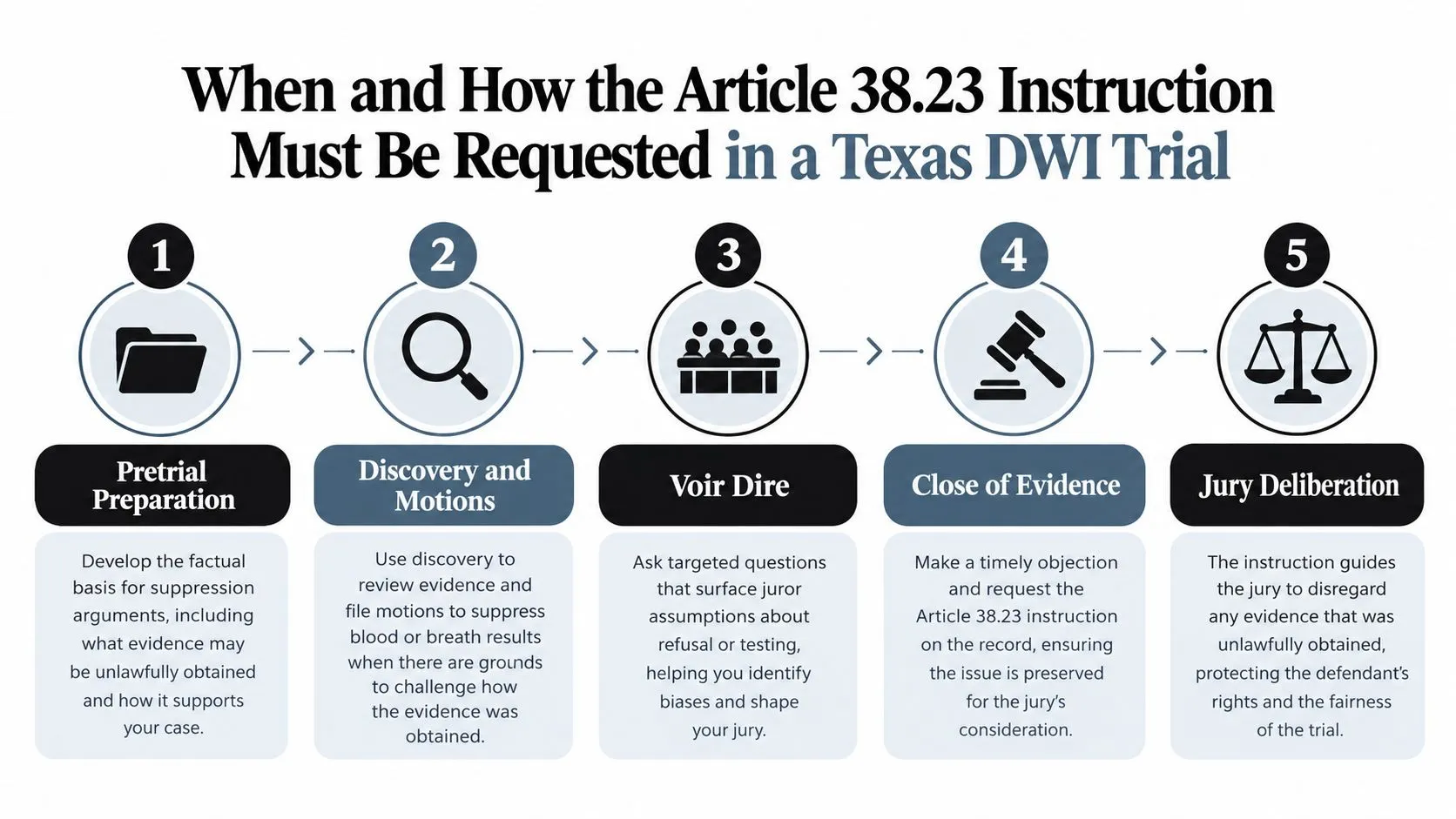
An Article 38.23 request begins before the jury charge. The defense must develop the factual dispute during investigation, discovery, hearings, and testimony so the trial record contains evidence supporting the instruction.
Build the record early
The attorney reviews dash-camera footage, body-camera footage, reports, audio, testing records, warrants, consent language, and witness testimony. Motions and cross-examination should focus on the facts that control legality, not just on general concerns about police performance.
The defense may also need to address the administrative side of the arrest. Implied consent is the legal concept that a person who drives in Texas has generally agreed to submit to certain alcohol or drug testing under statutory conditions. An administrative license suspension, often called an ALR suspension, is a civil driver-license consequence handled separately from the criminal DWI prosecution. Texas DPS states that you have 15 days after receiving notice to request an ALR hearing, making the Texas DPS ALR program information an important resource after arrest.
Present and preserve the request
At the charging conference, after the evidence is presented, the defense attorney submits a proposed instruction tied to the specific factual dispute. The request should explain the evidence supporting the issue and identify the constitutional or statutory violation that would make the challenged evidence inadmissible.
If the court refuses the instruction, the attorney must make a clear objection and ensure the record reflects the requested language and the legal basis. Failing to object can limit appellate review and may forfeit an opportunity to challenge the omission later.
The attorney may also raise the issue in a motion for new trial and, if necessary, in an appellate brief. Timing matters because Texas criminal procedure requires counsel to preserve errors at the right stage. A lawyer familiar with how jury trials work in Texas DWI cases plans the record from the beginning rather than waiting until the charge is about to be read.
After arrest, the practical sequence usually includes protecting the ALR deadline, addressing bond, gathering evidence, litigating suppression issues, evaluating plea or trial options, and preparing for the jury charge. These are separate stages, and a decision in one doesn't automatically resolve the others.
Why the Right Defense Attorney Makes This Instruction Count
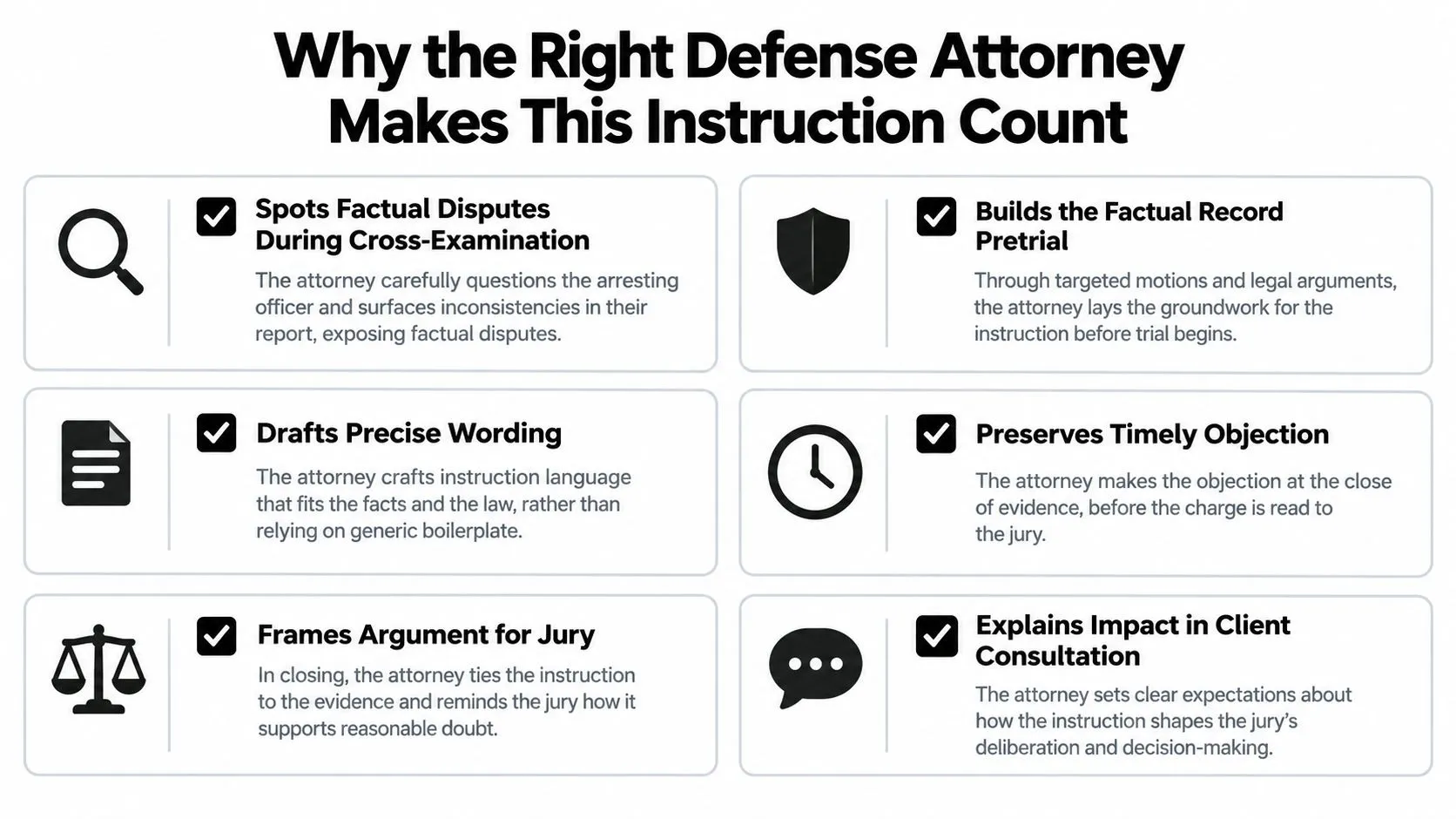
Article 38.23 isn't boilerplate that a lawyer adds at the last minute. It depends on careful factual development. The attorney must recognize the difference between an officer being unconvincing and the officer's disputed account creating a material question about the legality of the evidence.
Strategy starts with the first review
A careful Texas DWI defense attorney examines the stop timeline, officer reports, video, dispatch communications, field sobriety instructions, breath-test records, blood-draw documents, and consent or warrant issues. Cross-examination can expose differences between the report and testimony, but those differences must be tied to the legal question that controls the evidence.
The attorney then frames the issue in precise language. A vague request saying the jury should consider whether police acted improperly may not satisfy the statute. A specific request identifies the particular fact, such as whether the officer continued the detention without a lawful basis, and explains what jurors must do if they find the evidence was illegally obtained.
The instruction must make sense to jurors
Closing argument connects the disputed fact to the instruction without asking jurors to become lawyers. For example, counsel may explain that if jurors find the officer extended the stop without the required legal basis, they must follow the instruction and disregard the evidence obtained after that point. The argument should stay grounded in the testimony and the wording the court gives the jury.
A defense plan also addresses the broader consequences of a DWI arrest. Texas DPS states that a first DWI offense can involve up to a $2,000 fine, up to 180 days in jail with three mandatory days, and driver-license loss for up to one year in its Texas impaired-driving information. Those consequences make early advice important, whether you're facing a first DWI in Texas, a repeat allegation, a DWI license suspension, or professional and family concerns.
You may be searching for a Houston DWI lawyer, a Texas DUI attorney, or practical guidance on how to fight DWI Texas cases. The right lawyer should explain which disputes involve suppression, which concern reliability or weight, whether an Article 38.23 request is supported, and how to preserve the issue for review. A record-sealing or expunction question may arise later, but it should be evaluated separately from the immediate defense.
The Law Office of Bryan Fagan, PLLC offers DWI defense, ALR representation, evidence review, and trial preparation for Texans dealing with these issues.
Request a free consultation or case evaluation with the Law Office of Bryan Fagan, PLLC to review the stop, testing procedures, license-suspension deadline, and possible Article 38.23 issues in your case. The firm can help you understand your options and take the next step with a defense plan built around the facts.

