
A DWI arrest can be overwhelming, especially if you're looking at an old notice, an unpaid balance, or a suspended license and wondering whether Texas ever replaced the surcharge. You may have heard that the Texas DWI surcharge was repealed, then found another fine, reinstatement fee, or license hold attached to your record. The confusion is understandable because several separate systems can affect your driving privileges.
The short answer is that Texas didn't replace the old surcharge with one new annual bill. The state moved toward a combination of criminal court fines, a separate court-imposed state fine under Transportation Code §709.001, the Administrative License Revocation system, and case-specific DPS reinstatement fees. Those obligations don't all come from the same agency, and they don't all affect your license in the same way.
Why Texas Drivers Are Still Asking About the Surcharge
Consider a driver who had a DWI case before the repeal. The driver remembers receiving recurring state surcharge notices, then hears that Texas eliminated the program. They reasonably assume the entire DWI-related debt disappeared and that the license should be clear automatically. When a DPS eligibility search still shows a requirement, the driver may not know whether the remaining issue is an old surcharge, a court obligation, insurance, or a separate suspension.
That distinction matters. Texas repealed the Driver Responsibility Program, but the repeal didn't erase a DWI conviction, criminal penalties, court costs, insurance consequences, or suspensions imposed for another reason. It removed a particular surcharge-based debt and lifted suspensions based solely on unpaid DRP surcharges. The Texas surcharge information for drivers can help explain why an old record may still need closer review.
Three financial categories cause most confusion
Criminal court fines come from the criminal case. A judge may impose fines and court costs as part of the case resolution. Those amounts aren't the same as a former DPS surcharge.
The §709.001 state fine is a separate amount connected to a final intoxication-related driving conviction. It's collected through the court, not billed annually by DPS, and it isn't triggered because someone was arrested.
DPS reinstatement fees are tied to specific license enforcement actions. A driver may owe one after an alcohol-related suspension or another qualifying action even though the DRP surcharge itself is gone. DPS also warns that drivers can remain responsible for fines, fees, or suspensions connected to a DWI, driving without insurance, an invalid license, or another enforcement action. Texas DPS explains the Driver Responsibility Program repeal.
The answer to “Texas DWI surcharge repealed, what replaced it?” therefore depends on which obligation appears on your record. The Law Office of Bryan Fagan, PLLC helps drivers in Houston, Dallas–Fort Worth, Austin, San Antonio, and surrounding counties understand what their notices and eligibility records mean.
Understanding the Driver Responsibility Program
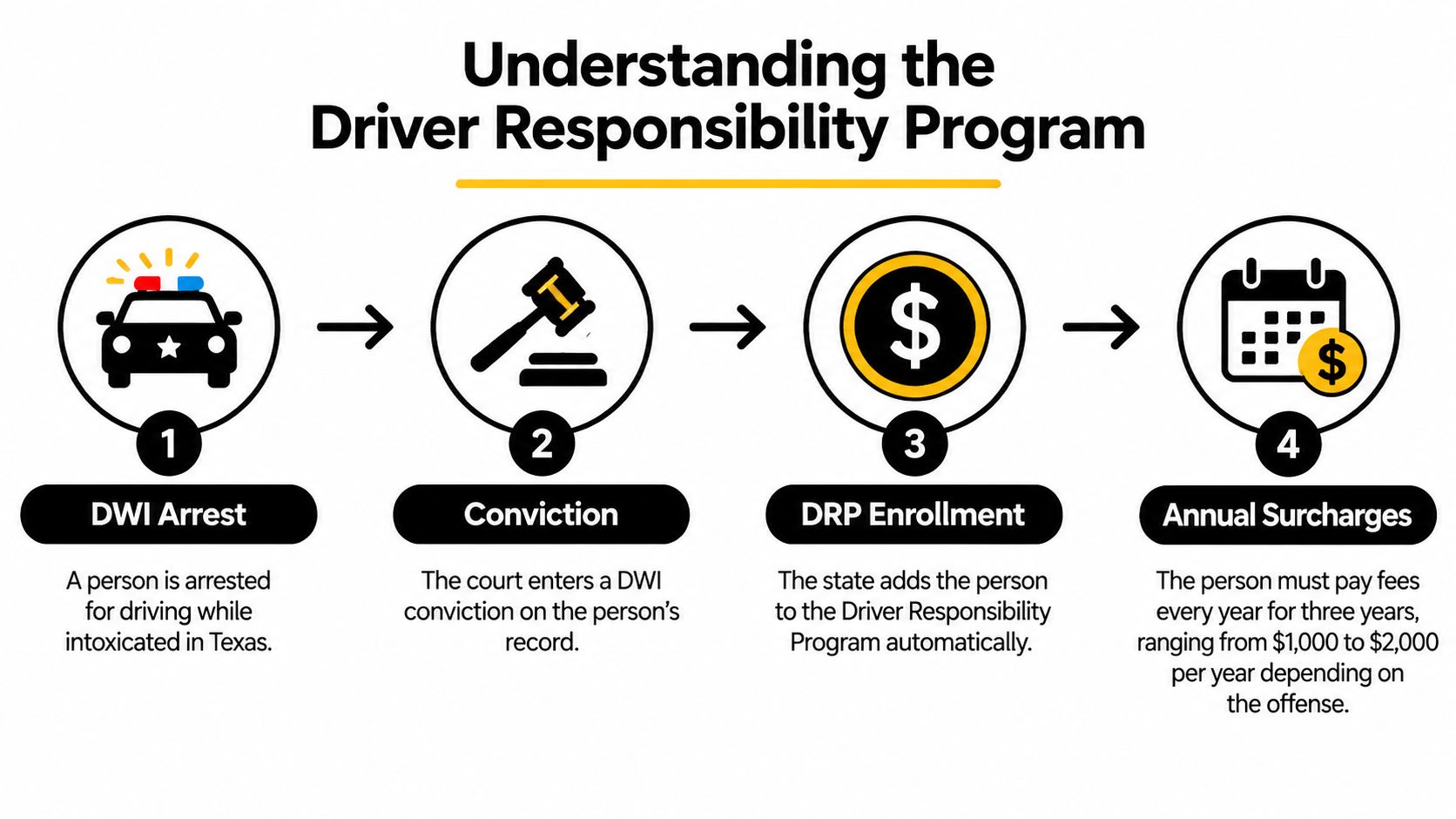
If you were convicted of DWI years ago, you may remember getting hit twice. First came the criminal case in court. Then came a separate bill through the driver licensing system. That second layer was the Driver Responsibility Program, or DRP, and it is the piece many drivers still mix up with everything else.
The easiest way to sort it out is to separate the three buckets. Criminal court fines belonged to the criminal case. The old DRP surcharge was a separate state charge tied to certain driving offenses. DPS reinstatement fees could still come up when a license had to be restored after a suspension. Those are different obligations, and they affect license eligibility in different ways.
Under the old DRP, a DWI conviction could trigger a yearly surcharge on top of whatever happened in court. A driver might finish the criminal case and still face a separate state debt afterward. If that debt went unpaid, the problem moved from money to mobility, because the state could suspend the person's license based only on the unpaid surcharge.
That is why the program caused so much confusion. Drivers often saw one DWI event and assumed every payment demand came from the same place. In practice, the system worked more like parallel tracks. The court handled the criminal judgment. The state licensing system handled the surcharge. One did not replace the other.
What House Bill 2048 changed
House Bill 2048, passed during the 86th Texas Legislature, ended the DRP effective September 1, 2019. From that point, existing DRP assessments were waived, no new DRP surcharges could be imposed, and suspensions based only on unpaid surcharges were lifted, as reflected in the Texas Legislature Online history for House Bill 2048.
Here is the practical takeaway. The repeal ended the old surcharge system. It did not erase the underlying DWI conviction, wipe out criminal court fines or costs, or create refunds for surcharge payments already made.
| What the DRP was | What the repeal changed |
|---|---|
| A separate state surcharge system connected to certain driving offenses | Existing DRP assessments were waived |
| A licensing-related debt separate from court fines | No new DRP surcharges could be imposed |
| A basis for suspensions caused solely by unpaid surcharges | Those surcharge-based suspensions were lifted |
| An obligation administered through the driver responsibility system | The program ended effective September 1, 2019 |
What the Repeal Did Not Erase
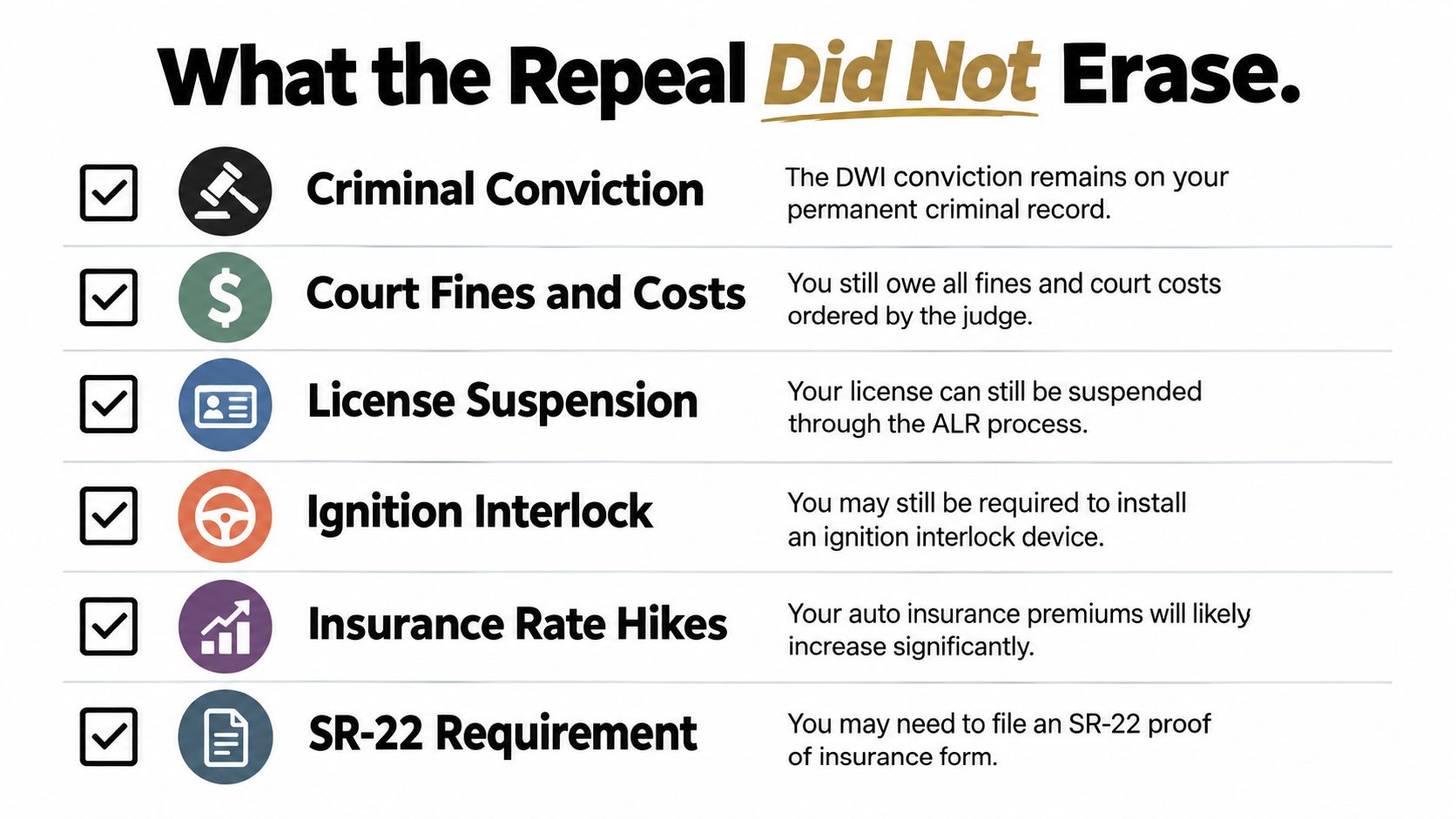
The repeal removed the DRP surcharge system. It didn't give every DWI-related consequence a clean slate. A driver can be free from an old surcharge suspension and still have other legal or financial responsibilities.
The surviving obligations
- Criminal conviction: A DWI conviction remains part of your criminal history. The repeal didn't dismiss the case or remove the conviction.
- Court fines and costs: Amounts ordered by the criminal court remain separate from the old DPS surcharge. The court may still require payment of those obligations.
- Insurance consequences: An insurer makes its own underwriting decisions. The state's repeal doesn't require an insurance company to ignore a DWI conviction when setting premiums or deciding whether to renew coverage.
- Independent license suspensions: DPS may maintain a suspension connected to the DWI itself, driving without insurance, an invalid license, or another enforcement action. A suspension based on one of those grounds isn't automatically lifted by DRP repeal.
- Prior payments: Texas didn't create refunds for surcharge payments already made.
- Other reinstatement requirements: You may still need to satisfy a fee, proof-of-insurance requirement, or another DPS condition before eligibility is restored.
Why the source of the suspension matters
Suppose your license was suspended only because you didn't pay a DRP surcharge. The repeal could remove that barrier. But suppose DPS also suspended your license after an alcohol-test refusal, an alcohol-test result, or a separate insurance violation. That second action can remain even though the surcharge-based suspension is gone.
Practical rule: Don't treat “the surcharge was repealed” as the same statement as “your license is eligible.” Confirm the exact reason for every hold.
A DWI can also affect your daily life through insurance, employment, and transportation needs long after the surcharge issue is resolved. Understanding which consequence remains is useful because each problem may require a different solution. A criminal defense lawyer may address the case, while DPS procedures and insurance requirements may require separate steps.
The Court-Imposed State Fine Under Transportation Code §709.001
A lot of confusion starts here, because people hear “replacement surcharge” and assume Texas brought back the old DRP bill under a new name. That is not how the system works. The court-imposed state fine under Texas Transportation Code §709.001 is tied to a final conviction for an intoxication-related driving offense, and it is collected through the criminal case, not as an annual DPS charge. For background on how the old surcharge system wound down, see Texas DWI surcharges ending.
The statute sets out three separate amounts:
- $3,000 for a first conviction within 36 months
- $4,500 for a second or subsequent conviction within 36 months
- $6,000 when the prosecution proves an alcohol concentration of at least 0.15
Those figures come from Texas Transportation Code §709.001. They are court-imposed state fines, so they belong in the criminal judgment and payment record. They are not the same thing as a recurring surcharge, and they are not triggered just because someone was arrested.
That distinction matters when you are reading paperwork. A court cost, a criminal fine, and a DPS reinstatement fee can all appear in the same case, but they serve different purposes and move through different offices.
How the legislative financing discussion fits
The repeal debate also included proposed ways to replace the revenue stream. Those discussions included a $2 increase tied to vehicle registration, a traffic-fine allocation change from $30 to $50, and higher one-time fines for certain offenses. One proposal discussed raising the maximum first-DWI fine from $1,000 to $3,000, with a fine as high as $6,000 when the driver's blood-alcohol concentration was at least twice the legal limit. Those numbers describe the financing ideas lawmakers debated around repeal, not a continuation of the old annual surcharge model. DPS materials explain alcohol-related offenses and separate reinstatement obligations.
The court and DPS still operate on different tracks. The court handles the §709.001 fine. DPS handles license eligibility and reinstatement conditions. Paying one does not automatically clear the other.
Does the state fine automatically block reinstatement?
No blanket answer fits every file. DPS says drivers can still face non-DRP suspensions, fines, and fees, but the §709.001 amount comes from the conviction itself and is collected through the court. Your Driver License Eligibility status is the document to check, not a general assumption that every unpaid amount either always stops reinstatement or never does.
If you are dealing with a Texas Penal Code §49.04 charge, a Texas DWI Defense Lawyer can review the criminal case, the judgment, and the licensing record together. Before you pay anything, ask for a written accounting that separates ordinary court fines, court costs, the §709.001 state fine, and any separate DPS requirement.
How the ALR System Replaced Surcharge-Based License Pressure
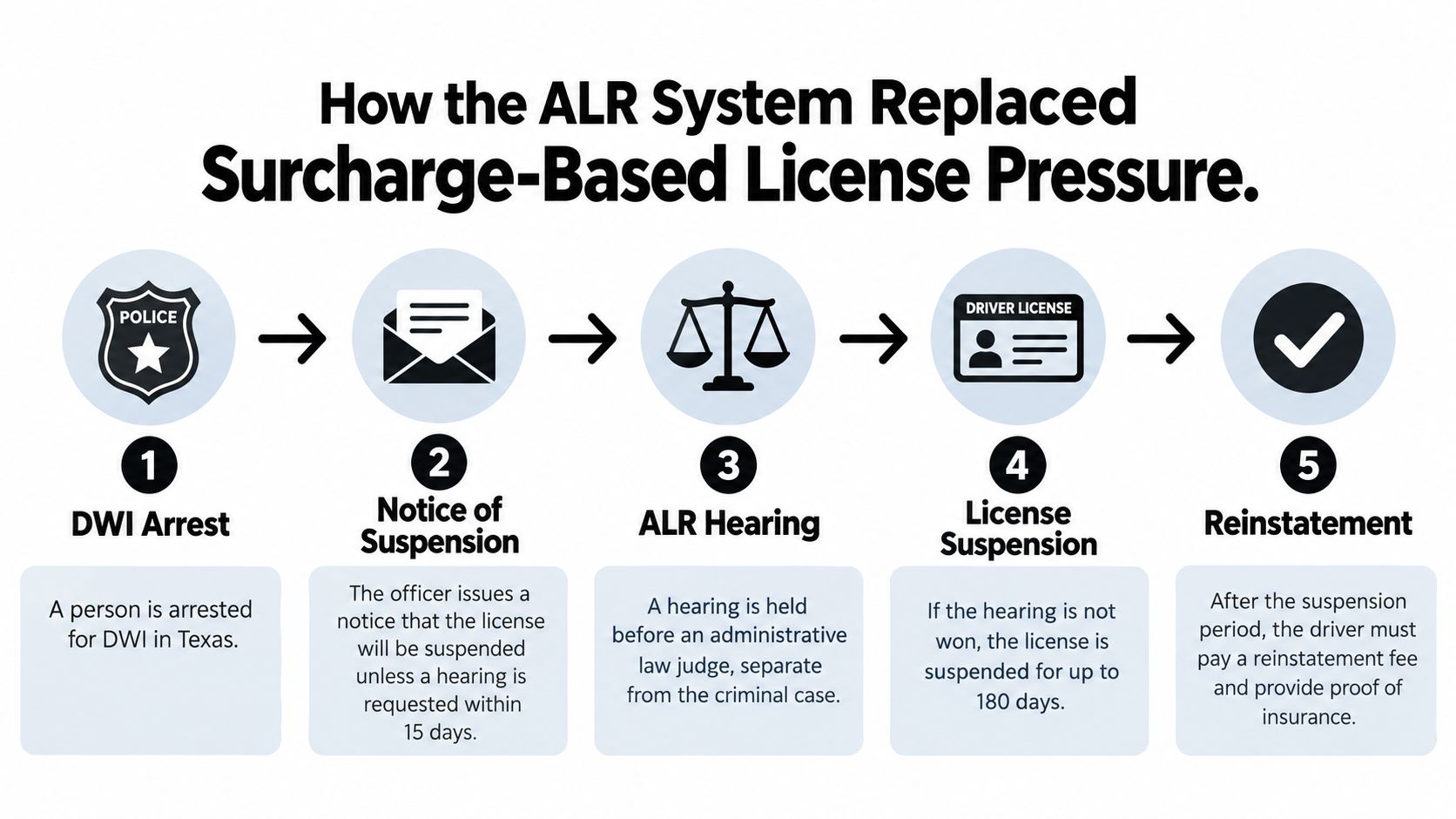
A driver can face two separate tracks after a Texas DWI arrest. The criminal case moves in one lane, while Administrative License Revocation, or ALR, gives DPS a separate path to suspend driving privileges after a test refusal or an alcohol-test result at or above 0.08% BAC for a noncommercial vehicle. For a commercial vehicle, the threshold is 0.04% BAC. DPS outlines the ALR process and its separate licensing consequences.
BAC, or blood-alcohol concentration, is the alcohol concentration measured in a person's blood, breath, or another approved sample. Implied consent means Texas law treats driving as consent to certain alcohol or drug testing under specified conditions. A refusal can trigger an administrative licensing issue even if the criminal case later becomes harder for the prosecutor to prove.
The deadline is short
After the suspension notice arrives, you generally have only 15 days to request a contest before the State Office of Administrative Hearings. If you miss that window, the suspension typically begins on the 40th day after notice. DPS sets out the ALR deadline and hearing process.
An administrative license suspension is a DPS licensing consequence, not a criminal conviction. The ALR hearing focuses on limited issues, such as whether the officer had a lawful basis for the stop or arrest, whether the testing process followed the required procedures, and whether the refusal or test result supports the suspension. It does not decide guilt in the criminal court.
Criminal and ALR cases move independently
A win, dismissal, or plea deal in the criminal case does not automatically end the ALR case. The two proceedings may use the same facts, but they serve different purposes and follow different timelines. That is why an attorney may need to challenge the administrative case while also defending the criminal charge.
A field sobriety test is a roadside evaluation used by an officer to look for signs of impairment. It can include balance, eye movement, divided attention, and the driver's ability to follow instructions. A lawyer can review whether the officer administered and interpreted those exercises properly, along with probable cause and chemical-test procedures.
If you want a step-by-step look at what happens after a request is filed, the Texas ALR hearing process breaks down the administrative side from the criminal case. The 15-Day ALR Deadline: Save Your License After a DWI Arrest explains why that request period demands fast action.
After ALR-related eligibility is restored, DPS identifies a $125 reinstatement fee for that process, along with any other outstanding obligations. If you receive the notice, request the hearing within the 15-day period and speak with an attorney before the deadline so the evidence can still be reviewed while it matters.
Old Surcharge Versus New Replacement System
The old DRP system placed the licensing pressure on a recurring state surcharge. The current framework separates the financial and administrative consequences among the criminal court, the court-imposed state fine, DPS, and the ALR process.
| Question | Old DRP Surcharge | What Replaced It |
|---|---|---|
| Who handled the obligation? | The Driver Responsibility Program administered the surcharge | The criminal court handles court fines and the §709.001 state fine, while DPS handles licensing requirements |
| What triggered it? | Certain driving offenses, including qualifying DWI-related convictions | A final conviction can trigger the §709.001 fine; a refusal or qualifying alcohol-test result can trigger ALR action |
| Was it recurring? | The DRP surcharge operated as a recurring state assessment | The §709.001 amount is a court-imposed state fine, not an annual DPS surcharge |
| How did the license consequence arise? | A suspension could result solely from unpaid DRP surcharges | A suspension may arise through ALR or another independent enforcement action |
| What happened at repeal? | Existing DRP assessments were waived and surcharge-only suspensions were lifted | Remaining court, insurance, ALR, and reinstatement obligations must be reviewed separately |
| Were old payments refunded? | No refunds were created for surcharge payments already made | The repeal didn't create a general refund process |
Who needs extra caution
Repeat offenders should review the conviction history carefully because §709.001 uses different amounts for a second or subsequent conviction within the specified period. A prior case may also affect the criminal charge and licensing consequences in ways unrelated to the old surcharge.
CDL holders face additional concerns because the commercial-vehicle BAC threshold is different in the ALR context. DWI and Commercial Drivers (CDL) in Texas addresses why an impaired-driving allegation can create serious commercial licensing concerns.
Out-of-state drivers shouldn't assume that clearing a Texas DPS record resolves every issue in the state where they live or work. A home state may review the Texas conviction or suspension under its own licensing rules.
The central question isn't whether an amount remains unpaid. It's whether that amount appears as a court obligation, a DPS reinstatement requirement, an ALR suspension, an insurance condition, or another hold. Check your Driver License Eligibility status and compare it with a written court accounting before you pay anything.
Practical Next Steps and When to Call a Texas DWI Attorney
Start with the deadline. If you recently received an ALR notice, request a hearing within the 15-day window before focusing on older balances. Preserve the notice, envelope, arrest paperwork, and any test-related documents.

Then work through this list:
- Check DPS eligibility: Determine whether the hold is connected to DRP, ALR, insurance, an invalid license, or another enforcement action.
- Request a court accounting: Ask the clerk to identify ordinary fines, court costs, and any §709.001 state fine separately.
- Verify insurance requirements: Ask your insurer whether it requires an SR-22 or has treated the conviction as a separate underwriting issue.
- Review special licensing status: CDL holders and out-of-state drivers should check commercial and home-state records separately.
- Get legal advice before payment: A payment may resolve a debt, but it won't necessarily challenge an ALR action, correct a record, or address the criminal case.
If you're researching a first DWI in Texas or a felony DWI, review the legal issues specific to your charge before assuming the surcharge repeal ends the matter. A DWI record can feel overwhelming, but separating the obligations turns a confusing file into a workable plan.
The Law Office of Bryan Fagan, PLLC offers DWI defense, ALR representation, and case evaluations for Texas drivers sorting through license suspensions, court fines, and post-repeal DPS requirements. Visit Law Office of Bryan Fagan, PLLC to request a free consultation and discuss your situation with a Texas defense team serving Houston, Dallas–Fort Worth, Austin, San Antonio, and surrounding counties, with 24/7 support available.
