
A DWI arrest can be overwhelming, but you don't have to face it alone. Maybe you're months past the arrest, your sentence is finished, and a background check still raises the same question: can I ever get this off my record?
Texas DWI record sealing isn't a simple “file a form and make the case disappear” process. Your result depends on how the case ended, the charge and BAC, whether an accident occurred, your prior record, the sentence you completed, and whether you acted quickly enough to protect your driver's license after arrest.
Texas generally uses DWI, or driving while intoxicated, for adult impaired-driving cases. The ordinary BAC threshold is 0.08 percent, although prosecutors can allege intoxication below that level if alcohol or drugs affected your ability to drive, as explained by TxDOT's impaired-driving guidance. By the end of this guide, you'll have a practical framework for identifying the right remedy, understanding the waiting period, and connecting record sealing to the ALR process and CDL consequences.
Why Texas DWI Record Sealing Feels Out of Reach
A common situation looks like this. You were arrested, resolved the criminal case, completed supervision, paid what the court required, and moved on. Then an employer, landlord, licensing board, or professional background-check company finds the DWI. The case may be old to you, but it remains relevant to anyone reviewing your public record.
That's when people search for “Texas DUI attorney,” “fight DWI Texas,” or “can a first DWI in Texas be sealed?” Online information often makes the problem worse because expunction, nondisclosure, and Texas's “Second Chances” law are frequently treated as if they mean the same thing. They don't.
Texas changed its modern DWI record-sealing framework in 2017, when Governor Greg Abbott signed House Bill 3016 on June 15, 2017. The law took effect on September 1, 2017, and applied retroactively to eligible offenses committed before, on, or after that effective date, according to this Texas DWI record-sealing overview. The change created a path for many qualifying first-time, nonviolent misdemeanor offenders, including certain DWI defendants, to seek an order of nondisclosure.
The record usually doesn't disappear automatically
Finishing probation or paying a fine doesn't automatically remove a DWI from public view. A conviction can continue creating employment, housing, licensing, and reputation concerns unless you qualify for a specific legal remedy and complete the required filing process.
A nondisclosure order can limit public access, but it isn't the same as destruction. Law enforcement and certain authorized agencies may still access the record. That distinction matters if you work in a regulated profession, hold a security-sensitive position, or drive commercially.
Practical rule: Treat sealing as part of your original defense strategy, not as an administrative afterthought.
The larger strategy begins immediately after arrest. Texas's implied consent law means a driver who operates a motor vehicle has generally agreed to provide a breath or blood specimen when lawfully requested under the circumstances described by law. A refusal can create a separate administrative problem even when the criminal case later changes.
Your criminal case, ALR case, DPS driving record, and any CDL consequences can affect one another, but they aren't one proceeding. Understanding that separation is the first step toward making a realistic sealing decision.
Expunction vs Nondisclosure for a Texas DWI
Expunction is the stronger remedy. If granted, it can require agencies to destroy or remove records tied to an eligible arrest and may allow you to deny the incident in most situations. A dismissed case, an acquittal, or an arrest that never led to a qualifying prosecution may be a better expunction candidate than a DWI conviction.
Nondisclosure is different. It seals the record from ordinary public access while preserving access for law enforcement and certain authorized agencies. For a qualifying first-time DWI conviction, the practical remedy usually falls under Government Code §411.0731. The Texas order of nondisclosure process is therefore about limiting public visibility, not erasing every trace of the case.
The distinction is important when reviewing court records, DPS information, and commercial background checks. A nondisclosure order may reduce what a private employer or landlord sees, but it doesn't rewrite the historical events available to agencies with lawful access.
| Question | Expunction | Nondisclosure |
|---|---|---|
| What is the usual eligibility posture? | Often tied to a dismissal, acquittal, or another legally qualifying arrest outcome | May apply to a narrow group of qualifying first-time DWI convictions |
| What happens to public access? | The eligible arrest and related records may be removed or destroyed | The record is hidden from ordinary public view |
| Can government agencies still access it? | Access is heavily restricted after a granted expunction, subject to legal exceptions | Law enforcement and certain authorized agencies may retain access |
| Does it erase the driving history? | It doesn't automatically resolve every separate DPS or licensing record | It doesn't automatically erase the DPS driver record or ALR history |
A person convicted after a guilty plea generally can't use expunction to erase that conviction. That person may instead need to examine nondisclosure eligibility, sentence completion, waiting periods, and statutory exclusions.
For a plain-language discussion of whether a DWI can be removed or sealed, see Clearing a Texas DWI: Expunction and Nondisclosure. The answer depends on how the case ended, not just on how much time has passed.
Who Actually Qualifies Under Texas Law
Eligibility for first-time Texas DWI record sealing is narrow. Start with the court documents, not memory. The charging instrument, judgment, plea papers, supervision order, BAC evidence, and proof of completion can each affect the analysis.
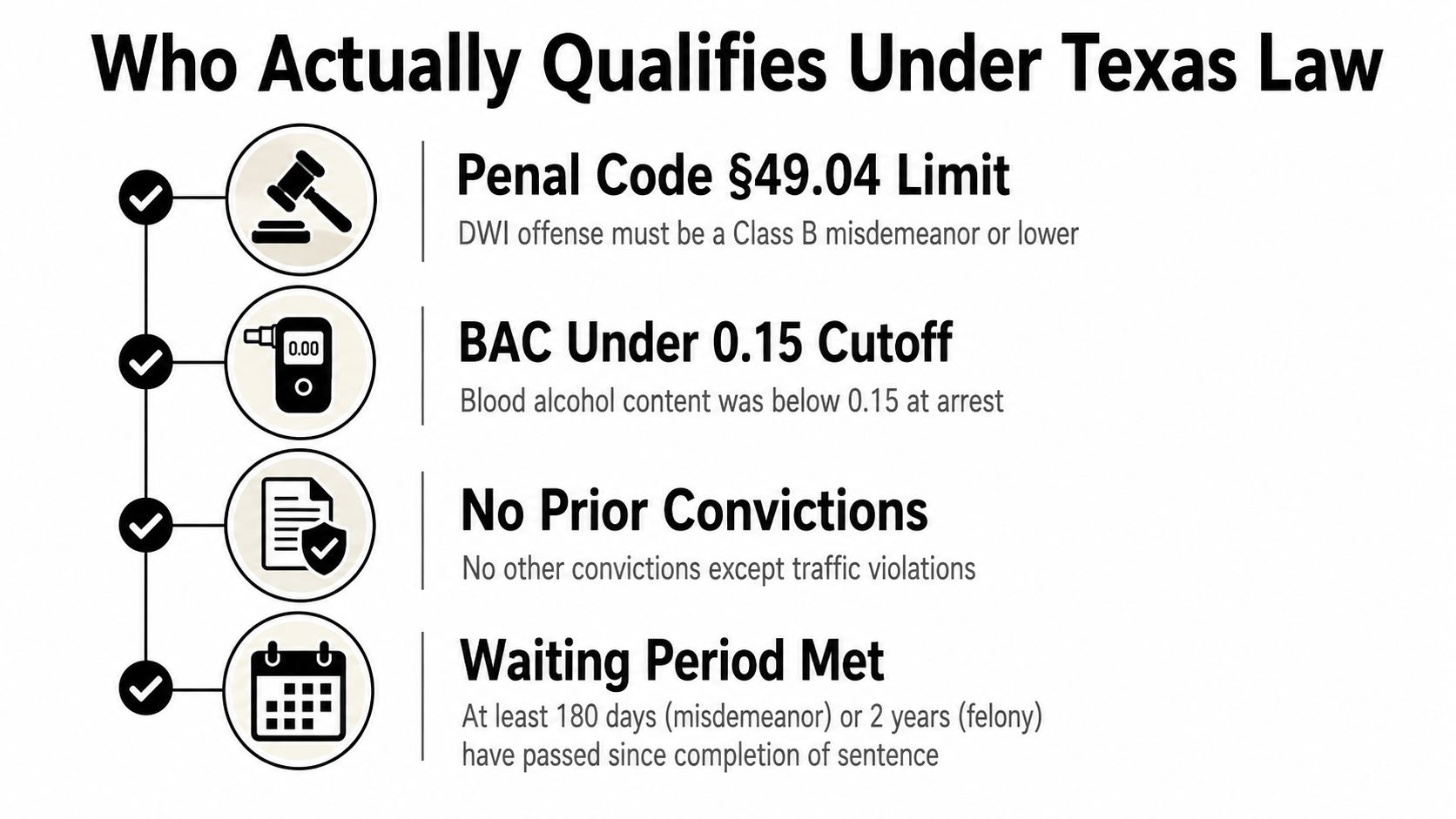
The core checklist
A qualifying case generally must meet each of these conditions:
- Correct offense: The conviction must be under Penal Code §49.04. The most common pathway concerns a lower-level first DWI rather than an aggravated or felony intoxication offense.
- BAC below the cutoff: The BAC must have been below 0.15, according to TexasLawHelp's explanation of expunctions and nondisclosures. A BAC of 0.15 or higher is statutorily ineligible for this same DWI sealing remedy, as summarized in Texas DWI nondisclosure eligibility guidance.
- No accident involving another person: The case can't involve an accident with another person. A collision involving another person may remove the case from the ordinary first-time DWI nondisclosure pathway, even if the injuries seem minor.
- No disqualifying prior record: You can't have prior convictions or deferred adjudications, other than fine-only traffic offenses. That review includes out-of-state matters, not just Texas cases.
- Sentence completion: You must have completed every term imposed by the court, including supervision conditions, payment obligations, classes, community service, and any required device or testing conditions.
A driver with a BAC of 0.14 may satisfy the BAC requirement, assuming the other conditions are met. A driver with a BAC of 0.16 generally falls outside this particular remedy. Likewise, a passenger in the vehicle doesn't automatically create a disqualifying accident, but an accident involving another person can.
Cases that follow a different path
Dismissed cases, no-bills, and certain acquittals may call for an expunction analysis rather than a conviction-based nondisclosure petition. Deferred adjudication cases also require careful review because the applicable remedy can depend on the offense, the supervision order, and whether all conditions were successfully completed.
Juvenile DUI matters and adult DWI convictions shouldn't be placed into the same checklist without examining the governing statute and court history. If your record includes a prior theft plea, another criminal case, a felony, or a complicated supervision term, a quick online screening may give you the wrong answer.
The safest self-screen is simple: obtain the official case file, identify the exact statute of conviction, confirm the BAC evidence, review accident allegations, list every prior case, and calculate the waiting period from the correct completion date. If any item is uncertain, have a Texas DWI lawyer review it before filing.
How the Waiting Periods Work in Real Time
Time matters because Texas doesn't treat sealing as immediate relief. Depending on the conviction, sentence, and interlock history, the waiting period can be 2 years, 3 years, or 5 years, as described in Texas DWI sealing timeline guidance.
For a qualifying conviction, the standard wait is 2 years if you completed at least 6 months of driving with an ignition interlock device as part of the sentence. If no interlock requirement applied, the wait can increase to 5 years. Some jail-sentence cases use a 3-year period with an interlock and 5 years without one.
The clock starts at the right legal event
The relevant date usually relates to completion of community supervision or completion of the sentence, not just the arrest date or the date you entered a plea. A person who finished supervision in one calendar year may have a different eligibility date from someone arrested on the same night but placed under different sentence terms.
Consider two otherwise similar first-time defendants. One completed the required interlock period and may reach the 2-year waiting point. The other had no applicable interlock requirement and may face the 5-year period. The difference isn't a minor paperwork detail. It can affect job applications, professional licensing, housing, and insurance decisions over a substantial stretch of time.
The best time to discuss the sealing consequence of an interlock condition is before you accept or complete the sentence, not after the waiting period has already become a problem.
New criminal cases, missed conditions, or an incomplete sentence can create additional complications. Don't assume that a payment made late, an unfinished class, or an unresolved supervision issue is invisible to the court reviewing your petition.
You can use this Texas DUI waiting-period timeline guide as a starting point, but the final calculation should come from the actual judgment and supervision records. A Houston DWI lawyer can compare those documents with the statutory timeline before you spend money on filing.
Filing the Petition Step by Step
Once eligibility and timing look favorable, the petition must still be prepared accurately. A judge doesn't decide based on a general statement that you completed probation. The court reviews the legal basis, the case identifiers, the agencies involved, and the proof supporting eligibility.
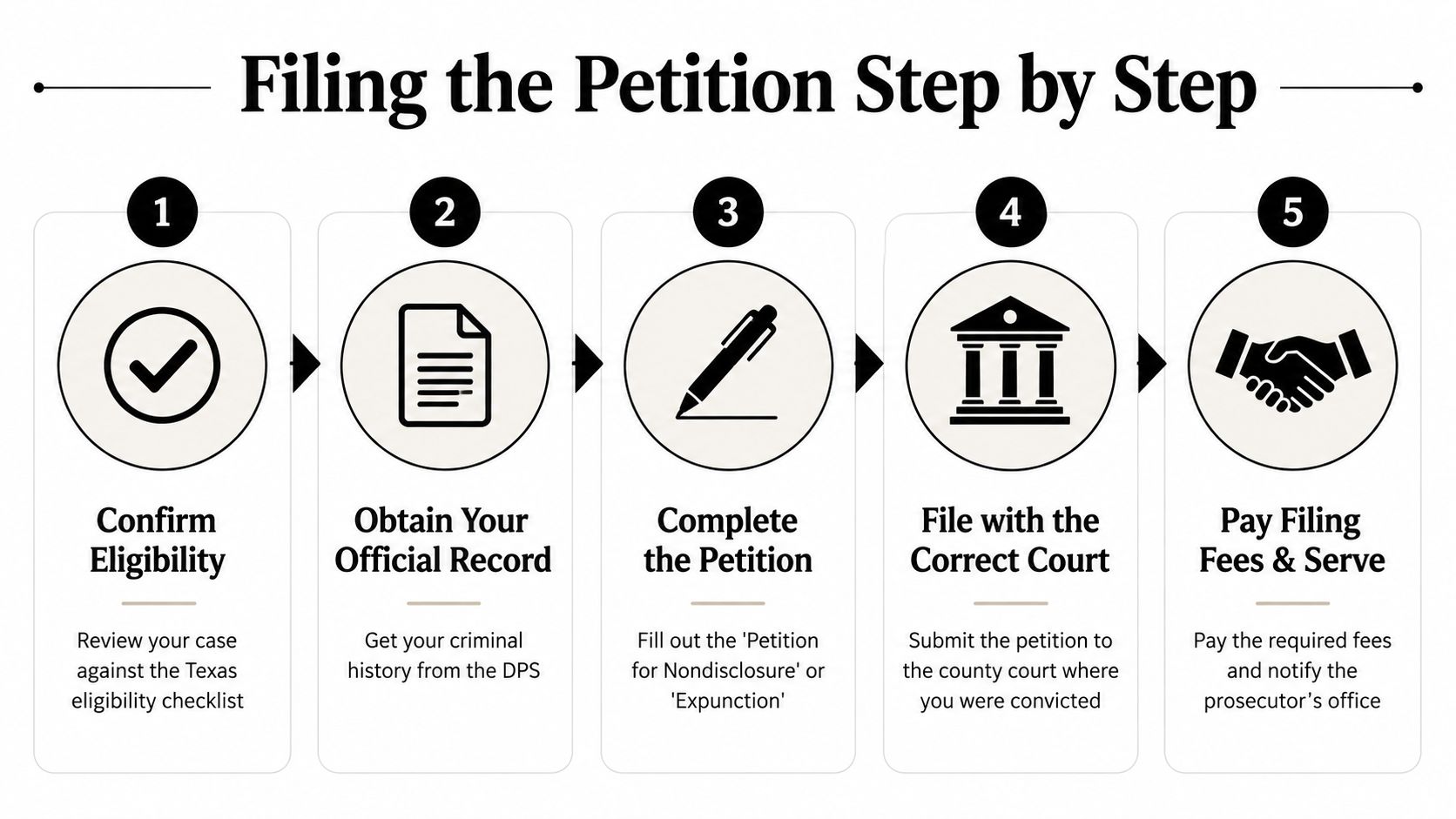
A practical filing sequence
Confirm the case outcome and statute. Verify whether you're pursuing expunction or nondisclosure. Confirm the offense, BAC, accident history, prior record, sentence terms, and completion date.
Collect official records. Obtain the judgment, plea documents, supervision order, discharge or completion proof, and relevant DPS or arrest information. Fingerprints and agency identifiers may also be necessary, depending on the petition and county procedure.
Prepare the petition. The filing should identify the correct legal remedy and every agency that may hold responsive records. A wrong case number or incomplete agency list can create avoidable objections and delays.
File in the proper court. For a first-time DWI nondisclosure, the petition is filed in the court that imposed community supervision. Expunction filings follow the applicable court and case-ending rules. Filing in the wrong court can result in denial even when the underlying facts appear favorable.
Pay, serve, and prepare for review. The clerk requires the applicable filing fee, and the prosecuting authority and relevant agencies must receive notice. The State can object, so your documents should support each eligibility element rather than merely repeat it.
What happens after filing
A hearing may be set after the required notice period and local scheduling process. Many people should expect the process to take roughly 60 to 90 days before a hearing or court action, although the actual schedule depends on the county, objections, service, and filing quality.
The judge generally decides whether the statutory requirements are satisfied and whether the proposed order properly identifies the agencies and records covered. A certificate showing sentence completion can matter as much as the petition itself.
DIY filing can work in a straightforward case, but the trade-off is real. A technical defect can cost the filing fee and force you to correct the matter later. Before filing, compare your paperwork against the court's requirements and make sure every date and agency name matches the official record.
How Sealing Interacts With the ALR, DPS, and a CDL
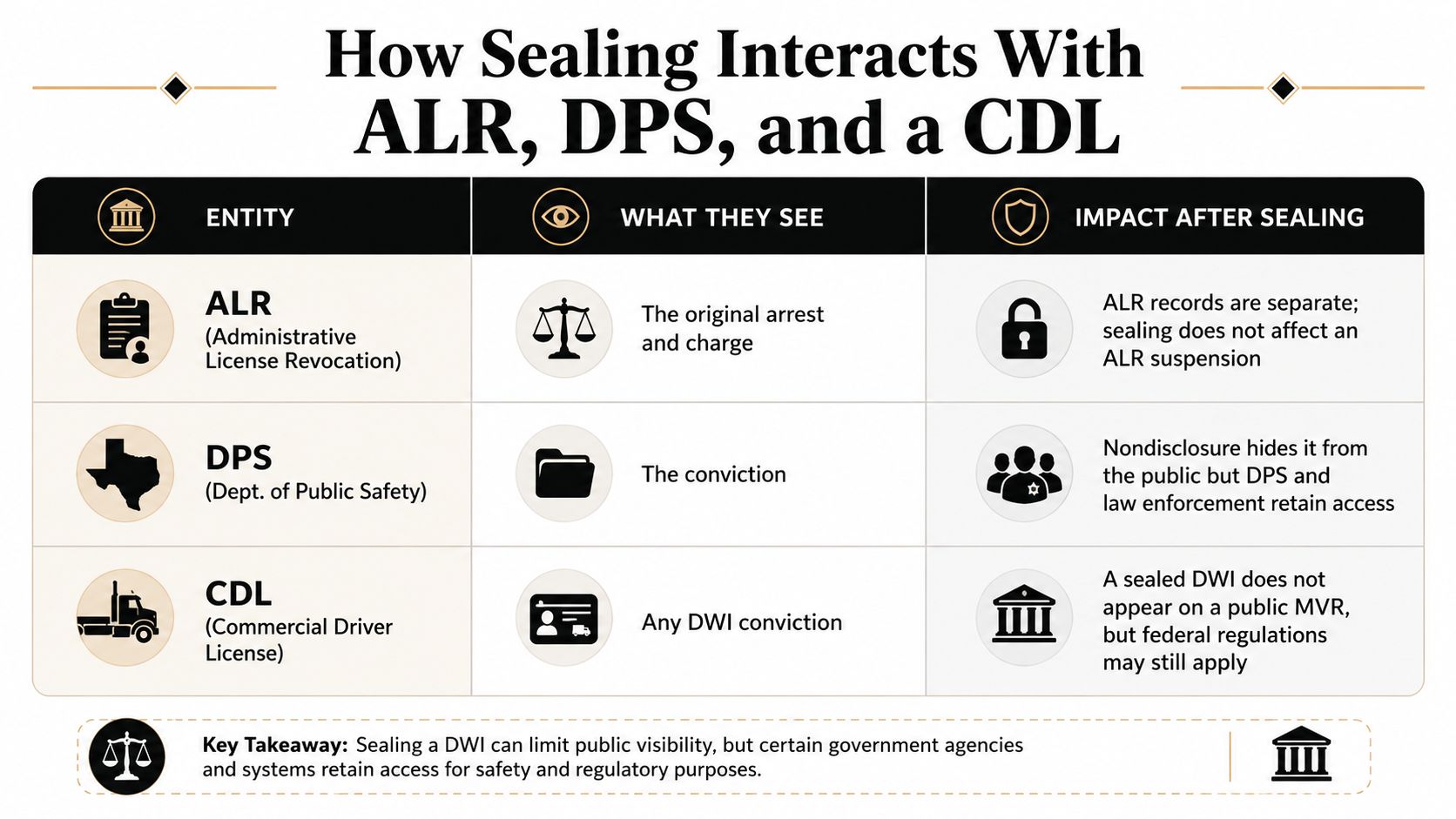
A nondisclosure order doesn't solve every post-arrest problem. The ALR process, or Administrative License Revocation process, is a separate administrative track involving your driving privilege. An administrative license suspension is the loss or restriction of driving privileges imposed through that process, rather than the criminal court's punishment after conviction.
The deadline is urgent. Texas DWI defendants often have only 15 days after refusing or failing a chemical test to request an ALR hearing, according to Texas ALR law information. A first-time refusal can trigger an automatic 180-day license suspension. Waiting years to pursue sealing doesn't restore the opportunity you may have had to challenge that suspension at the beginning.
Why the DPS record remains important
DPS maintains driver and public-safety information. Nondisclosure limits public access to the conviction, but it doesn't automatically erase the DPS driver record or the separate ALR history. The criminal record and driving record therefore need separate review.
A BAC means blood alcohol concentration, the measure used to describe alcohol in a person's system. For most adult drivers, Texas identifies 0.08 percent as the standard threshold, but impairment can still be alleged below that number. Commercial drivers face a lower 0.04 percent BAC limit, as explained in this Texas DWI law overview for commercial drivers.
CDL holders face a different risk calculation
A CDL holder can pursue nondisclosure for a qualifying misdemeanor and still face commercial licensing consequences. Sealing doesn't automatically undo the effect of a DWI on a commercial driving record, and federal or employer rules may continue to matter.
For example, a truck driver may eventually limit public access to a qualifying Texas conviction, but that step doesn't replace the early ALR defense or protect the driver from every CDL review. The driver needed a coordinated strategy from the arrest date, including a timely ALR request, criminal defense, and later record analysis. Review the separate licensing concerns in DWI impact on a Texas commercial driver's license.
A field sobriety test is a set of roadside coordination and attention exercises used by an officer to assess possible impairment. It isn't the same as a chemical BAC test, and questions about instructions, conditions, balance, medical issues, and officer interpretation may matter in the criminal case. Protecting the license and evaluating the evidence come before planning a future sealing petition.
Common Mistakes and When to Call a Texas DWI Lawyer

People commonly file too early, count from the arrest instead of sentence completion, use the wrong court, or overlook an out-of-state conviction or deferred adjudication. Another frequent mistake is assuming sealing removes the underlying facts from DPS, ALR, law-enforcement, or CDL systems.
A complicated sentence, felony case, multiple convictions, accident allegation, BAC at or above the statutory cutoff, or commercial license concern deserves legal review. The Texas DWI court process from arrest to resolution also matters because the decisions made before disposition can shape later record options.
The Law Office of Bryan Fagan, PLLC handles DWI defense, ALR hearings, chemical-test challenges, criminal court matters, and post-conviction record questions for Texans in Houston, Dallas–Fort Worth, Austin, San Antonio, and surrounding counties. The firm can review your case history, identify the correct remedy, and explain the trade-offs before you file.
Here's a short video discussion to supplement the practical guidance above:
If you're ready to determine whether Texas DWI record sealing fits your situation, request a free, no-obligation case evaluation with the Law Office of Bryan Fagan, PLLC. Bring your judgment, supervision-completion records, BAC information, and any CDL or ALR documents so the team can explain your options and help you take the next responsible step.