
A DWI arrest can be overwhelming, but you don't have to face it alone. Maybe the criminal case was dismissed, maybe a jury said not guilty, or maybe the stop never should've turned into an arrest in the first place. Either way, the paper trail can keep following you, and that's exactly where the Texas DWI expunction process comes in.
A lot of people assume a DWI arrest is permanent. That's wrong. Texas courts have granted 9,555 expungements between September 2018 and February 2025, with a peak of 2,782 granted in 2021 alone, and the same statewide data notes that more than 4 million people are currently eligible for expunction in Texas (Texas DWI Law Firm). That doesn't mean everybody qualifies for DWI expunction, but it does mean the remedy is real, active, and used every day.
If your case ended the right way, you may have a path to erase the arrest entirely. If it didn't, you still may have options to seal the record instead of leaving it open to background checks. The key is knowing the difference before you waste time on the wrong filing.
Why a DWI Arrest Follows You and What You Can Do About It
You can beat the criminal case and still feel stuck with the arrest. That's the part many don't expect. Employers, landlords, licensing boards, and background screening companies don't care that the prosecutor dismissed the case if the arrest record still shows up.
A dismissed DWI can create the same kind of stress as a conviction when you're applying for work or trying to renew a professional credential. The arrest can keep surfacing because the record never disappeared on its own. Texas law gives you a legal way to attack that problem, but it won't happen automatically.
The remedy is formal, not automatic
The Texas DWI expunction process is a civil court procedure, not a clerical cleanup. Texas practice guidance says it starts with a verified petition filed in the arresting county, and that petition has to identify you, the arrest details, the case number, and every law enforcement agency that may hold a record (McConathy Law). After filing, the clerk notifies DPS, a hearing is typically set no earlier than 30 days, and the signed order has to be sent out to each record custodian.
Practical rule: if the paperwork is sloppy, the case slows down or fails. DWI expunction is about precision, not hope.
That's why I tell clients not to treat an expunction like a formality. It's a court-supervised remedy with real requirements, and those requirements matter more than the arrest itself. The good news is that, when the case qualifies, the process is manageable.
For a reader still sorting out the bigger picture after a dismissal, Clearing a Texas DWI: Expunction and Nondisclosure is the right starting point. It focuses on whether and how a DWI can be removed or sealed from your record.
Who Qualifies for a Texas DWI Expunction
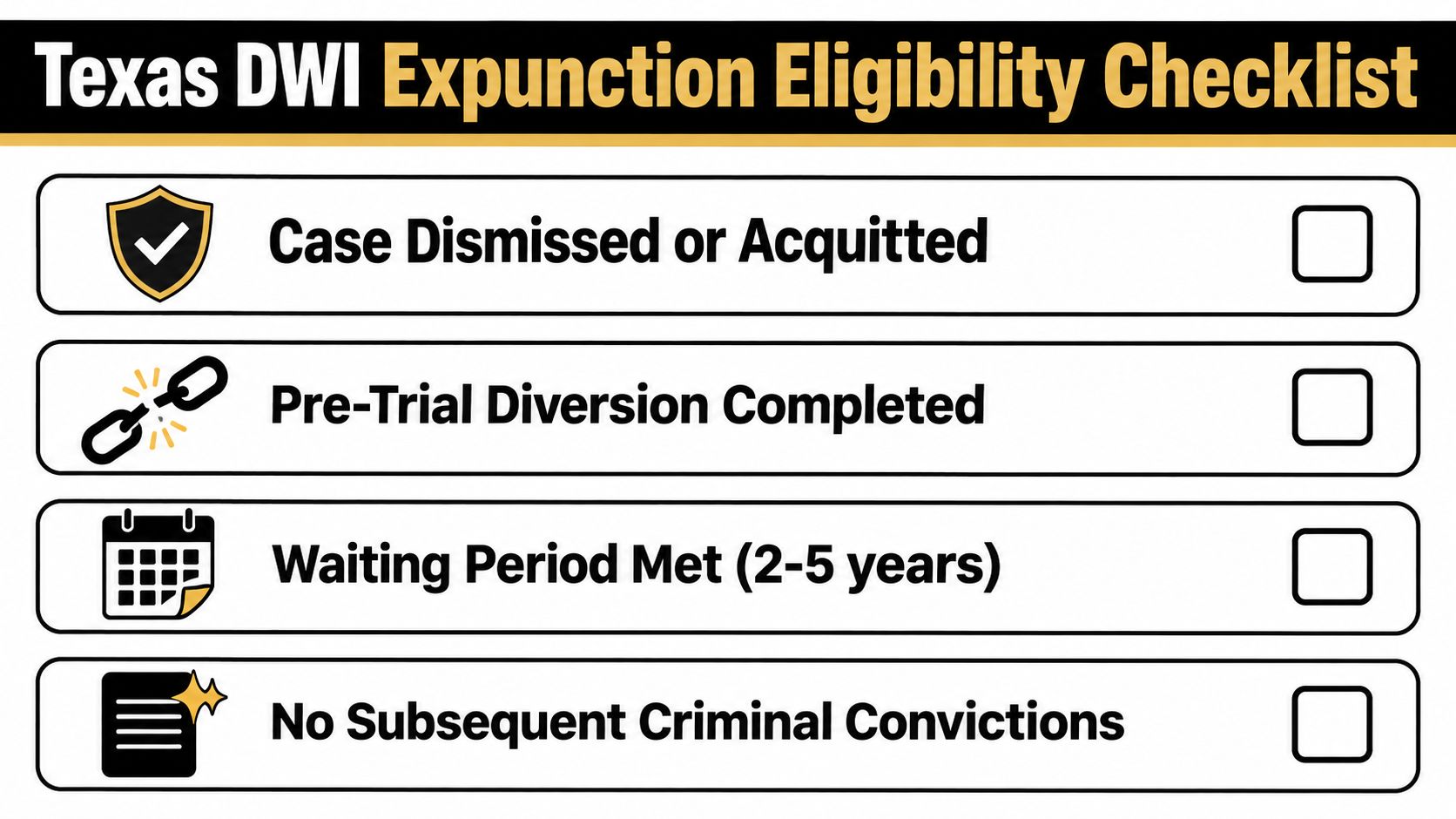
Eligibility comes down to the outcome of the case, not just the fact that you were arrested. That's a common mistake. If the result was a dismissal, acquittal, no-file, pardon, or certain overturned outcome, you may have a path to expunction. If it was a conviction, you usually don't.
The case outcome controls the answer
A dismissed DWI case is the most common place to start. If the charge was dismissed before conviction, the arrest may qualify for expunction depending on the specific reason and timing. An acquittal is even cleaner. Texas practice guidance says the court must enter an order for expunction within 30 days of an acquittal, and the petition still has to contain the detailed information Chapter 55 requires (Kevin Bennett Law).
Pardons can also open the door, and so can some cases overturned on appeal. If the state never filed charges after the arrest, that can also support relief. Those are the situations where you should stop assuming your record is stuck forever and start checking the exact posture of the case.
What usually does not qualify
A DWI conviction generally doesn't qualify for expunction. Deferred adjudication for DWI is also a different animal, and many people in that position need to look at nondisclosure instead of expunction. That's the route for sealing, not destroying, the record.
If you want a second opinion on whether your outcome fits the expunction rules, the legal framework in Texas DWI Expunction is worth reviewing. It's a direct way to see whether your case belongs in the expunction category or the sealing category.
If your case ended in a conviction, don't assume the conversation is over. In many cases, the real issue becomes whether nondisclosure can reduce the damage.
Quick self-check
- Dismissed case: likely worth reviewing for expunction eligibility.
- Acquittal at trial: strong basis for expunction relief.
- No charges filed: may fit expunction rules.
- Conviction: usually not expunction, look at sealing options instead.
- Deferred result: often points toward nondisclosure, not destruction.
Expunction vs Nondisclosure for Texas DWI Cases
People mix these terms up all the time, and that mistake can send you down the wrong path. Expunction destroys the arrest record. Nondisclosure seals it from most public view, but it does not erase it.
Side by side, the difference is major
Texas Law Help explains that expunction petitions are filed in the arresting county, while nondisclosure petitions are filed in the court that handled the criminal case (Texas Law Help). That filing difference tracks the remedy you are asking for. If you file in the wrong place, you waste time and invite delay.
Here is the practical comparison:
| Feature | Expunction | Nondisclosure |
|---|---|---|
| What it does | Destroys or removes the arrest record | Seals the record from most public view |
| Who can still see it | Very limited access after destruction rules apply | Law enforcement, licensing agencies, and certain government entities |
| Filing location | Arresting county | Court that handled the criminal case |
| Best fit | Dismissals, acquittals, no-file cases, pardons, certain appeals | Cases that qualify for sealing rather than destruction |
| Effect on background checks | Strongest form of relief | Helps with public-facing checks, but not total destruction |
That distinction matters most if your job depends on a clean public record. If you hold a CDL, work in a licensed profession, or keep running into background checks, “sealed” and “gone” are two very different outcomes. A sealed record can still leave you answering questions you would rather never face. An expunction usually ends that problem at the source.
Why many DWI guides get this wrong
A lot of online advice treats “clear my DWI record” as one bucket. Texas law does not work that way. If your case qualifies for expunction, pursue expunction. If it only qualifies for nondisclosure, do not waste effort on the wrong filing.
The internal resource on an Order of Nondisclosure in Texas is the right follow-up if your case ended in a way that points toward sealing instead of destruction. That route helps when the arrest cannot be wiped out completely.
Filing Your DWI Expunction Petition in Texas
A lot of people stall here because the paperwork looks technical. It is technical. The good news is that the process is orderly, and once the petition is accurate, the rest of the case is much easier to manage.
Start with a verified petition
The petition belongs in the district court of the arresting county, and it has to identify you, the arrest, the case number, and every law enforcement agency that may hold a related record. Texas procedure also requires notice to the agencies that maintain those records, and the Texas DWI expungement timeline helps show why getting the filing right at the start matters. If you leave out an agency, its records can remain in place even if the court grants the relief you want.
Once the petition is filed, the clerk sends notice to DPS and the listed agencies. Those agencies become respondents, and they may appear at the hearing. That is why the petition is the core of the case. It tells the court exactly what relief you want and tells every record holder what must be destroyed if the order is signed.
What happens next
The hearing usually cannot happen until at least 30 days after filing, so do not expect immediate relief. The judge reviews the petition, the outcome of the case, and whether the statutory requirements are satisfied. If the court signs the order, the signed Order of Expunction is sent to each custodian of records, and they must destroy or return the records they hold.
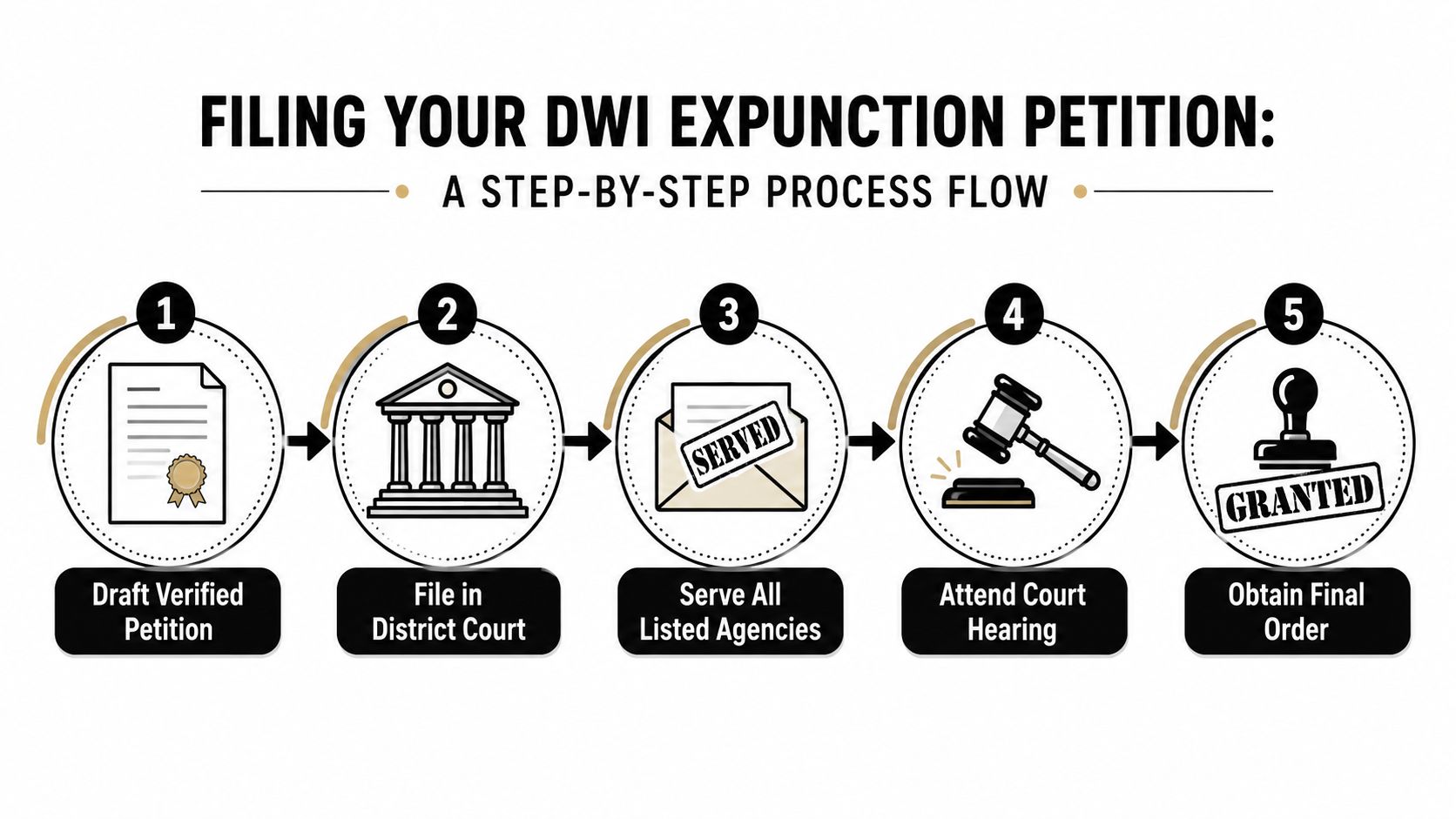
That is the process. It is manageable when the case qualifies and the petition is complete. It turns into a problem when people file too early, leave out an agency, or guess at facts instead of checking the record.
Texas DWI practice pages break this down in plain language, and that is the standard you should expect from your lawyer too. The goal is simple. File the petition correctly the first time.
Costs and Timelines You Should Expect
A Texas DWI expunction is not free, and it does not happen overnight. If you are planning around a job search, a license renewal, or a background check, you need a realistic schedule. I would rather clients hear that upfront than get surprised halfway through the process.
What the money side usually looks like
Court filing fees vary by county, and the total also changes with service costs and certified copies. Some Texas guides place filing costs in the low hundreds, while others put county-level costs higher depending on the court and the number of agencies that must be served (The Texas Trial Attorney). That spread tells you the same thing every time, the cost is county-specific and case-specific.
If you are trying to keep costs down, build a budget before you file. Even a simple expunction has real out-of-pocket expenses. If you hire a lawyer, you are also paying for careful drafting, correct agency notice, and a petition that matches the record the court will review.
The timeline is controlled and deliberate
The process starts with preparing and filing the petition, then the court sets a hearing after the required waiting period. Texas guidance says a hearing is typically set no earlier than 30 days after filing (McConathy Law). If the petition is contested, the case can take longer. After the judge signs the order, the agencies still need time to destroy or return the records they hold.
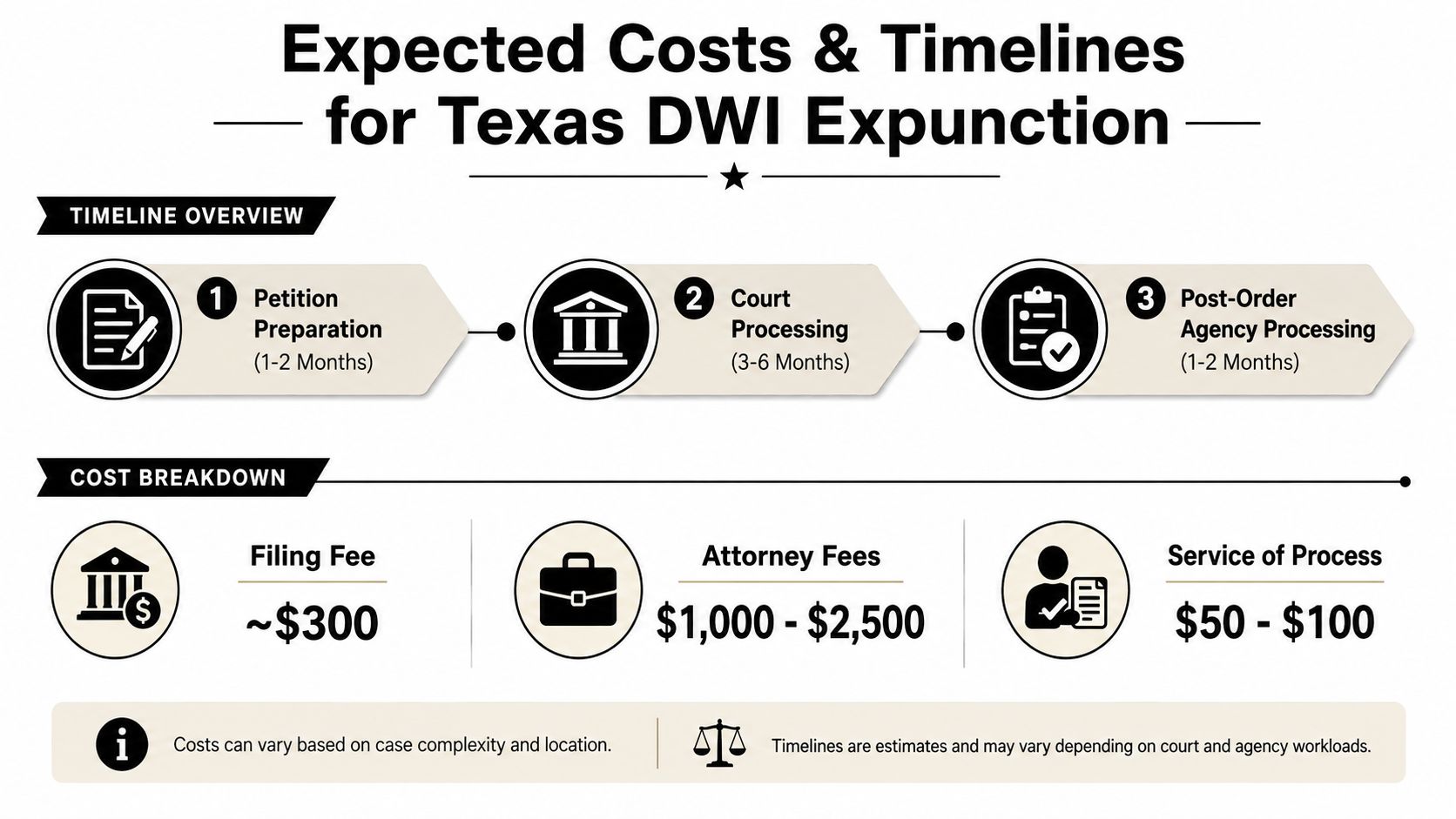
For a clear breakdown of the pacing and the steps after filing, the page on Texas DUI expungement timeline is a good companion. It gives you a practical sense of how the process moves before you start.
Bottom line: expunction works best when you plan for a process, not a quick fix.
Common Mistakes That Derail DWI Expunction Petitions
The usual mistakes are plain, and that is why they keep happening. People miss small details, and those details decide whether a Texas DWI expunction gets granted or stalls out. If you are trying to clear the record after a dismissal or acquittal, the paperwork has to be exact from the start.
The errors that cause avoidable problems
Filing in the wrong county is a common failure point. An expunction belongs in the county where the arrest happened, not wherever the filing seems easier. Leaving out an agency that holds the record is another mistake that causes trouble. If DPS, a city police department, or a court record holder is not named, the order will not reach every place that still has your arrest information.
Incomplete petitions cause problems too. Texas Chapter 55 requires specific details, and this is not the place to improvise. Dates, case numbers, arrest information, and agency names need to match the record exactly. If they do not, the court can reject the petition or slow the case down while the errors get fixed.
Expunction and nondisclosure are not interchangeable
People also ask for expunction when the case only qualifies for nondisclosure. That choice wastes time and usually leads to denial. If the case ended in a conviction or another result that blocks destruction of the record, the better route may be a nondisclosure filing instead. If the case was dismissed or you were acquitted, expunction may be available.
A lawyer who has handled DWI record relief denied in Texas cases knows this distinction matters. Denials often come from choosing the wrong remedy or filing the right remedy in the wrong way.
File the remedy that fits the outcome. If the case supports nondisclosure, file nondisclosure. If it supports expunction, file expunction.
Why a lawyer helps even in a “simple” case
People like to call expunction simple. The law is straightforward in the abstract, but the filing work is easy to mess up. A lawyer checks the agencies, matches the records, and keeps the petition tied to what the court will review. That kind of precision keeps a clean case from turning into a delayed one.
If you are still sorting out the underlying charge, the firm's first DWI in Texas resource gives a useful starting point on the penalties and the case path before you focus on clearing the record.
Take the Next Step Toward Clearing Your Record
If your DWI case was dismissed or you were acquitted, don't sit on that result and hope the record cleans itself up. It won't. The Texas DWI expunction process gives you a real path to erase qualifying arrests, but only if the petition is filed in the right court and the case fits the rules.
The hard part is usually not whether the process exists. It's deciding whether your case belongs in expunction or nondisclosure, then getting the paperwork right the first time. That's where experienced help matters, especially if your career, license, or background check is on the line.
The Law Office of Bryan Fagan, PLLC works with Texans facing DWI and DUI problems in Houston, Dallas-Fort Worth, Austin, and San Antonio, and that includes post-case record relief when the facts support it. If you need a clear answer about whether your record can be cleared, a free consultation is the smartest next step.
The Law Office of Bryan Fagan, PLLC can review your DWI dismissal, acquittal, or sealing options and help you map out the next move. If you're ready to fight DWI Texas problems and protect your future, visit Law Office of Bryan Fagan, PLLC to request a free consultation and get a case evaluation.