
In Texas, tampering with evidence means knowingly altering, destroying, or concealing a record or thing while knowing an investigation is pending, with intent to impair its use as evidence. The ordinary offense is a third-degree felony, but a missing file or deleted message doesn't automatically establish that crime.
You may be looking at your phone after a DWI arrest, wondering whether an old deleted text will cause another charge. Or you may have learned that the police recording of your stop is missing. Those situations raise different questions: Did someone intentionally interfere with evidence, or is the evidence incomplete or unreliable?
What Tampering with Evidence Means in Texas
A DWI arrest can be overwhelming, but you don't have to face it alone. When an officer or prosecutor mentions tampering, your attorney's first job is to identify the exact conduct being alleged, not assume that something missing proves wrongdoing.
Texas evidence-tampering law protects the investigation. It addresses interference with proof, separately from whether you drove while intoxicated.
Think of evidence as a witness that can't speak for itself. A recording, document, or sample communicates through what it contains. Intentionally hiding or changing it can prevent investigators from learning what really happened.
What Can Count as Evidence
A DWI investigation may involve much more than a breath-test result:
- Digital records: Phone texts, photographs, videos, dashcam files, and body-camera footage.
- Physical items: Receipts, bottles, clothing, or objects found in a vehicle.
- Testing records: Blood samples, breath-test files, laboratory documentation, and written reports.
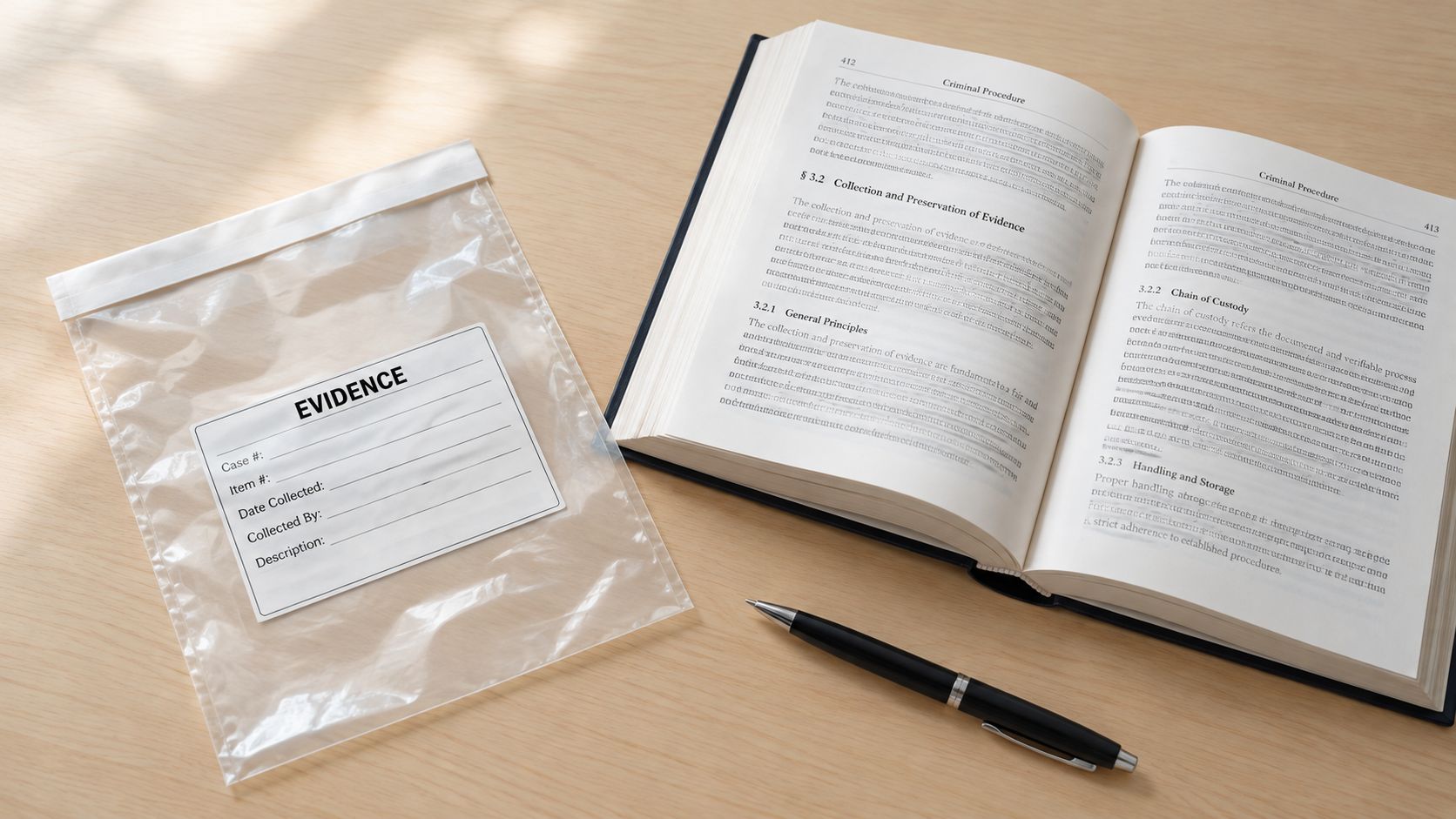
The preservation issue is illustrated below.
Losing Something Isn't the Same as Tampering
Suppose a driver deletes a crash video after learning officers want to review it, specifically to keep them from seeing what happened. That presents a different legal problem from a video lost during an ordinary phone upgrade.
The missing video alone doesn't explain who caused the loss, what that person knew, or why it happened. Your lawyer needs the timeline, device records, and surrounding communications.
Practical rule: Preserve potentially relevant material, even when you think it looks unfavorable. Let your attorney evaluate its meaning rather than trying to improve the record yourself.
Your defense should address the alleged act, the required mental state, the possible penalties, and the separate consequences for your criminal case and driving privileges.
The Three Things Prosecutors Must Prove
| Element | What the State Must Show | DWI Example |
|---|---|---|
| Knowledge | You knew an investigation or official proceeding was pending or underway | An officer tells you a crash is being investigated |
| Conduct | You altered, destroyed, or concealed a record, document, or thing | You erase a recording relevant to the stop |
| Intent | You acted to impair the item's truth, readability, or availability as evidence | You delete the recording to prevent investigators from reviewing it |
These requirements come from Texas Penal Code Section 37.09, which also addresses conduct after someone knows an offense has occurred when the purpose is to impair evidence in a later investigation.
Knowledge Depends on What You Understood
An officer's instructions, a traffic stop, or a request for evidence may help prosecutors argue that you knew an investigation existed. But the State must connect that knowledge to the time of the alleged act.
Say your phone automatically removed an old video before the stop. Learning afterward that police wanted the video doesn't establish that you knew about an investigation when it disappeared.
Conduct Requires More Than an Empty Folder
A prosecutor must identify what you allegedly did. Did you manually delete a file, hide a device, or change a document?
A missing file could instead reflect an incomplete download, a storage problem, or another person's actions. Device examination reports and access records can help distinguish those possibilities. The statute also separately addresses knowingly making, presenting, or using false evidence with the required purpose.
Intent Is the Purpose Behind the Act
Deleting a message deliberately isn't necessarily the same as deleting it to impair evidence. A person may intentionally clear storage without intending to interfere with an investigation.
Timing can strengthen or weaken either explanation. Deleting a recording immediately after an officer asks for it may support the prosecution's argument, while documented automatic retention settings may support the defense.
Your lawyer should test these questions:
- Knowledge: What proves you understood an investigation existed or knew an offense had occurred?
- Action: What establishes that you, rather than software or another person, changed the item?
- Purpose: What connects your action to an intent to interfere with evidence?
- Effect: Was the item hidden, altered, or made unavailable in the manner alleged?
If the State can't establish knowledge or intent, the disappearance of an item doesn't fill that gap.
Texas Penalties for Tampering with Evidence
The punishment depends on the felony classification. Under the Texas evidence-tampering statute, tampering is a third-degree felony under Section 37.09(a) or (d)(1). If the evidence is a human corpse, the offense is a second-degree felony. The general punishment ranges are:
| Offense Level | Prison Range | Maximum Fine | When It Applies |
|---|---|---|---|
| Third-degree felony | 2 to 10 years | Up to $10,000 | Tampering under subsection (a) or (d)(1) of Section 37.09 |
| Second-degree felony | 2 to 20 years | Up to $10,000 | When the item tampered with is a human corpse |
What the Felony Classification Means
A tampering charge may be filed alongside a DWI charge. Each is a separate offense, so the prosecution must prove the elements of both, and each can carry its own punishment exposure.
The DWI's classification matters too. Your prior record, the circumstances of the driving, and other case-specific facts shape the punishment analysis. A tampering charge does not replace that separate review.
A felony conviction can have effects beyond the courtroom:
- Criminal history: The conviction can become part of your public record.
- Employment and licensing: Employers and professional boards may consider it.
- Firearm rights: Federal restrictions may apply after a felony conviction.
- Release and supervision: Additional allegations can affect bond conditions and sentencing options.
The consequences depend on the person and the case. Before deciding whether to plead, your lawyer should consider your work, professional licenses, immigration concerns, and prior history.
A Charge Doesn't Determine the Outcome
Prosecutors may reduce or dismiss a charge when the available records do not support the required knowledge, conduct, or intent. In Texas, whether felony community supervision is available depends on statutory eligibility, the offense and its facts, and the defendant's criminal history. Eligibility is not automatic, so counsel must review those factors in the specific case.
The statute also protects certain concealed material that is privileged or constitutes party work product. Counsel can assess whether that protection applies. It is not permission to hide documents.
A careful review can identify favorable records, test other explanations, and clarify available resolutions. No lawyer can promise a dismissal, and the charging decision is only one part of the case's outcome.
How Evidence Tampering Changes Your DWI Case and License Hearing
A DWI arrest can lead to two separate proceedings: a criminal case and a civil license case. They may involve some of the same records, but each asks different questions. Understanding that difference helps you see why a missing file, a test refusal, or a tampering accusation must be evaluated in context.
Implied consent means Texas law treats driving as consent to specified breath or blood testing after a lawful arrest under applicable conditions. BAC, or blood alcohol concentration, is the alcohol level reported through breath or blood testing. An administrative license suspension is a civil action affecting driving privileges, separate from the criminal prosecution.
Separate Proceedings Need Separate Attention
Under the Texas DPS Administrative License Revocation program, a non-commercial driver may face suspension for refusing or failing to complete testing, or for a BAC of 0.08% or more. The stated threshold for a commercial motor vehicle is 0.04% or more. DPS generally allows 15 days after the suspension notice to request a hearing. Without a request, suspension takes effect on the 40th day after service.
Where a tampering allegation shows up in a DWI matter
| Proceeding | What It Decides | How a Tampering Issue Appears |
|---|---|---|
| Criminal DWI case | Guilt or innocence on the DWI and any added tampering charge | Prosecutors may argue deletion suggests consciousness of guilt; the defense examines knowledge and intent |
| ALR hearing | Whether your driving privileges stay suspended | Missing test files or unclear sample handling may raise reliability questions |
| Test refusal record | Whether you refused or failed to complete testing | The refusal may affect licensing and may also be offered in the criminal case |
| Video or phone records | Whether a file was preserved and is authentic | Missing, altered, or incomplete files may support an admissibility or weight challenge |
An ALR hearing does not decide guilt on the DWI or tampering charge. It addresses the license suspension, while the criminal court considers the charges. Coordinated review matters because the same record may raise different questions in each proceeding.
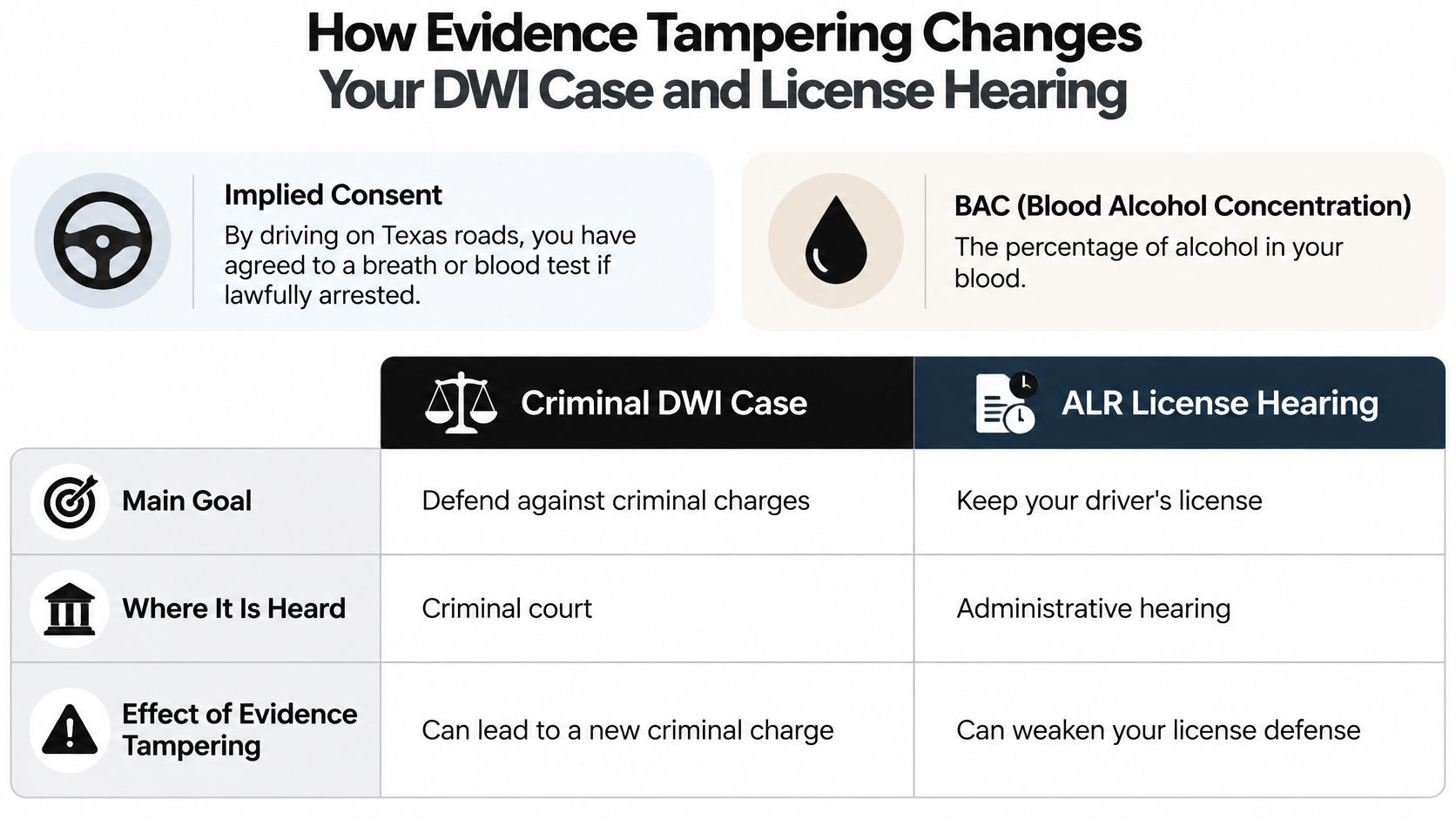
A missing dashcam file or a broken chain of custody may raise a reliability issue for the defense. That alone does not show that you intentionally destroyed or altered evidence. For example, if a breath-test export is incomplete, your attorney can compare the available records with the original record and assess whether they support the reported result. That inquiry is different from an accusation that you deleted the file.
A test refusal raises its own questions, including whether the officer properly requested testing and documented your response. It may affect the license proceeding and may also be offered in the criminal case, but it is not the same issue as whether someone intentionally altered or concealed evidence.
The firm's guide to DWI administrative penalties explains the licensing consequences. What Is an ALR Hearing in Texas? describes how the civil suspension case differs from the criminal DWI case.
If this is your first DWI in Texas, the criminal court will not automatically address your license. Give your attorney every notice you received so both proceedings can be evaluated promptly.
What Happens After a Texas DWI Arrest, Step by Step
The exact sequence can vary, especially when laboratory testing or a warrant is involved. These are the main stages you should prepare for.
Roadside investigation. A field sobriety test assesses coordination or eye movement, not chemical BAC. A Texas appellate opinion discusses horizontal gaze nystagmus, Romberg, and one-leg-stand testing, and explains that DWI can be proved through loss of normal physical or mental faculties without a numeric BAC result.
Chemical testing. After arrest, officers may request breath or blood testing under the applicable legal procedures. Tell your lawyer what warnings you received, what you answered, and whether officers obtained a warrant.
Booking and bond. Bond and release conditions govern your release while the case is pending. Ask counsel to review restrictions, testing requirements, and court dates before an accidental violation creates another problem.
License-hearing request. Give your lawyer the suspension notice immediately. The firm's ALR deadline guide addresses why prompt action matters.
Arraignment and discovery. Counsel addresses the charge and obtains available evidence. The Texas DWI discovery process may involve recordings, laboratory files, reports, and maintenance records.
Pretrial defense. Your attorney evaluates suppression motions, evidentiary objections, and negotiations. A plea offer should be assessed against the actual proof and consequences, not just the desire to finish quickly.
Resolution. The case may end through dismissal, plea, or trial. If it's dismissed, ask whether you qualify for expunction; dismissal alone doesn't automatically erase the record.
Your Role Throughout the Process
Keep notices, attend required appearances, and preserve potential evidence. A written timeline and organized documents help your attorney act on facts rather than incomplete memories.
Common Situations That Lead to Tampering Accusations
A driver arrives home after a stop and clears a message thread. Another driver opens a cloud account and discovers that videos have disappeared without any recent manual deletion. Both situations involve missing material, but they don't establish the same conduct or purpose.
Phone Changes and Actions at the Scene
- Deleting texts, photos, or videos: Say you remove a crash recording after officers request it. The central question is whether you acted to prevent its use, rather than whether the delete button was pressed.
- Pouring out or hiding a bottle: A passenger sees you empty an open container during a stop. Counsel must examine what you knew and whether you were trying to impair evidence connected to the investigation.
- Breaking or hiding a phone: A phone falls and shatters during an argument. Was that an accident, an unrelated act, or a deliberate effort to keep officers from obtaining relevant information?
- Cleaning the vehicle: You discard items before officers document the car. The timing and reason matter, including whether this was ordinary cleanup or an attempt to remove evidence.
Asking a passenger to claim they were driving creates a different concern. A false verbal account isn't automatically physical-evidence tampering, although it may create other legal exposure. Creating or submitting a false written statement requires its own statutory analysis.
Don't ask anyone to coordinate stories. Preserve the actual communications and let your lawyer address discrepancies.
When the Problem Belongs to the Evidence System
Suppose an agency overwrites dashcam footage under its retention settings. The defense should investigate the retention policy, preservation requests, backups, and export history. The agency's missing recording isn't proof that you destroyed anything.
A blood sample presents another example. A mislabeled vial or an unexplained custody interval raises questions about identity and handling. Storage delays may require scientific review, but they don't establish that the accused manipulated the sample.
A sample that may be unreliable and a person accused of intentionally changing evidence present different legal questions.
Automatic cloud deletion, routine phone behavior, and failed file exports also deserve examination before anyone assigns intent. Forensic software may reveal whether a user deleted something, a synchronization setting removed it, or an export left it out.
Every scenario turns on details that a short accusation leaves out. Bring the device, notices, and available records to counsel without editing or reorganizing the original material.
How to Challenge a Tampering Accusation in Court
The strongest defense isn't always a technical attack. Often, counsel starts with the basic allegation: What evidence shows that you knew about an investigation and acted to interfere with it?
Your lawyer should pair each disputed element with records that can answer that question. A general denial is less useful than a documented explanation.
Challenge Knowledge With a Reliable Timeline
An attorney may compare dispatch records, body-camera timestamps, messages, and device activity. The objective is to establish what happened before you learned of the investigation.
For example, a routine deletion recorded before police contact may undermine the State's timing theory. But counsel must also consider whether you already knew an offense had occurred and acted to affect an anticipated investigation.
Challenge Intent With Device and Account Records
Automatic deletion settings, storage warnings, repair documentation, and cloud synchronization logs can help explain an apparently suspicious loss. A forensic examiner may distinguish a user command from system behavior.
Don't change those settings to demonstrate your explanation. Preserve the device in its existing condition and let counsel arrange an appropriate examination.
Examine Whether the Alleged Conduct Impaired Evidence
Your lawyer should look for backups, recipient copies, original attachments, and recoverable files. If the material remained readable and available, that may undermine the prosecution's account of concealment or destruction.
Recovery isn't an automatic defense, however. The exact act, statutory subsection, and surrounding facts still matter.
Useful requests include:
- Original material: Native files rather than screenshots or edited clips.
- Recovery records: What investigators restored, from where, and in what condition.
- Access history: Who could modify the file or account.
- Transfer documentation: How each copy moved between custodians.
Challenge Authenticity Separately From Intent
A cryptographic hash functions as a file-level digital fingerprint. Comparing hashes can help determine whether a produced file matches the copy preserved at acquisition.
A mismatch doesn't establish intentional tampering. Conversion, corruption, metadata changes, or an incomplete copy may explain it. Conversely, a matching hash doesn't establish lawful seizure, complete collection, or correct interpretation.
The National Institute of Justice's chain-of-custody guidance explains that custody problems can affect exclusion or evidentiary weight. Counsel should request handler identities, transfer records, acquisition information, access logs, and the preserved original.
For chemical testing, the blood-draw chain-of-custody challenge guide addresses the handling issues that deserve review. Your lawyer may also examine breath-device calibration, maintenance history, test logs, and laboratory audit trails.
Evaluate Lawful Collection and Courtroom Remedies
A motion to suppress can challenge evidence obtained through an unlawful stop, arrest, or search. An authenticity objection asks a different question: whether the offered item is adequately established as what its proponent claims.
Roadside observations also deserve scrutiny. Instructions, lighting, surface conditions, medical limitations, and the officer's recorded observations may affect how much confidence a court should place in field testing.
Exclusion isn't guaranteed whenever a record is incomplete. Sometimes the appropriate response is cross-examination or an argument that the evidence deserves less weight. Early review helps counsel choose the remedy supported by the actual records.
Protect Your Case With a Free Consultation Today
You don't need to solve the evidence questions yourself before speaking with a lawyer. You need to prevent avoidable losses, preserve your options, and provide an accurate account of what happened.
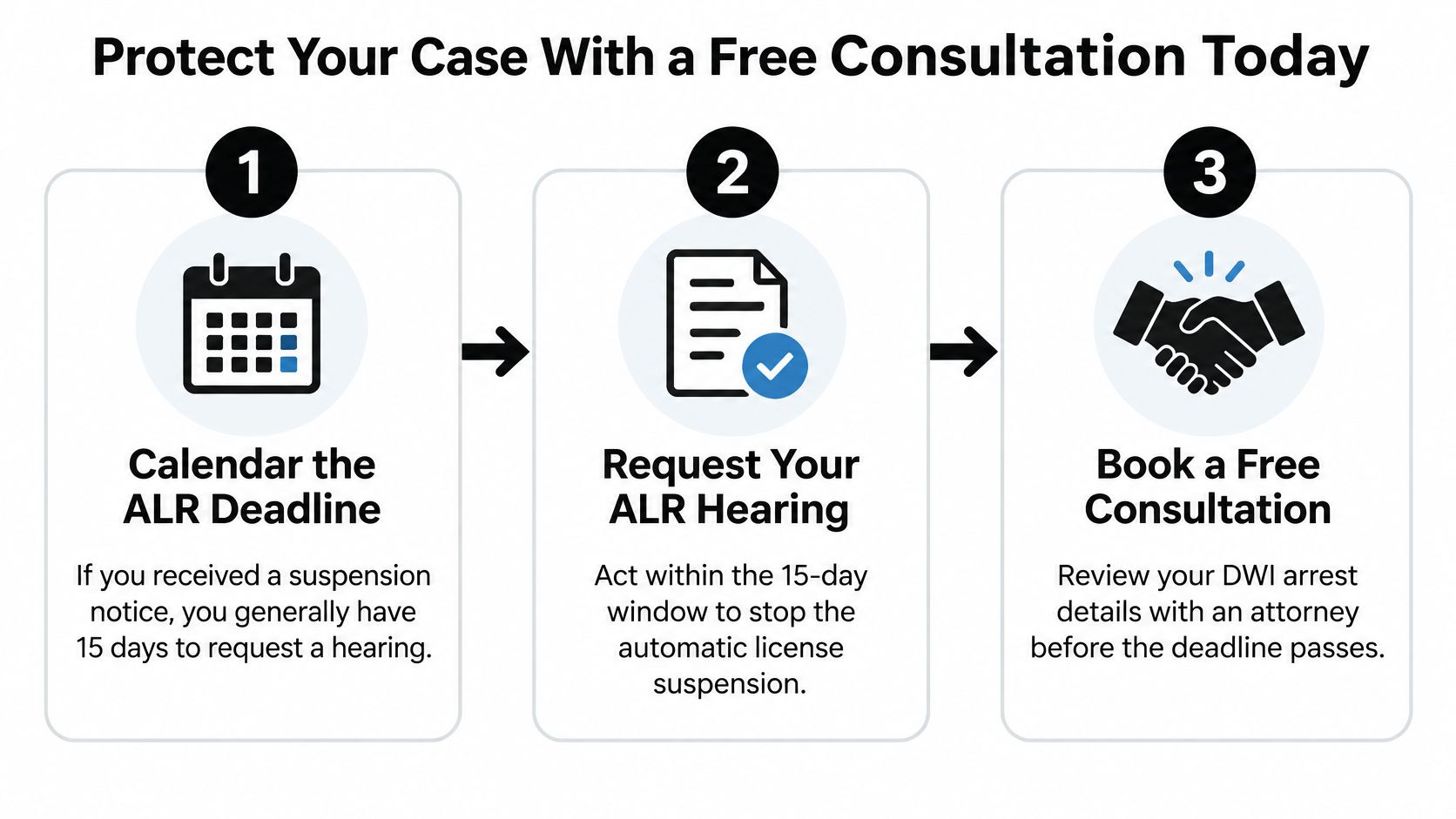
This visual outlines the immediate priorities after an arrest and suspension notice.
Take These Actions Before Changing Anything
Calendar your license deadline. Keep the suspension notice and record when it was served. Ask counsel to confirm the hearing-request deadline immediately, rather than waiting for your criminal court date.
Preserve your phone, cloud account, and vehicle records. Don't delete, reset, repair, or discard potentially relevant material without legal guidance. Keep unfavorable material too, because its context may matter.
Write a private timeline for counsel. Record the stop, testing requests, arrest, calls, messages, and any device problems while your memory is fresh. Separate what you personally remember from what someone later told you.
Limit discussions about the facts. Don't explain the case on social media or ask friends to contact witnesses. Speak with counsel before giving investigators a substantive statement.
Identify records for your attorney to obtain. These may include arrest reports, recordings, chemical-test logs, laboratory custody records, and phone extraction reports. Counsel can also consider preservation requests before routine retention periods cause additional loss.
Request a free consultation. Bring charging papers, bond conditions, suspension notices, and your account of the alleged deletion or loss. You don't need a complete case file to start.
Get Advice That Connects Both Cases
Whether you need a Houston DWI lawyer or a Texas DUI attorney elsewhere in the state, ask how counsel will coordinate the criminal defense with the DWI license suspension matter. If you're searching “fight DWI Texas,” focus on a concrete plan for reviewing the stop, testing, preservation history, and alleged intent.
Our team serves Houston, Dallas–Fort Worth, Austin, San Antonio, and surrounding communities, with free consultations and around-the-clock support. Representation can include first-offense defense, administrative hearings, trial preparation, and evaluation of expunction eligibility when appropriate.
The video below offers another resource as you prepare to discuss your case.
A missing recording or deleted message deserves investigation, not assumptions. Getting advice promptly lets you address the allegation without trying to explain, recover, or alter evidence on your own.
The Law Office of Bryan Fagan, PLLC offers free consultations for Texans facing DWI charges and related tampering with evidence allegations, including review of preservation problems and license-hearing concerns. Visit Law Office of Bryan Fagan, PLLC to request a free case evaluation and discuss a practical defense plan with a team that serves your community.
