
A DWI arrest can be overwhelming, especially when you're already carrying the stress of a prior case. You may be wondering whether you'll go to jail, how you'll get to work, and whether the State has already decided what happens next. You don't have to face those questions alone.
Texas law generally calls this offense DWI, or driving while intoxicated, even though many people search for “second DUI Texas.” A second DWI usually brings more serious criminal exposure than a first DWI in Texas, but an arrest is not a conviction. The State still has to prove its case, and your lawyer can challenge both the evidence and the procedures used against you.
The most important point is that you're facing two separate tracks. The criminal case concerns guilt and punishment. The administrative license case, called an ALR proceeding, concerns whether the Texas Department of Public Safety can suspend your driving privileges based on a refusal or chemical-test result. Those tracks run on different clocks, so protecting your rights requires action on both.
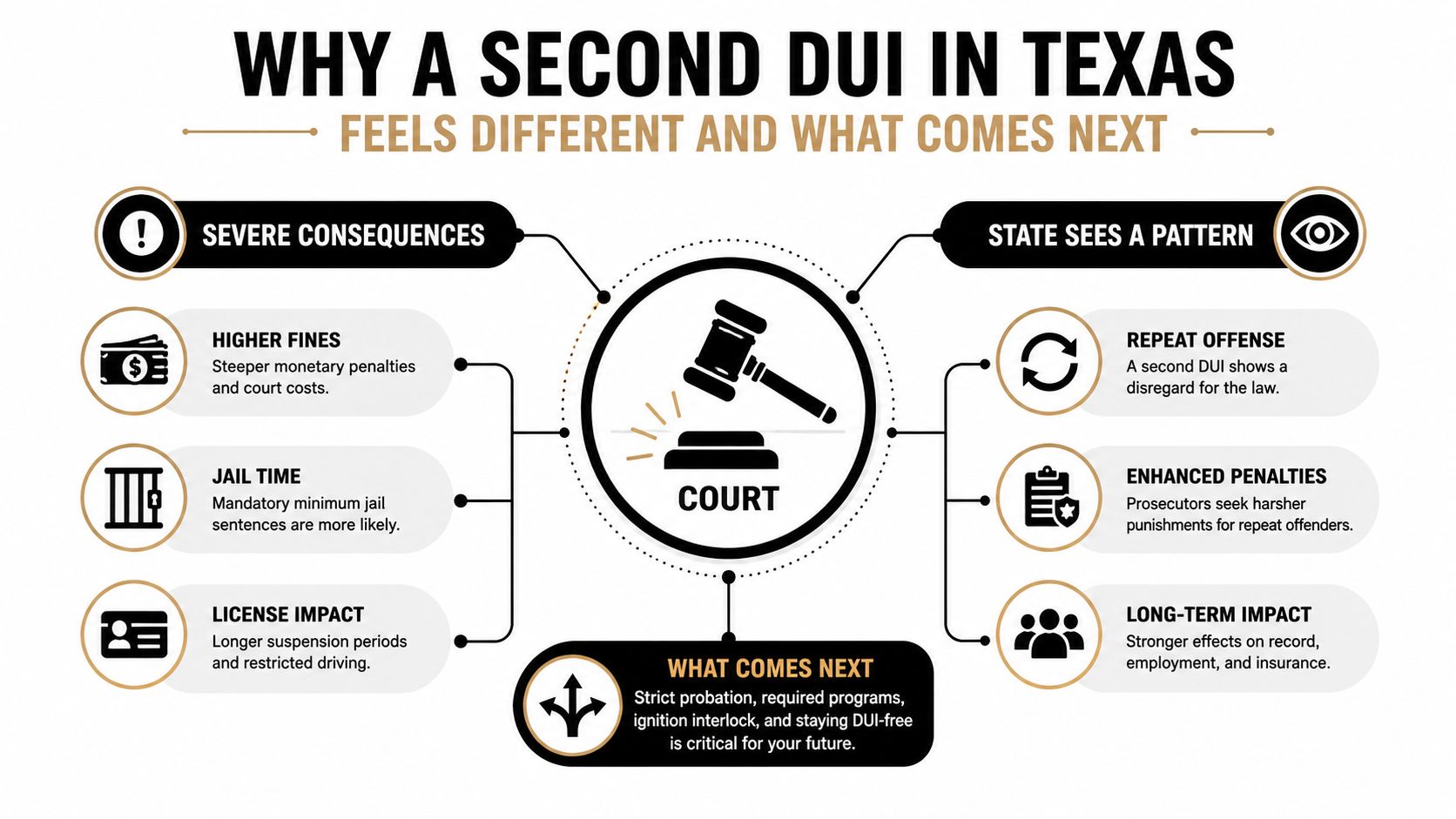
Why a Second DUI in Texas Feels Different and What Comes Next
After a second-offense arrest, the first call you may receive could concern bond, court, or your driver's license. Those matters are connected, but they aren't the same case. Texas generally treats a second DWI as a Class A misdemeanor, and the prior conviction can change the State's approach from a first-offense investigation to a repeat-offense prosecution.
That doesn't mean the outcome is automatic. The State still must establish that the stop was lawful, the arrest was supported by probable cause, the testing was reliable, and the prior conviction legally belongs in the new case. Counsel should also examine whether the charging document accurately identifies the alleged prior offense. The details can affect the charge, negotiations, and sentencing exposure.
The two clocks begin after arrest
The criminal case moves through bond, court settings, discovery, negotiations, motions, and possibly trial. The ALR case can move forward even if prosecutors haven't filed or resolved the criminal charge. Texas DPS says an ALR matter may arise when a driver refuses a breath or blood specimen or provides a specimen showing a BAC of 0.08% or more in a non-commercial vehicle, as explained in its Administrative License Revocation program guidance.
You generally have only 15 days from notice to request an ALR hearing. That deadline matters because the hearing can provide an opportunity to challenge the suspension before the license consequence becomes final. Missing it can remove an important defense opportunity.
Start by preserving paperwork, identifying the exact prior conviction alleged, and writing down what happened while the memory is fresh. A careful review of the Texas DWI lookback period and prior-offense rules can also help counsel determine whether the State is using the correct conviction for enhancement.
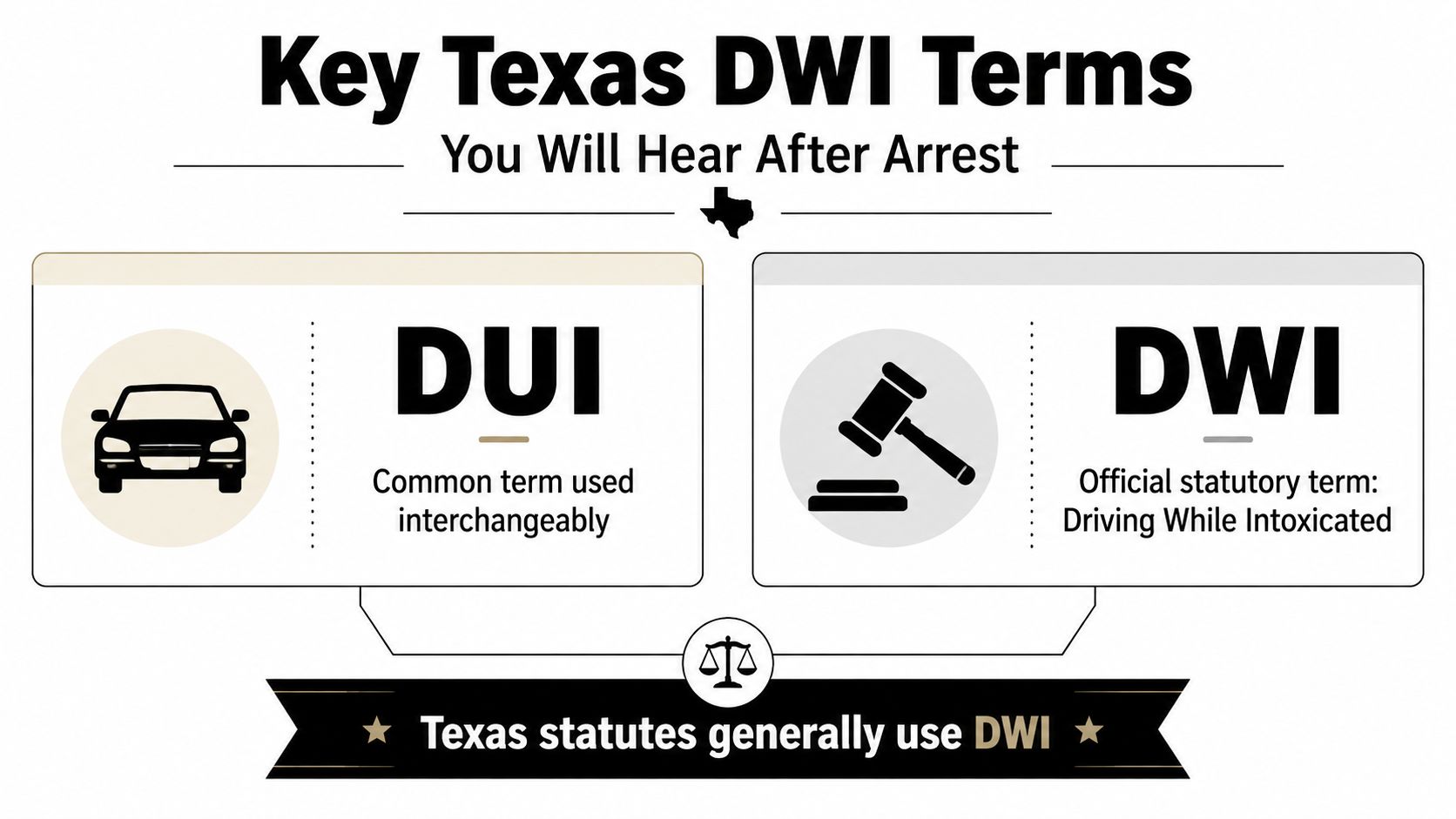
Key Texas DWI Terms You Will Hear After Arrest
People often use DUI and DWI as if they mean different Texas charges. In ordinary conversation, they're often interchangeable. Texas statutes generally use DWI, meaning driving while intoxicated. Intoxication may involve alcohol concentration, a loss of normal mental or physical faculties, or both.
BAC and implied consent
BAC, or blood alcohol concentration, refers to the amount of alcohol shown in a breath or blood specimen. For an ordinary non-commercial driver, Texas DPS identifies 0.08% or more as a basis for an ALR case when the other legal requirements are met, according to its ALR program explanation.
Implied consent means that driving in Texas carries a legal consent to chemical testing when law enforcement suspects intoxication. The Texas Impaired Driving Task Force explains that this rule applies to all Texas drivers and can make a refusal or failed test lead to administrative consequences through the Texas DWI laws and consequences overview. A refusal doesn't decide the criminal case by itself, but it can create a separate license issue.
Stops, probable cause, and field sobriety tests
A stop is the initial detention. The officer generally needs reasonable suspicion, based on specific facts rather than a bare hunch, to detain you. Probable cause is a stronger legal standard used for an arrest and usually requires facts supporting a reasonable belief that an offense occurred.
A field sobriety test, or FST, consists of divided-attention exercises officers may use to develop probable cause. Road conditions, footwear, weather, lighting, health conditions, and the instructions given can all matter. You should also understand that the roadside request itself usually doesn't create a separate criminal charge because you decline to perform the exercises.
The ALR proceeding is civil and administrative, not a criminal trial. It focuses on whether the requirements for a license suspension were met after an arrest involving a test result, refusal, or both. Drivers under 21 can face separate alcohol-related rules, and the Underage DWI and DUI in Texas resource addresses how Texas handles those offenses.
Criminal Penalties for a Second DWI in Texas
For a straight second DWI with no felony trigger, Texas generally treats the charge as a Class A misdemeanor. The current penalty framework provides 30 days to one year in county jail, a fine of up to $4,000, and a driver's license suspension that can last 180 days to two years, according to Texas guidance on impaired-driving laws and penalties.
| Issue | General Range or Consequence |
|---|---|
| Offense level | Generally a Class A misdemeanor |
| County jail | 30 days to one year |
| Fine | Up to $4,000 |
| License suspension | 180 days to two years |
Those figures describe legal exposure, not a guaranteed sentence. A judge may consider the evidence, your record, the circumstances of the arrest, and the terms of any negotiated resolution. A defense attorney may pursue community supervision, structured conditions, treatment-based options, or a reduced allegation when the facts and county practices allow it.
Why the prior conviction matters
The State must prove every element beyond a reasonable doubt. In a second DWI case, that can include proving the identity and validity of the alleged prior conviction. Counsel should review the judgment, charging documents, plea paperwork, and records showing whether the prior offense qualifies under Texas law.
The criminal case may also involve a court-ordered license consequence separate from ALR. Texas DPS materials describe a second DWI conviction as capable of producing a one-year administrative suspension when no court-ordered suspension is imposed, with the suspension beginning seven days after conviction, as shown in the Texas DPS driver-license enforcement chart. The exact interaction of court orders, DPS action, and any ALR suspension requires a case-specific review.
A second offense can become more serious if the allegation involves a child passenger, serious bodily injury, death, a prior felony DWI, or enough qualifying convictions to create a felony charge. Those facts must be analyzed before anyone can responsibly estimate your exposure.
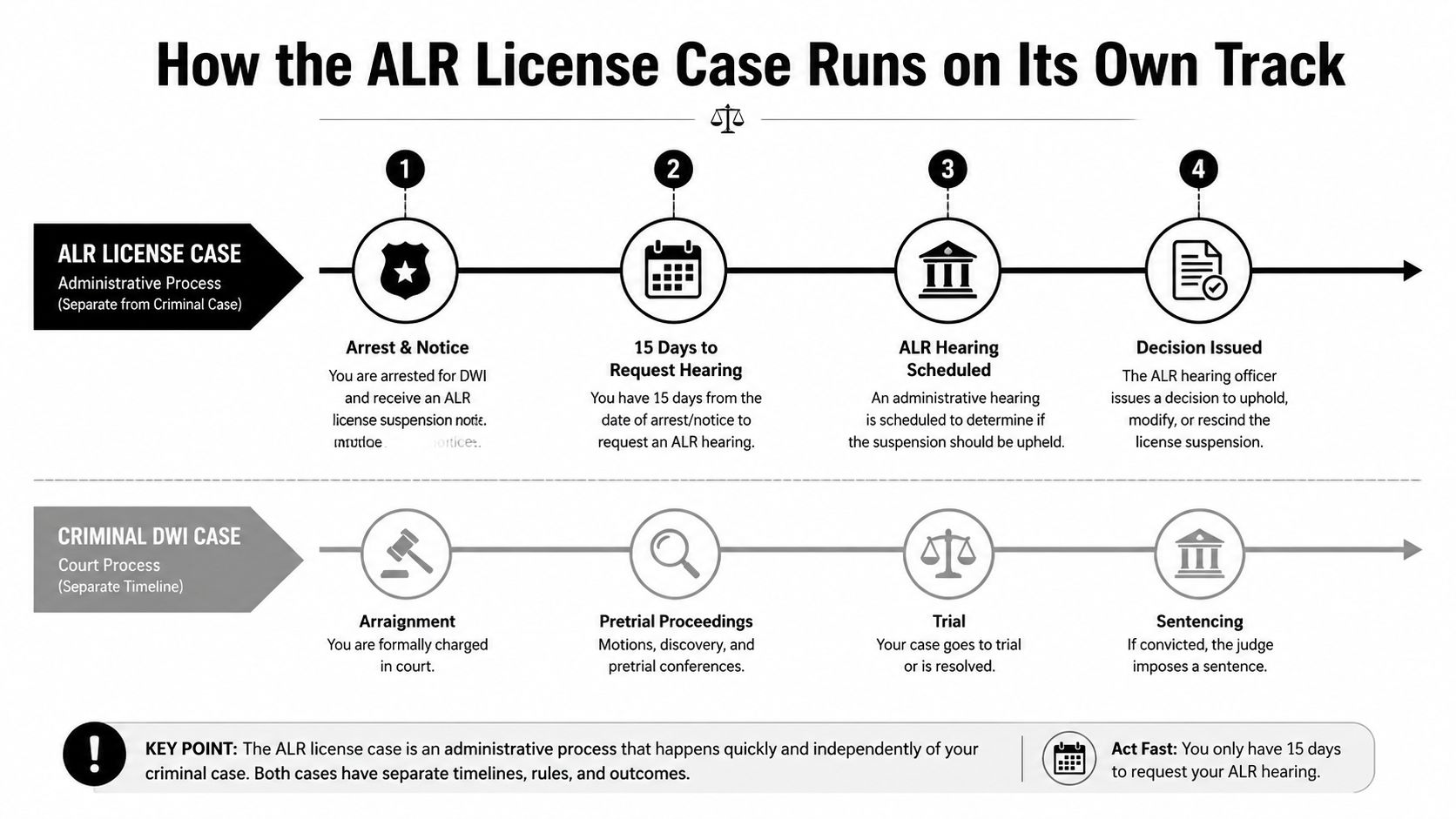
How the ALR License Case Runs on Its Own Track
The ALR case starts with the arrest-related paperwork, not with a criminal conviction. An officer may submit a sworn report, and DPS may issue notice that your license is subject to suspension. The notice should be reviewed immediately because it identifies the deadline and the basis for the proposed action.
You generally have 15 days from notice to request an ALR hearing. Texas DPS states that, after a prior alcohol-related enforcement contact, the ALR process can lead to up to a two-year suspension when a driver refuses or fails a chemical test, according to its Administrative License Revocation program guidance.
The administrative timeline
The process commonly follows this sequence:
- Arrest and notice. The officer documents the alleged refusal or test result, and DPS provides notice of the proposed suspension.
- Hearing request. Your request must be received within the applicable deadline. A late request can forfeit the opportunity to contest the suspension.
- ALR hearing. The hearing examines issues such as whether the officer had grounds to request testing, whether a refusal or qualifying result occurred, and whether the required procedures were followed.
- Decision. The hearing officer decides whether the administrative suspension should take effect.
The criminal court doesn't decide the ALR case, and winning the ALR hearing doesn't automatically dismiss the criminal charge. Still, the hearing can expose weaknesses in the officer's report, testing foundation, or probable-cause theory. A detailed explanation of the process appears in this guide to Texas ALR hearings.
Calendar rule: Treat the ALR deadline as an urgent legal deadline, not as paperwork you can handle after the first court setting.
Your lawyer should map both calendars at the beginning. One calendar tracks criminal court, bond conditions, discovery, and motions. The other tracks the DPS notice, hearing request, suspension decision, and driving options. That parallel review is often more useful than focusing only on the headline criminal penalty.
When a Second DWI Becomes a Felony in Texas
A second DWI isn't automatically a felony. The charge can cross into felony territory when additional facts change the offense level. Think of these facts as a decision tree. First, identify the alleged aggravating circumstance. Then determine whether it changes the charge, the potential sentence, the fine, or the license consequences.
| Trigger | Offense Level | Sentence Range | License Impact |
|---|---|---|---|
| DWI with a child passenger under 15 | State-jail felony | Felony exposure applies | Felony-related suspension consequences may apply |
| Intoxication assault causing serious bodily injury | Third-degree felony | Felony sentencing exposure applies | Suspension may extend beyond the ordinary misdemeanor track |
| Intoxication manslaughter | Second-degree felony | Felony sentencing exposure applies | Serious felony license consequences may apply |
| Prior felony DWI | Felony repeat-offender treatment may apply | Exposure depends on the applicable felony provision | May involve extended or additional revocation |
| Two prior DWI convictions | Third-degree felony for the new DWI | Felony sentencing exposure applies | Felony license consequences may apply |
The exact punishment depends on the charging statute and facts. A child passenger allegation is different from an injury allegation, and an injury allegation is different from a death allegation. The State must still prove the required elements, including the facts that create the felony classification.
Questions that should be answered early
Ask whether anyone under 15 was in the vehicle, whether another person suffered serious bodily injury, whether a death is alleged, and whether any prior DWI conviction was itself a felony. Also ask how many qualifying prior convictions the State is relying on and whether the records identify you as the person convicted.
Do not assume that a prosecutor's initial classification is the final answer. Defense counsel can inspect the indictment or information, prior judgments, accident evidence, medical records, and testing evidence. If a felony trigger is unsupported, the defense may challenge the allegation and seek a different case posture.
Defense Strategies That Target the Stop and the Evidence
A strong defense begins with the first moment of police contact. Suppose an officer claims you crossed a lane line, but the dashcam timing or video doesn't match the alleged violation. That discrepancy may support a challenge to reasonable suspicion and, depending on the court's ruling, a request to suppress evidence gathered after the stop.
The same careful review applies to field sobriety testing. If the exercises occurred on uneven pavement, in rain, near heavy traffic, or without clear instructions, the test results may not mean what the officer says they mean. Balance problems can also have causes unrelated to intoxication, including footwear, medical conditions, fatigue, or the environment.
Chemical testing requires technical scrutiny
A breath result isn't self-proving. Counsel may request records concerning the machine, maintenance, calibration, operator procedures, and observation period. For example, a possible radio-frequency interference issue or a gap in the required observation process can create questions about reliability and admissibility.
Blood evidence has its own vulnerabilities. The defense may examine who collected the sample, how it was labeled, where it was stored, who transported it, and whether the laboratory documentation supports an unbroken chain of custody. Contamination concerns, collection errors, or gaps in the records can affect the weight of the evidence and sometimes support exclusion.
The two-track strategy
The ALR hearing can create an earlier setting to test the officer's account. A lawyer may use hearing testimony and documents to identify contradictions that also matter in the criminal case. That doesn't guarantee a particular result, but it can improve the defense's understanding of the State's evidence and negotiating position.
A focused review of when DWI evidence can be suppressed helps explain why the defense must investigate the stop, testing, and collection process rather than argue that the result is unfair.
Defense focus: The question isn't whether an officer wrote that you appeared intoxicated. The question is whether the State can prove each step with legally admissible, reliable evidence.
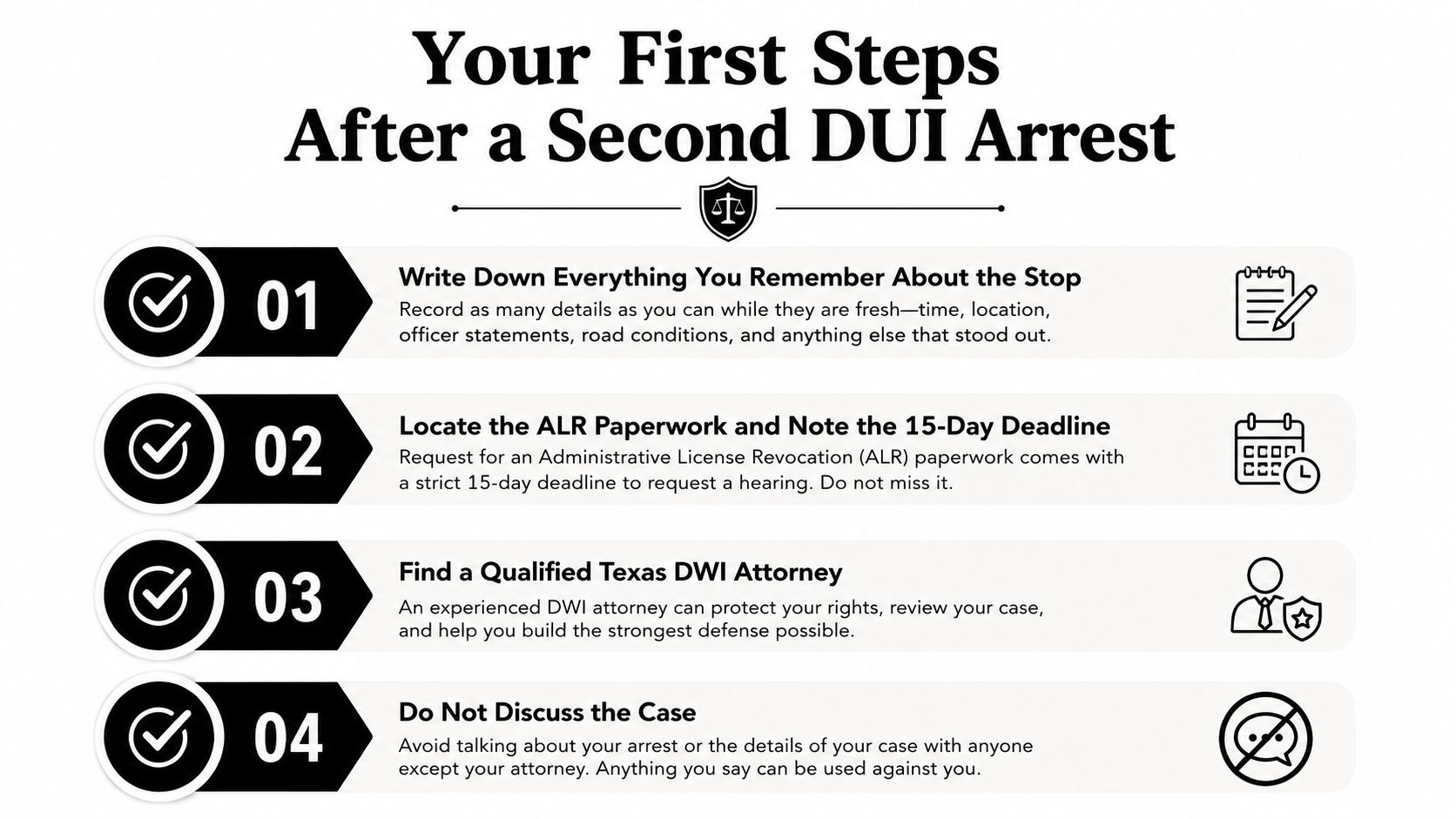
Your First Steps After a Second DUI Arrest
The first days after arrest should be calm and organized. Every action protects one of the two parallel cases, either the criminal prosecution or the ALR license matter.
- Write down the stop. Record where the officer contacted you, what was said, the lighting and weather, road conditions, tests performed, and whether you were injured or ill. Memory fades, and small details can guide video and witness searches.
- Find the ALR paperwork. Locate the notice, identify the proposed suspension, and calendar the 15-day hearing-request deadline. Contact counsel immediately if you aren't sure when notice was served.
- Preserve evidence. Keep tow, jail, medical, repair, and employment records. Don't delete texts or videos, and don't edit recordings.
- Stay silent publicly. Avoid social media posts, screenshots, group messages, and casual explanations to friends. Prosecutors may use statements outside the courtroom.
- Calendar every obligation. Track bond conditions, court dates, interlock requirements, and license deadlines. Missing a condition can create a separate problem.
- Gather the prior case file. Bring prior judgments, probation paperwork, and license documents to your attorney so the enhancement can be evaluated accurately.
Don't contact prosecutors to explain your side before you have counsel. A well-intended conversation can create statements that are difficult to take back.
How a Texas DWI Attorney Protects Your Future
A second DWI case becomes more manageable when counsel takes control of both timelines early. The attorney can protect the ALR deadline, request the hearing, and examine whether the officer's sworn report supports the proposed license action. That work addresses the immediate driving issue while the criminal defense develops.
On the criminal side, counsel can review dashcam and body-camera footage, test the legality of the stop, analyze field sobriety instructions, and request breath-machine maintenance or calibration records. If blood was drawn, the review should include collection procedures, laboratory testing, storage, and chain of custody. The attorney should also verify that the alleged prior conviction qualifies and belongs to you.
Negotiation is another part of the defense. Depending on the evidence, county, record, and circumstances, counsel may pursue reduced charges, treatment-based sentencing, community supervision, or other lawful alternatives. If the State's evidence is weak, litigation through suppression motions or trial may be appropriate.
The Law Office of Bryan Fagan, PLLC handles Texas DWI defense, ALR matters, and related criminal cases, with attorneys serving Houston, Dallas-Fort Worth, Austin, San Antonio, and surrounding counties. If you're searching for a Houston DWI lawyer, a Texas DUI attorney, or guidance on how to fight DWI Texas, a confidential case evaluation can help clarify your options.
The Law Office of Bryan Fagan, PLLC offers free consultations to discuss the criminal case, the ALR license track, and the evidence supporting a second DWI charge. Contact the firm today to protect the 15-day hearing deadline and speak with a Texas DWI defense team about your next step.