
A DWI arrest can be overwhelming, but you don't have to face it alone. You may be holding a ticket, a test printout, and a notice about your license, all at once. The later number feels final. It isn't the only question a Texas court has to answer.
The gap between driving and testing is the core of a rising blood alcohol defense. NHTSA explains that alcohol is absorbed through the stomach and small intestine before it enters the bloodstream, and its materials state that alcohol can generally be measured within about 30 to 70 minutes after you drink. NHTSA also identifies 0.08 g/dL as the national threshold for alcohol-impaired driving. A later result at or above that line does not, by itself, prove your exact level at an earlier minute.
Why a Rising Blood Alcohol Defense Matters After a Texas DWI Arrest
You were stopped. You answered questions. You may have tried a field sobriety test, the roadside set of balance and eye exercises officers use as clues of impairment. Then came the wait for transport, booking, and a breath or blood test. By the time a number appeared, the night already felt decided.
That feeling is common, and it skips the legally relevant minute. The rising blood alcohol defense is a timing argument. It asks what your BAC (blood alcohol concentration) was while you were operating the vehicle, not only what a later test reported. Your case lives in that gap.
The same clock, different lives
A first arrest, a commercial license, a teenager's permit, a professional credential, or a rental car on a work trip can all turn on minutes. None of those situations shares one absorption rate. A Texas DUI attorney can look at your last drink, your meal, the stop, and the test before anyone treats the printout as the whole story.
What you can pin down
You can sort the science of absorption from the math of back-calculation. You can see which records build a timeline and which assumptions make that timeline weak. You can also see how prosecutors answer the argument, and how a license hearing and a criminal case use the same facts on different deadlines.
If this is a first DWI in Texas, the useful move is a clear timeline, not a guess. You can still fight DWI Texas charges by testing whether the State proved the concentration at the moment of driving.
A later test is a picture of a later minute. Your driving happened earlier.
What the Rising Blood Alcohol Defense Actually Argues
Picture a bathtub that is still filling. A mark you take an hour later does not tell you the water level when someone first stepped away. A chemical test works the same way when alcohol is still entering your blood.

BAC is the alcohol in a specimen at the moment that specimen is collected. The defense does not claim you were sober, and it does not ask a jury to ignore bad driving. It says the State must prove the concentration while you were driving.
Absorption is the stage when alcohol moves from the stomach and small intestine into the bloodstream. During that stage your level is still climbing. Peak BAC commonly occurs about 30 to 90 minutes after the last drink, though the timing changes with the facts, so your level at the stop can differ from a later result.
Why the later number can sit higher
Food, drink strength, how fast you drank, gastric emptying, and your body all bend that curve. A person who finished a drink with dinner, then drove a short distance, can still be on the way up. A test taken 45 to 90 minutes later can read higher than the level behind the wheel. That window is a way to test your facts. It is not an automatic result in your case.
A statement that you drank shortly before driving can support the idea. It does not prove it. Someone trained in alcohol calculations has to ask whether the drinks, your size, and the minutes on the clock can produce the measured result.
You can see how different readings change the charge in this guide to Texas DWI BAC levels.
A short video walks through the same timing problem in plain language.
Why Back-Calculating BAC Has Real Limits
Retrograde extrapolation means estimating an earlier concentration from a later measurement. NIST guidance says the estimate should be a range, not one assumed value, and that the calculation should not be performed below 0.020 g/dL. A low result is a poor base for a confident trip backward.
In the basic post-absorptive model, an analyst starts with the test result and adds the product of an elimination rate and the elapsed time. NIST directs analysts to use a minimum elimination-rate range of 0.010 to 0.025 g/dL per hour, and to address alcohol that may still be unabsorbed. That addition makes sense only after absorption has finished and the level is falling.
If the incident was more than two hours after drinking stopped, NIST says it is reasonable to assume the person was past absorption. When that condition is not shown, an expert should look at an absorption-phase scenario instead of a simple straight-line adjustment.
Three phases, three meanings
| Phase | What Is Happening | Why It Matters for the Defense |
|---|---|---|
| Absorption | Alcohol is still moving into the blood and the level is climbing | A later test can overstate the level at driving |
| Peak | The climb has topped out | A small timing error can cross 0.08 |
| Post-absorptive | The body is eliminating alcohol and the level is falling | A back-calculation is on firmer ground, and it is still a range |
TxDOT notes that samples are typically collected shortly after arrest because BAC falls as alcohol is metabolized. That falling phase is not the only phase. If you were still absorbing, the same delay points the other direction.
The math is only as steady as the phase it assumes. A straight line through a rising curve is the wrong tool.
Ask for raw data, calibration and uncertainty records, collection times, the test method, and the calculations. Then compare the opinion with the full elimination range, not a single favorite rate. More on how the curve changes a case is in this discussion of alcohol absorption rates in Texas DWI cases.
Building a Timeline With the Right Evidence
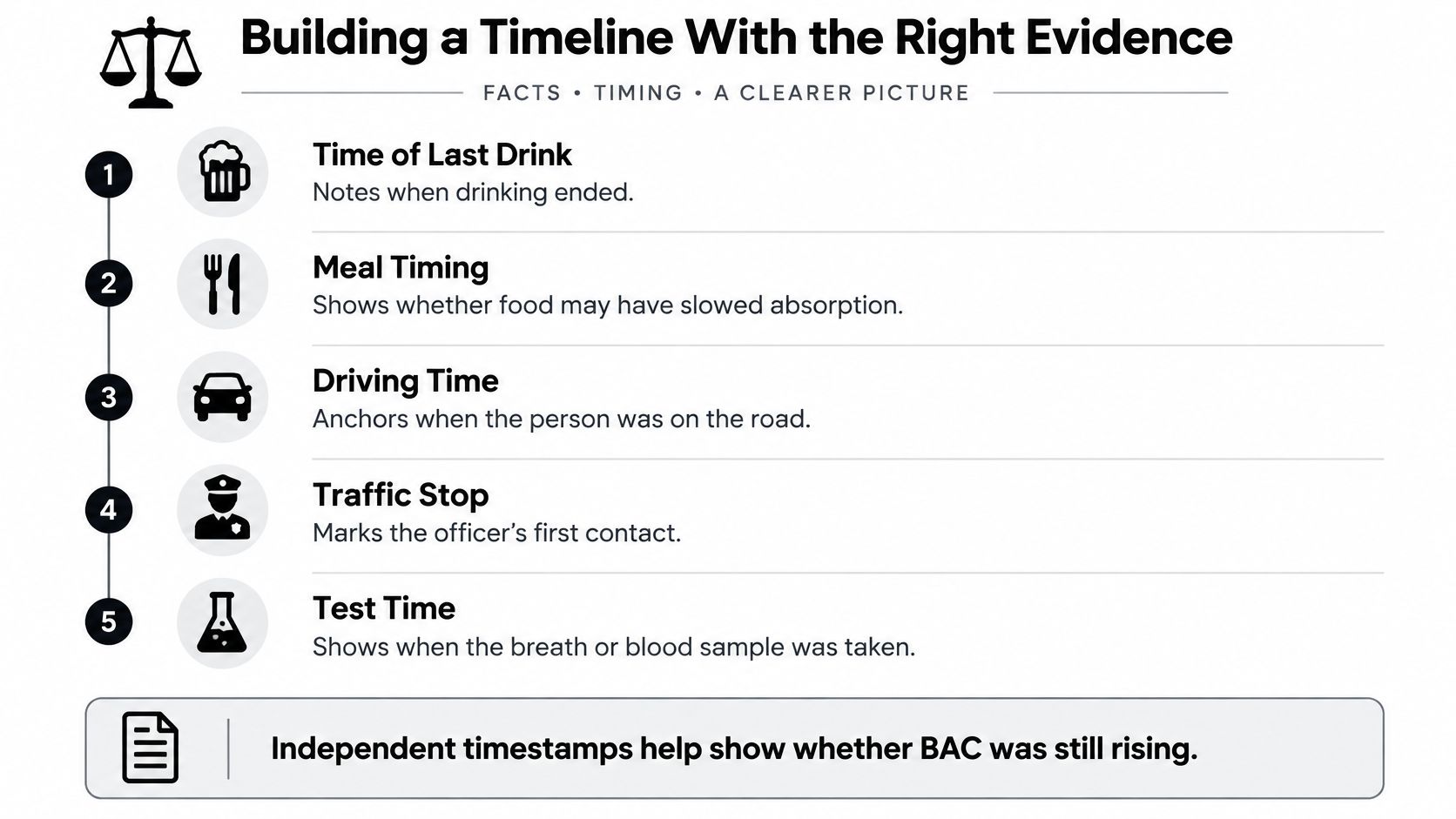
The rising blood alcohol defense is strongest when the later result is clear and the earlier concentration cannot be rebuilt with reliable facts. Start with independent timestamps, not with a memory of "around then."
Anchors you can gather
Last drink. A receipt, a tab, a text, or a witness can show when drinking ended. A vague "I had a couple" is weaker than a time-stamped record.
The meal. Food can slow absorption. A dinner check, a photo, or a companion's account belongs next to the drink times, not in a separate story.
Driving and the stop. Note when you left, when you were on the road, and when the officer first made contact. Dispatch logs and body-camera time stamps often beat a rounded time in a report.
The test. Breath collection and blood collection are different minutes. Write down both if both happened, and note any drink after the stop. Post-stop alcohol is a different problem, and it has to be on the timeline too.
Records the State or the lab holds
You will not have every page at home. Calibration records, the full lab file, collection times, and the method of analysis usually come through the Texas DWI discovery process. Surveillance from a bar, medical records, and complete video may need a formal request.
What to line up early:
- Bar or restaurant records: what was ordered and when the tab closed.
- Messages and witnesses: who saw the last drink, and what they remember about food.
- Video: driving before the stop, and your condition at the roadside.
- Lab paperwork: whether the reported number rests on a documented collection time.
A clean later result with a messy earlier clock is not a technical trick. It is a failure of proof about the minute that matters.
Comparing Defense Strategies to Prosecution Rebuttals
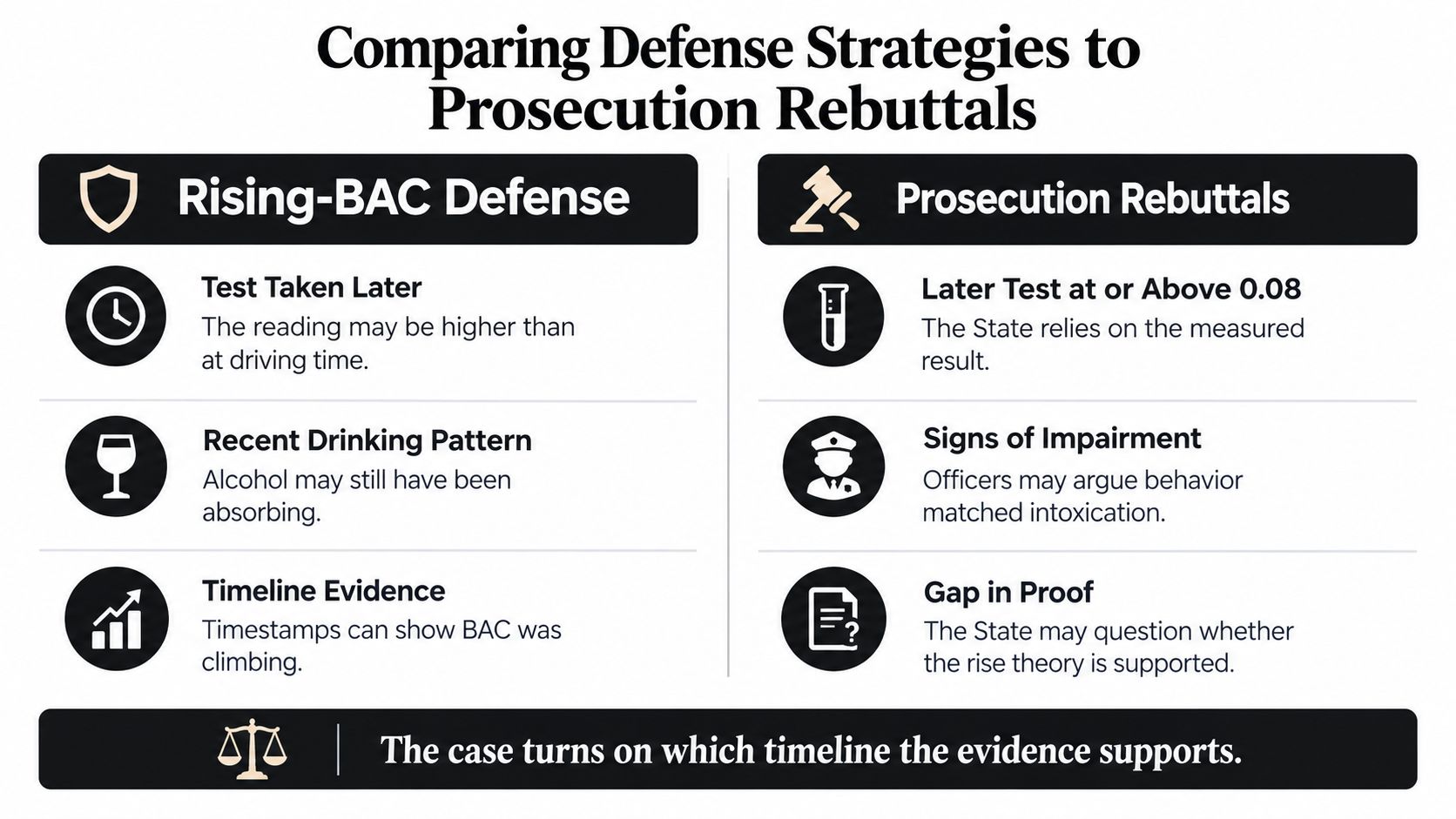
Prosecutors rarely stop at your timeline. They point at the test, the roadside clues, and the length of the delay. You should expect all three.
Texas law recognizes two ways to prove intoxication. One is loss of normal mental or physical faculties from alcohol or another substance. The other is an alcohol concentration of at least 0.08. The statute measures that concentration in grams per 210 liters of breath, 100 milliliters of blood, or 67 milliliters of urine. The specimen type is tied to the collection time, not automatically to the minute you were driving.
How the two stories collide
A rising-BAC argument says recent drinking may still have been absorbing, so a later reading can sit above the driving-time level, and timestamps can show the climb. The State answers that the later test is at or above 0.08, that your speech, driving, or field tests matched impairment, and that the delay was too short to matter.
Both can be partly true. If the video shows poor control at the stop, the faculties theory can survive even when the per se number is in doubt. If the driving looks ordinary and the result sits near the line, the missing earlier concentration becomes the State's problem.
The argument is not automatically favorable. Evidence of impairment before the test can still support that second theory. A Texas DWI Defense Lawyer handling a charge under Texas Penal Code 49.04 reviews the stop, probable cause, and whether evidence was obtained lawfully, then looks at dismissal, a reduced charge, deferred adjudication, or another lawful outcome when the facts allow it. Attorneys at the Law Office of Bryan Fagan, PLLC do that review as one option among firms that try these cases.
How Hearings and Trials Play Out in Real Cases
Courts have treated timing, scientific testimony, and the prosecution's burden as the center of this fight. In Shinault v. Commonwealth, the Virginia Court of Appeals in 2014 reversed a conviction after finding that rising-BAC evidence could create reasonable doubt where testing followed a substantial interval and the result was close to the legal limit. Texas courts use their own standards. Shinault is an illustration of the timing problem, not a rule that binds a Texas judge.
A labeled Texas illustration
Take a driver who had one drink near the end of dinner, left soon after, and was stopped a few minutes later. The breath or blood test came well after the roadside exercises and the ride to the station. Nothing in that sketch proves a result. It shows the work.
Counsel would pull the receipt, texts, and any camera at the restaurant. Dispatch and body-camera times would fix the stop. The lab file would fix the collection. An expert would then test whether those drinks, that meal, and that body could still have been absorbing at the wheel. If the assumptions do not fit, the opinion should say so. How that testimony is challenged is covered in this look at DWI toxicologist testimony.
Two forums, one timeline
The same minutes can matter at an administrative license hearing and at a criminal trial. The hearing is about whether the State met the statutory facts for a suspension. The trial is about proof beyond a reasonable doubt, including whether you were intoxicated while operating the vehicle. Bond conditions and court settings run on their own calendar while that proof is tested.
A Houston DWI lawyer, or counsel in another Texas county, turns that stack of times into a strategy you can follow. The value is not a slogan. It is a timeline a judge or jury can use.
Reasonable doubt here is often a missing minute, not a missing test printout.
Your Next Steps After a Texas DWI Arrest
Two cases start together, and they do not share a deadline. Implied consent means Texas treats driving as agreement to give a breath or blood sample after a lawful DWI arrest. A refusal, or a result at the legal line, can start an administrative license suspension, the separate DPS process that can affect your license even while the criminal charge is pending. That is the DWI license suspension track, and it moves first.
DPS explains that you generally have 15 days after you receive the suspension notice to request an ALR hearing. If you do not request one, the suspension begins on the 40th day after the notice was served. A hearing may take roughly 30 to 60 days to schedule. Missing the request can mean you never test reasonable suspicion, probable cause, the arrest, or whether the refusal or the result was valid.
An order that protects both files
- Request the ALR hearing inside the 15 days. Write down the date you were served. Do not wait for the criminal court date.
- Write the timeline while it is fresh. Last drink, food, driving, stop, and test. Save receipts and messages.
- Talk with a Texas DUI attorney early. The license case and the criminal case use the same facts, and delay can lose video or bar records.
- Ask what the evidence can support. Some cases end in dismissal, a reduction, deferred adjudication, or another sentencing option. Others go to trial. None of those outcomes is guaranteed, and none requires you to guess tonight.
Parents of a young driver, CDL holders, licensed professionals, and visitors from another state all face the same first choice. Preserve the hearing, then build the clock.
The Law Office of Bryan Fagan, PLLC offers free consultations and 24/7 support for drivers in Houston, Dallas-Fort Worth, Austin, and San Antonio. A calm review of your notice and your timeline is the practical next step, not a promise about the verdict.
The Law Office of Bryan Fagan, PLLC helps Texans sort a rising blood alcohol defense across both the criminal DWI case and the license hearing, including the 15-day ALR deadline and the timeline behind a later test. You can bring your notice, your stop time, and what you remember about the last drink. Visit Law Office of Bryan Fagan, PLLC to request a free case evaluation and take the next step toward protecting your license and your record.
