
A DWI arrest can be overwhelming, but you don't have to face it alone. Maybe you're replaying the blue lights, the questions at the roadside, and the moment an officer opened your car. The key question is not what police found. It's what they knew, and when they knew it.
In Texas, an officer's authority to search a vehicle depends on the legal basis for the search and the scope that basis allows. A traffic stop or DWI arrest doesn't automatically authorize a search. By tracing the stop's timeline, you and your attorney can examine when probable cause allegedly arose and whether the search that followed stayed within its limits.
What Happens During a Texas DWI Traffic Stop
The lights come on behind you. You pull over, lower the window, and the officer asks for your license and insurance. Then come questions: Where are you coming from? Have you been drinking? Would you step out of the vehicle or perform a field sobriety test?
The answers and observations may become part of the officer's account of the stop. The officer might mention an odor of alcohol, an admission that you had a drink, an open container, or something visible in the car. If the officer then opens a door, console, bag, or trunk, the reason for that search matters.
The moment the encounter changes
Consider a Houston-area driver stopped after an officer reports seeing the car drift within its lane. The officer asks questions, notices an odor, and sees a closed backpack on the rear seat. Those facts don't automatically answer whether the officer could search the backpack. The important timeline is what the officer observed before opening it, what evidence the officer said they were looking for, and whether that evidence could fit inside.
A field sobriety test is a roadside exercise used by an officer to assess possible impairment. It may become part of the DWI investigation, but a test's result doesn't by itself settle whether police may search the vehicle. The search needs its own legal justification, based on the facts known at the time.
Keep the sequence clear: A discovery made during a search can't, by itself, provide the reason that justified starting that search.
A routine-feeling stop can produce evidence later used in a criminal case. But an officer's eventual discovery doesn't prove the search was lawful when it began. The question is whether facts known before the search gave the officer a valid legal basis to look in the specific place searched.
Understanding Probable Cause Under the Fourth Amendment
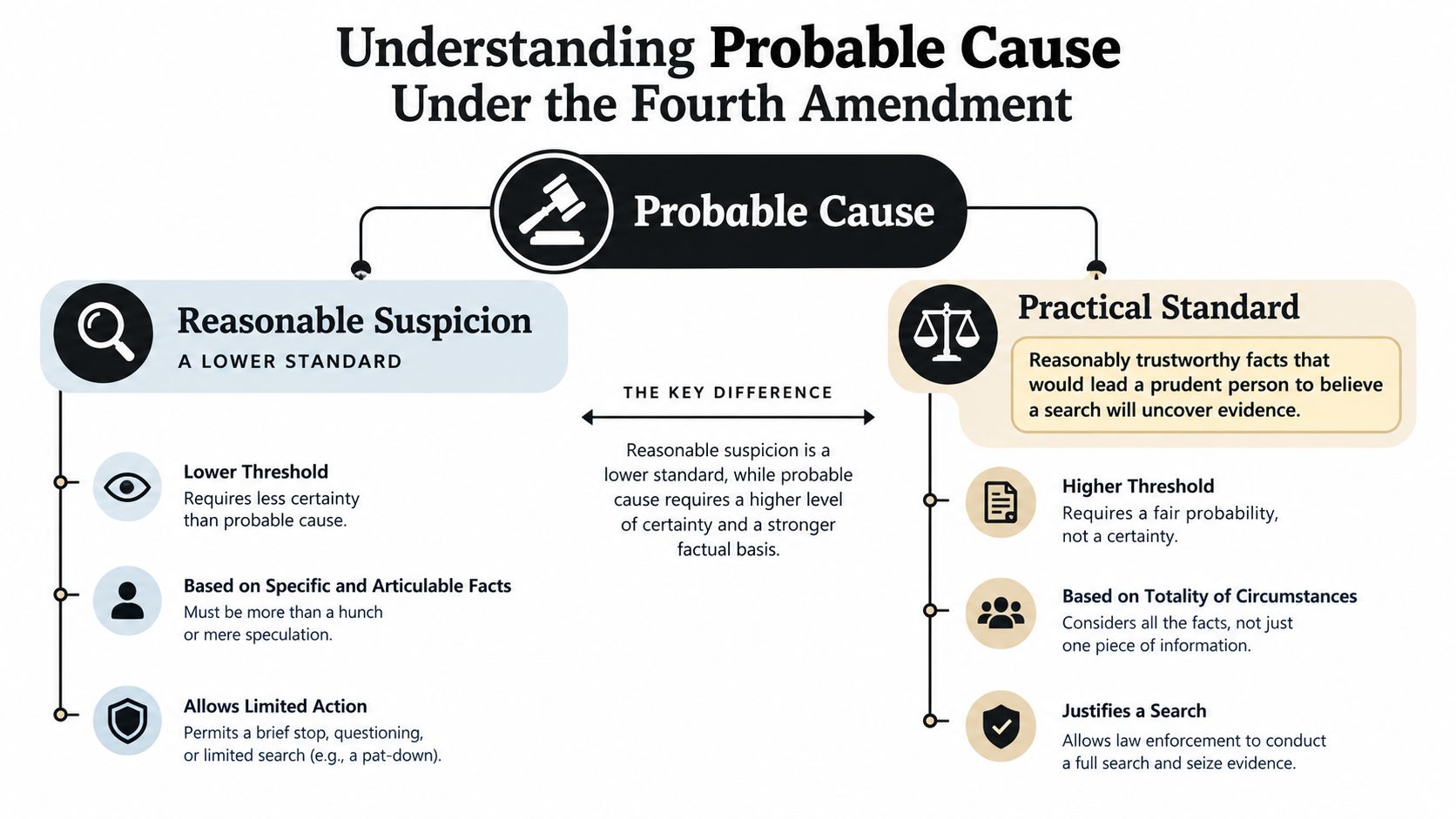
Probable cause is a practical legal standard. Texas courts describe it as reasonably trustworthy facts and circumstances known to the officer that would lead a reasonably prudent person to believe a search will uncover evidence or criminal instrumentalities. Courts evaluate the full context, not just one observation (Texas appellate court explanation of probable cause).
Think of a teacher deciding whether a student cheated. A vague rumor may justify paying closer attention, but it doesn't establish that the student cheated. A specific observation, such as seeing the student copy answers, carries more weight. Probable cause is not certainty, but it requires more than a hunch.
How the standards differ
Reasonable suspicion is a lower threshold that can support a brief investigative stop when specific facts point to possible wrongdoing. Probable cause requires facts that would lead a reasonable person to believe evidence of a crime will be found in the place to be searched. Neither standard means proof beyond a reasonable doubt, which is the much higher standard the State must meet to convict in a criminal trial.
That distinction matters in a DWI stop. An officer may have a lawful reason to stop a car, but that doesn't automatically create probable cause to search it. The State must justify a warrantless search under a recognized exception to the Fourth Amendment's warrant requirement. If the facts don't connect the suspected evidence to the particular vehicle, a defense attorney may ask the court to suppress evidence from the search.
For a closer comparison of these thresholds, see how probable cause differs from reasonable suspicion. A related discussion explains how an unlawful stop can undermine a DWI case.
The Automobile Exception and Why It Exists
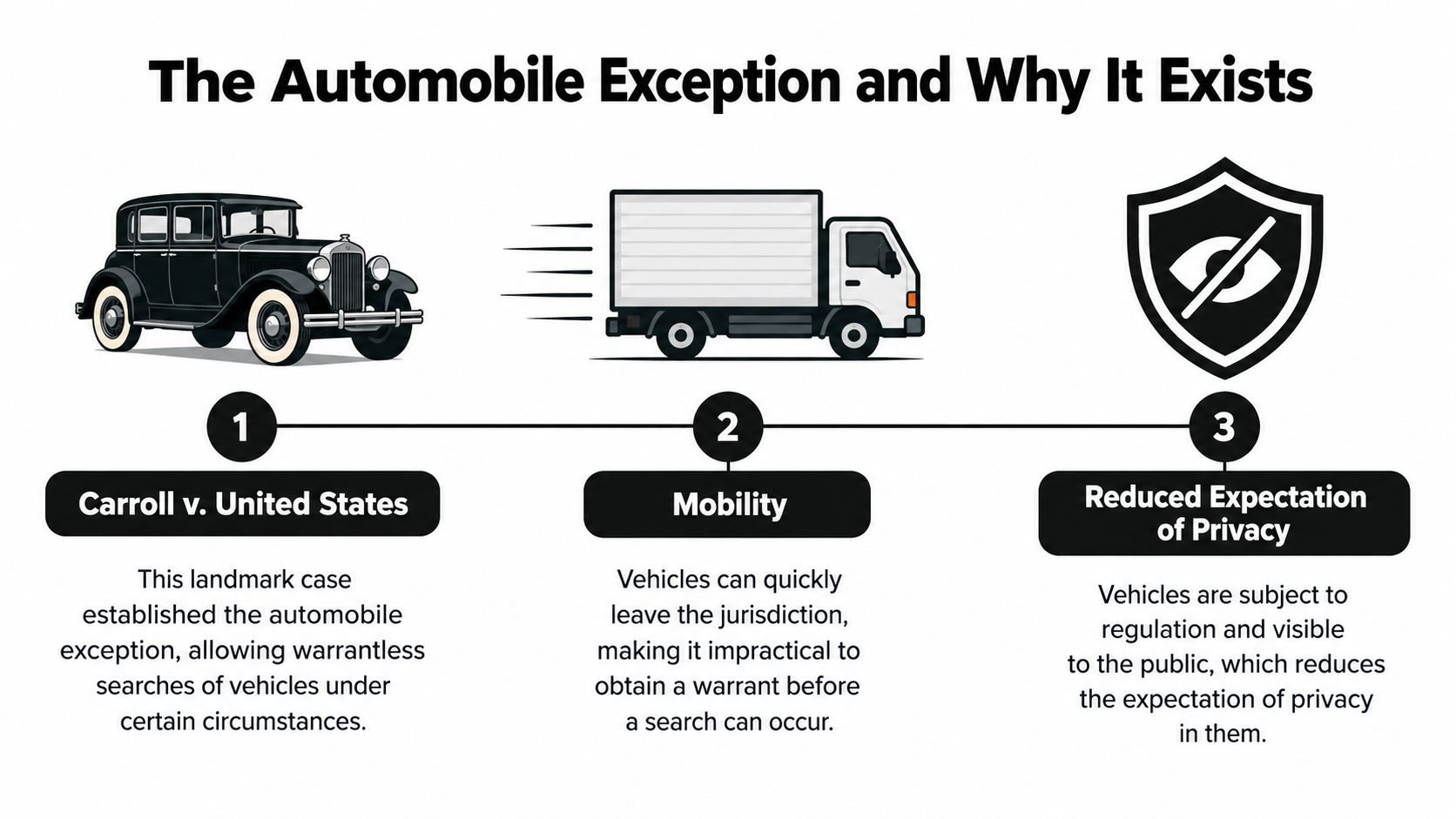
The automobile exception allows a warrantless vehicle search when the vehicle is readily mobile and officers have probable cause to believe it contains contraband or evidence of a crime. Mobility helps explain why this exception exists, but it doesn't erase the requirement for probable cause.
The modern rule began with Carroll v. United States, decided by the U.S. Supreme Court on March 2, 1925. The Court held that officers could search a vehicle without a warrant when facts known to them created probable cause to believe it contained contraband or other property subject to seizure. The reasoning emphasized that a car can leave the jurisdiction before officers obtain a warrant, unlike a home or fixed building. United States v. Ross discusses the automobile-search rule and its scope.
Mobility isn't a blank check
The Supreme Court clarified the potential scope in United States v. Ross, decided June 1, 1982. When probable cause supports a search of a lawfully stopped vehicle, officers may search the parts of the vehicle and its contents that could conceal the object they're seeking. That can include containers, but the suspected evidence still has to guide the search.
For example, if officers have probable cause to believe drugs are hidden in the car, a container capable of holding drugs may fall within the search. The automobile exception doesn't mean every traffic stop permits police to search every compartment. Officers still need facts tying the suspected evidence to the vehicle, and the object of the search limits where they may look.
A car's movement and its lower expectation of privacy than a home are part of the explanation for the rule. They aren't substitutes for probable cause. For a related discussion of why standardized field sobriety tests are more contestable than they appear, see the separate guide.
Common Facts Officers Cite as Probable Cause in Texas DWI Cases
Officers often build a search justification from several observations rather than one dramatic fact. A Houston driver's timeline might begin with a traffic violation, followed by questions at the window, roadside testing, and an officer's decision to search. To assess that decision, look at which facts existed before the search and how reliably they were recorded.
Build the timeline from the officer's observations
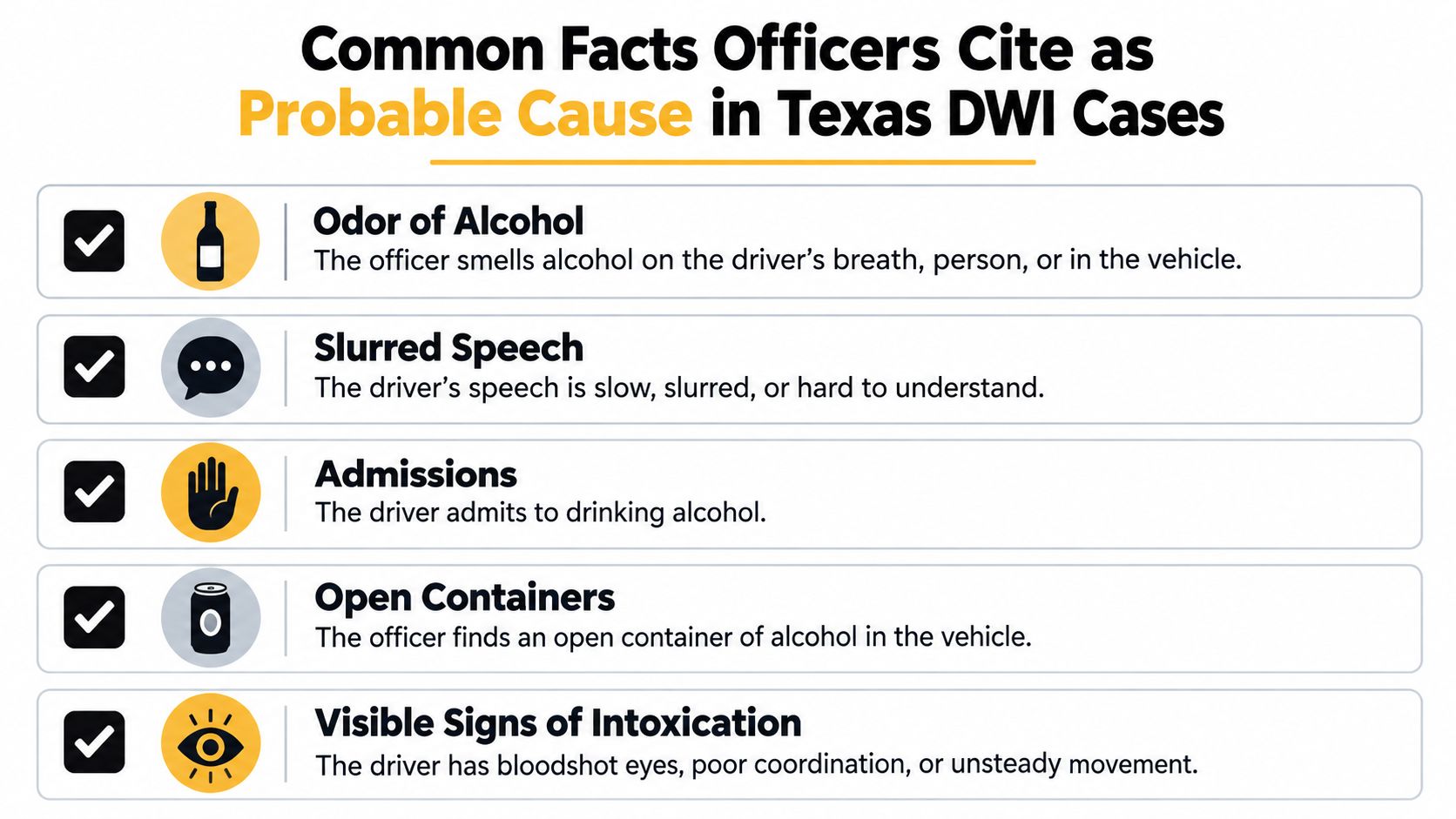
- Odor of alcohol or drugs: The officer may report smelling an odor inside the vehicle. The timing and location matter, as does whether the officer described what they smelled and where it seemed to come from.
- Slurred speech or visible signs: Bloodshot eyes, unsteady movement, or speech the officer describes as slurred may support an impairment investigation. They don't automatically establish that evidence is inside the vehicle.
- Admissions: An answer such as “I had a drink” may be included in the officer's account. The exact words and when the officer asked the question can matter.
- Open containers or visible items: A container or suspected drug-related item visible from outside the car may contribute to the officer's stated basis. Its location and what it appeared to be can be tested against video and photographs.
- Field sobriety test performance and driving: Officers may rely on roadside test observations or reported erratic driving. A defense review can compare those claims with body-camera or dashcam footage, the officer's report, and the actual search sequence.
No single item automatically settles the constitutional question. A smell or an admission may carry different weight depending on the surrounding circumstances, and a fact that supports further investigation doesn't necessarily justify opening every container.
Ask the timeline question: What did the officer know before opening the car, and what evidence could each searched area reasonably contain?
That analysis can show whether probable cause arose before the search or whether the explanation appeared only after officers found something.
How Consent, Inventory and Plain View Differ From Probable Cause
Police reports may describe a search as based on consent, probable cause, plain view, or an inventory after a vehicle is impounded. These are different justifications, each with its own legal requirements. The label in a report doesn't decide whether the search was valid.
| Justification | Legal Standard | Who Carries the Burden | Common Defense Challenge |
|---|---|---|---|
| Probable cause | Facts known to the officer must support a reasonable belief that the vehicle contains evidence or contraband. | The State must establish a valid exception to the warrant requirement. | Pin down when probable cause arose and whether the search stayed within its scope. |
| Consent | The officer must rely on consent that was voluntary under the circumstances. | The State must establish that consent justified the search. | Review what was said, whether consent was limited or withdrawn, and how the request appears on video. |
| Plain view | An officer must lawfully be in a position to see the item, and its evidentiary significance must support police action. | The State must establish a lawful basis for the seizure or related search. | Question whether the officer could lawfully see the item and whether its significance was apparent. |
| Inventory | Police must be carrying out an inventory under the applicable department procedures after a lawful impound. | The State must establish the inventory basis and its legitimacy. | Compare the report, impound process, and department policy to test whether the search was really an inventory. |
| Canine sniff | The State relies on the circumstances surrounding the dog's involvement and any alert to justify further action. | The State must establish the legal basis for the search that followed. | Examine the stop's timing, the dog's deployment, and what happened before and after any alert. |
Texas DPS distinguishes vehicle searches from searches of people taken into custody, and its motor-vehicle-stop reporting separately identifies probable-cause and inventory categories. A 2025 Cedar Park report said that 26.9% of searches were classified as discretionary consent searches, while the remainder involved probable cause, plain view, or inventory circumstances (Texas DPS motor-vehicle-stop report). Those categories describe reporting, not a court's conclusion that a particular search was lawful.
Consent can be a separate basis from probable cause; plain view describes how an officer encounters an item; and an inventory search is not the same as an evidence-seeking search. Video, the officer's stated objective, the timing, and department policy can help test whether the explanation fits what occurred.
Scope of the Search and Passenger Rights
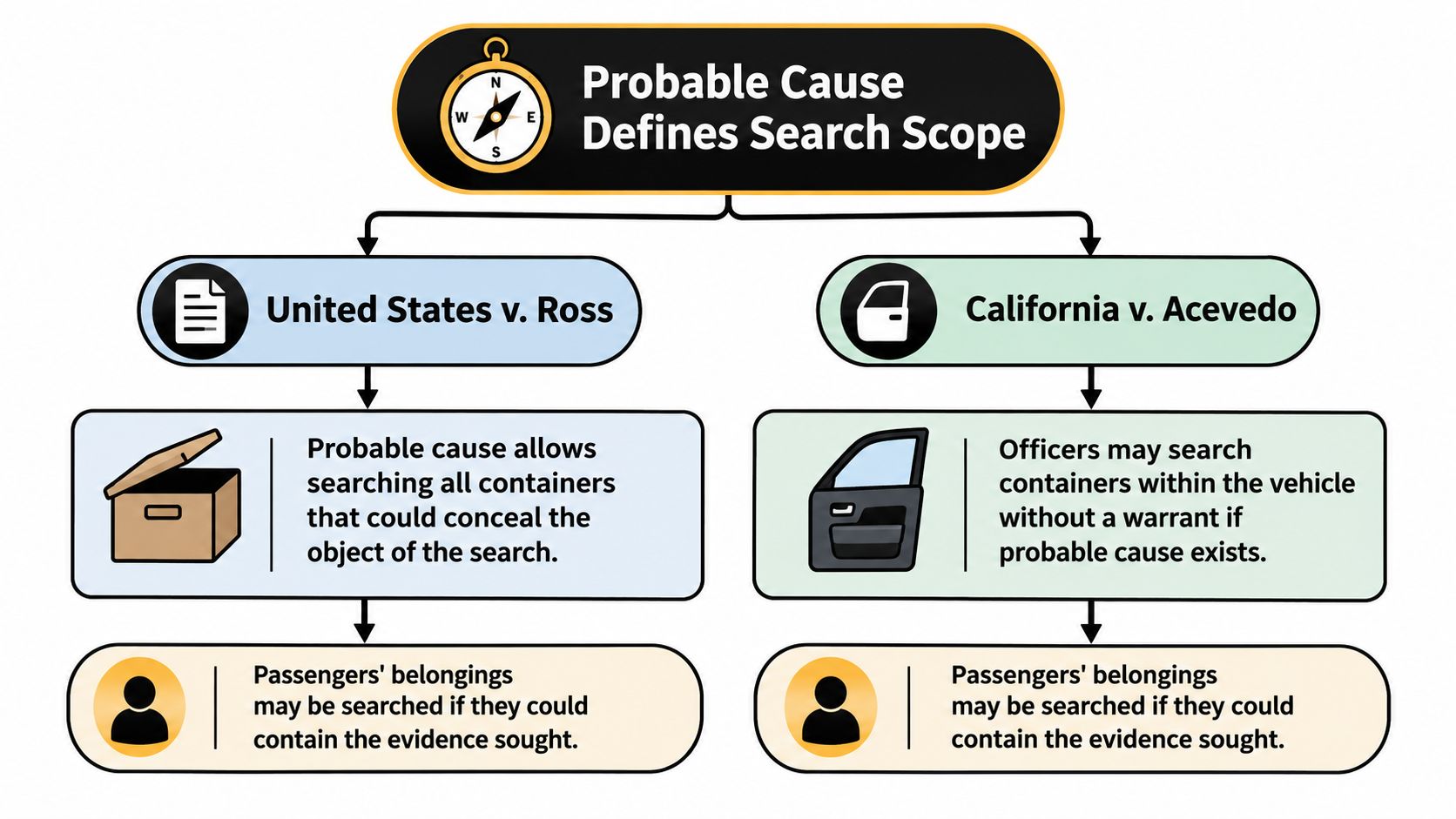
Probable cause affects not only whether officers may search, but also where they may look. In Ross and California v. Acevedo, the Supreme Court addressed searches of vehicle contents and containers. The practical rule is that officers may examine areas and containers capable of holding the evidence they're seeking, but the object of the search sets the limit.
Match the object to the place searched
If officers have probable cause to believe drugs are hidden somewhere in a car, they may be able to open a closed container that could hold drugs. But if the suspected object physically can't fit in a particular container, probable cause to search for that object doesn't automatically authorize opening that container.
The distinction also matters when probable cause relates only to a specific container. If officers have grounds to suspect one bag, that doesn't necessarily give them grounds to search every other part of the car. The precise facts and the claimed object of the search shape the analysis.
A passenger's property isn't the same as their body
A passenger's luggage may sometimes be searched as part of a vehicle search if it could contain the evidence officers are seeking, even if the passenger isn't suspected. Ownership alone doesn't decide the issue. A passenger's body is different. A vehicle-search justification doesn't automatically allow a body search; officers generally need separate grounds, such as reasonable suspicion that the person is armed and dangerous, for a protective pat-down.
To review a real stop, note the location searched, the evidence police said they sought, whether the container could hold it, and whether officers had individualized grounds to search a person. That evidence map helps expose a search that may have exceeded its legal scope. Passengers can also learn more about whether a passenger can get a DWI.
How to Challenge an Unlawful Search in Court
A defense attorney can ask the court to exclude evidence from an unlawful search by filing a motion to suppress. At a hearing, the State must establish the legal basis for the warrantless search. The court can then compare that explanation with the facts and sequence shown in the evidence.
Body-camera and dashcam footage, dispatch records, the officer's report, photographs, and property records may help establish what happened and when. A defense review focuses on the stop's basis, when the officer says probable cause arose, what the officer was looking for, and whether each place searched could contain it. Learn more about filing a motion to suppress evidence.
Don't overlook the license deadline
The Administrative License Revocation (ALR) process is a civil licensing matter separate from the criminal DWI prosecution. DPS may seek suspension or disqualification after a refusal or failure to complete a requested blood or breath test, or when a non-commercial driver provides a test showing a BAC of at least 0.08 percent. BAC, or blood-alcohol concentration, measures the amount of alcohol in a person's bloodstream. The notice generally gives you 15 days to request an ALR hearing; if you miss the deadline, DPS states that suspension takes effect on the 40th day after service of notice (Texas DPS ALR program).
Implied consent refers to Texas's rules concerning a driver's submission to a requested breath or blood test under the circumstances set by law. An administrative license suspension is a license consequence handled through the civil ALR process, not the criminal trial. Review the notice and arrest paperwork promptly, because the administrative case and criminal case can have different outcomes.
Protecting Your Rights After a Texas DWI Search
An arrest doesn't automatically justify a vehicle search, and owning a car or container doesn't itself create probable cause. If officers searched unlawfully, your attorney may seek to suppress physical evidence and statements obtained as a result. The outcome depends on the facts, the timeline, and what the State can prove.
The Law Office of Bryan Fagan, PLLC represents Texans facing DWI charges and reviews the details of traffic stops and searches. If you're worried about a DWI license suspension or need a Houston DWI lawyer, a Texas DUI attorney can assess the search and explain options for your case, including how to fight a DWI in Texas.
Request a free consultation or case evaluation with Law Office of Bryan Fagan, PLLC. The firm serves clients in Houston, Dallas–Fort Worth, Austin, San Antonio, and surrounding counties, and can review the stop timeline, search, and available video with you.
