
A DWI arrest can be overwhelming, but you don't have to face it alone. The situation becomes more serious when the prosecutor says an old conviction from another state can be used against you in Texas. A prior labeled DUI, DWI, OWI, or another impaired-driving offense may affect the charge level, jail exposure, license, and commercial driving privileges.
The important point is that an out-of-state conviction doesn't automatically qualify. Texas prosecutors must prove that the foreign offense is legally comparable to Texas DWI and that you're the person who was convicted. A missing judgment, weak identity evidence, or a statute that criminalizes broader conduct can change the result.
When an Old Case From Another State Follows You to Texas
A commercial driver from Louisiana is stopped by a Texas Highway Trooper on I-10 outside San Antonio. The driver faces a new Texas DWI and initially assumes the case will involve the ordinary consequences of a first offense, such as a fine, license trouble, and an SR-22 requirement.
Then the prosecutor's file identifies an older Louisiana DWI conviction. The State announces that the new case should be treated as a Class A misdemeanor, not the lower-level charge the driver expected. If the State identifies another qualifying conviction, the exposure can rise to a third-degree felony, carrying two to ten years in prison under Texas law. The Texas Court of Appeals has recognized that an out-of-state offense can support enhancement when its elements substantially match Texas DWI law. The Christensen decision addressed the use of a Colorado impaired-driving conviction for this purpose.
That change affects more than the punishment range. An enhanced case can influence bond conditions, plea negotiations, a DWI license suspension, CDL status, employment, insurance, and the long-term consequences of a criminal record. For a driver who works across state lines, the professional impact may become as urgent as the criminal case.
Practical rule: Treat every old impaired-driving case as a record that must be investigated, not as an automatic enhancement.
Texas generally has no broad lookback period for ordinary qualifying DWI priors. A conviction may remain relevant long after the original case ended, although specific felony proof rules can include timing requirements. This Texas DWI lookback period discussion explains why age alone may not resolve the issue.
The defense roadmap is concrete. Obtain the foreign records, compare the foreign statute with Texas Penal Code §49.04, test the State's identity evidence, and examine whether the conviction was final and constitutionally valid. The question is not just whether you were once arrested somewhere else. It is whether the State can prove a qualifying conviction in a legally reliable way.
Key Terms You Need to Know Before Anything Else
Texas DWI law becomes easier to understand once the basic terms are separated.
Texas DWI generally means operating a motor vehicle in a public place while intoxicated under Texas Penal Code §49.04. “Intoxicated” can involve losing the normal use of mental or physical faculties because of alcohol, drugs, or another substance, or meeting the statutory alcohol-concentration definition. A public place includes a location accessible to the public, such as a public road.
An out-of-state prior is a conviction from another state or qualifying jurisdiction for an offense such as DUI, DWI, OWI, or OUI. The label isn't decisive. Texas courts examine what the foreign statute required the State to prove.
Enhancement is the legal process that raises the punishment level of a new DWI because of qualifying prior convictions. Think of it as adding another block to the punishment structure. But the block only counts if the State proves that it belongs there.
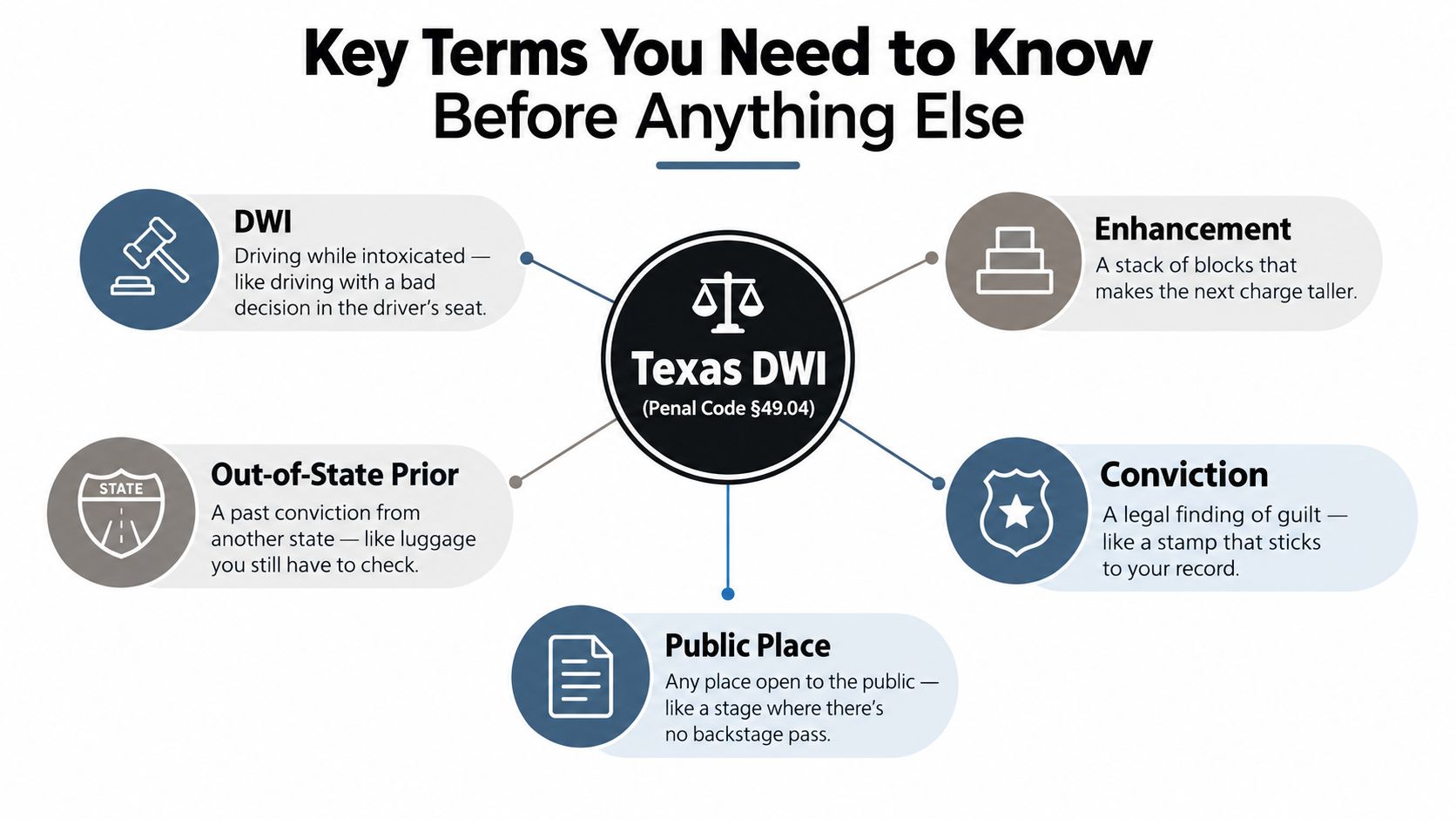
Conviction is different from an arrest
A prior qualifying conviction normally requires a final judgment, not merely an arrest, charge, citation, or dismissed case. A deferred disposition also requires careful review because the record may not establish a final conviction in the way the State needs for enhancement. The exact paperwork matters.
BAC means blood or breath alcohol concentration. A BAC result is only one possible part of a DWI case. The State may also rely on driving conduct, statements, field observations, and testing procedures.
A field sobriety test is a roadside assessment used by officers to observe balance, attention, coordination, and divided-attention tasks. It isn't a direct measurement of BAC, and its value depends on conditions, instructions, administration, and interpretation.
Implied consent refers to Texas's legal framework under which a driver is treated as having agreed to provide a specimen in circumstances covered by the Transportation Code. Refusing or failing to provide a specimen can lead to an administrative consequence, separate from whether the criminal DWI charge can be proved.
An administrative license suspension, often called an ALR suspension, is a DPS license action connected to an alleged refusal or failed chemical test. It's separate from the criminal court case. Transportation Code provisions, including §§521.344 and 724, can affect how the two proceedings interact.
For a plain-language overview of what a first DWI charge means and how it can be challenged, see First-Offense DWI in Texas: Penalties and Defenses.
How Texas Law Turns an Out-of-State DWI Into a Prior
Texas Penal Code §49.09 provides the enhancement framework. The State must connect the current DWI to qualifying prior intoxication-related convictions. For an out-of-state conviction, that means showing that the foreign offense prohibits operating a motor vehicle while intoxicated and contains elements substantially similar to Texas DWI law.
The comparison is technical. A court doesn't decide the issue solely from the foreign offense's name. It examines the statute and asks whether the elements line up closely enough with Texas Penal Code §49.04. The Texas Court of Appeals has treated this statutory comparison as central to deciding whether an out-of-state offense can support enhancement. The Texas appellate opinion available through Justia illustrates why the foreign statute itself matters.
One qualifying prior can raise a new DWI to a Class A misdemeanor. The verified legal materials identify a 72-hour minimum jail term associated with that enhanced level. Two qualifying priors can increase the case to a third-degree felony, with a two-to-ten-year prison range. The State may also rely on certain intoxication-related convictions under the statute's other provisions, but the precise analysis depends on the offense and the charging theory.
The punishment structure
| Priors on record | Charge level | Statute | Maximum penalty |
|---|---|---|---|
| No qualifying prior | Class B misdemeanor posture | Texas Penal Code §49.04 | The verified materials identify this as the lower-level DWI posture, but do not provide a complete maximum penalty range |
| One qualifying prior | Class A misdemeanor | Texas Penal Code §49.09 | The verified materials identify a 72-hour minimum jail term and do not provide a complete maximum penalty range |
| Two qualifying priors | Third-degree felony | Texas Penal Code §49.09 | Two to ten years in prison |
The Texas Department of Public Safety may identify prior convictions through its records, but a DPS record is not the end of the legal inquiry. Prosecutors still must prove the conviction, establish that the record belongs to you, and show that the foreign offense qualifies under the statute.
That distinction matters in negotiation. A prior that appears in a database may still fail in court if the certified record is incomplete, the identity evidence is weak, or the foreign law reaches conduct Texas DWI law does not cover.
How Prosecutors Actually Prove an Out-of-State Prior in Court
The State usually builds an out-of-state enhancement through a certified record packet. The packet may contain the foreign complaint, charging instrument, judgment, sentence, docket entries, and other records identifying the statute and disposition. Each document has a job. The judgment helps establish the conviction, while the statute allows the court to perform the substantial-similarity comparison.
The State must also prove that the person named in the foreign records is the same person facing the Texas charge. A shared name isn't enough by itself. Prosecutors may use fingerprints, photographs, identifying information, admissions, or testimony connecting the records to the defendant.
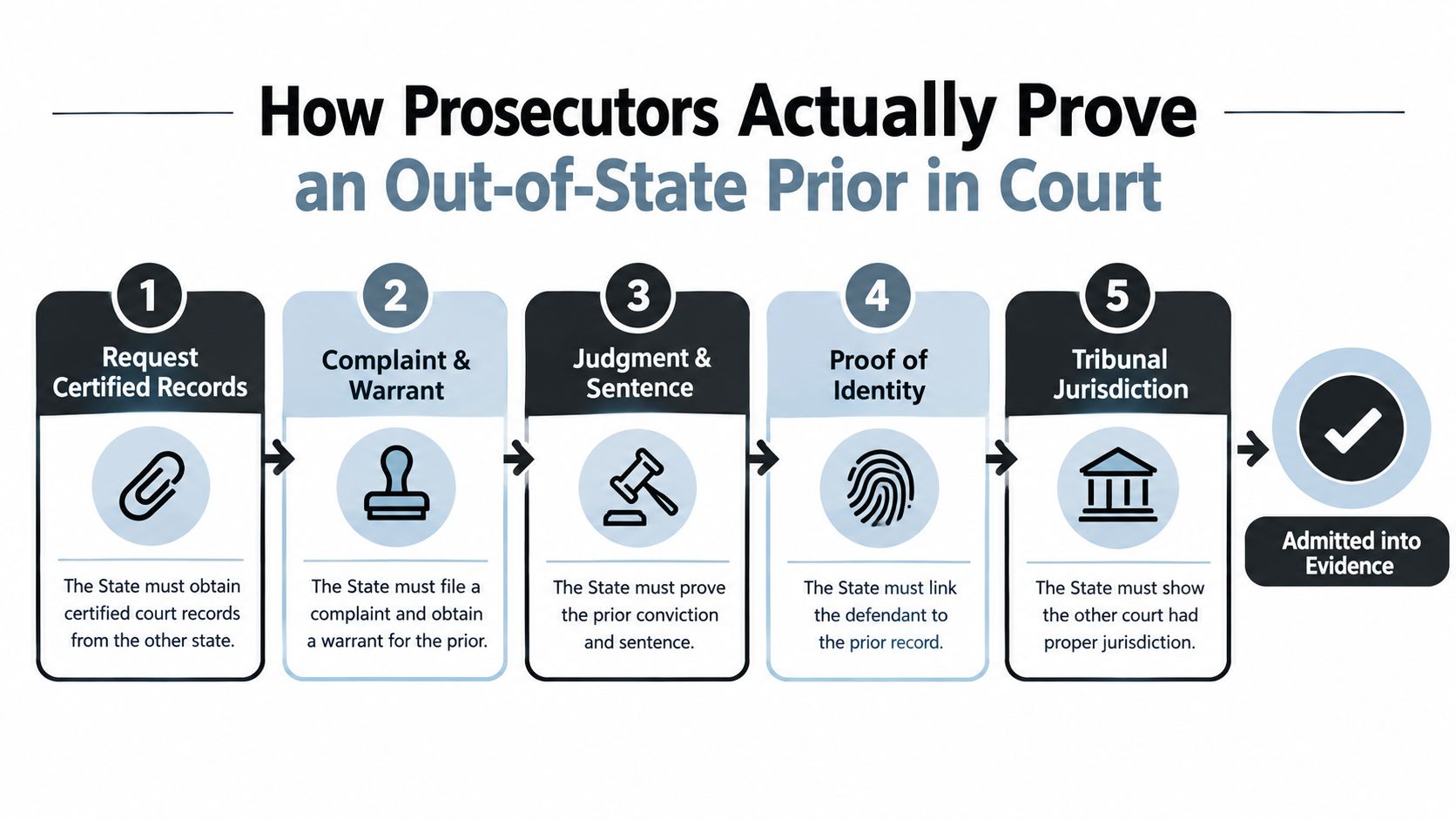
The five questions the court must answer
Is there a final conviction? An arrest, pending charge, or incomplete disposition doesn't establish the same thing as a final judgment.
Are the records properly certified and authenticated? Certified public records may qualify for admission under the Texas Rules of Evidence, but defects in certification or gaps in the packet can create an objection.
What statute was violated? A generic description such as “DUI” may not give the court enough information to compare the foreign offense with Texas law.
Are the elements substantially similar? The court compares the legal elements, not just the factual label or the officer's summary.
Is the defendant the person convicted? The State must connect the foreign record to the current defendant through admissible evidence.
The Fingerprint Exception Rule can be important when fingerprint records are included in a properly prepared packet. But the existence of a fingerprint page doesn't automatically resolve every issue. Counsel should examine whether the record is complete, whether the certification is proper, and whether the identification evidence links the defendant to the judgment.
The Texas DWI discovery process is where defense counsel can often obtain the arrest materials and prosecution records needed to test these claims.
The State's burden applies to the enhancement allegation. A prosecutor may have a certified judgment but no reliable identity evidence, or identity evidence but a foreign statute that is materially broader than Texas law. Those weaknesses should be identified before a defendant stipulates to the prior.
Real-World Examples of How Enhancement Changes Your Case
The practical impact of an out-of-state DWI depends less on the label in a database than on what the State can prove from the foreign court record. The same current Texas allegation may lead to a routine misdemeanor negotiation, a heavily contested enhancement hearing, or a felony case.
Scenario one: the prior never becomes usable
A prosecutor may allege an old Louisiana or Oklahoma DWI based on a docket search. Defense counsel requests the complete packet and finds that it contains an abstract and arrest information, but no judgment showing the final disposition. The State may still argue that the record is sufficient, yet the missing sentencing or judgment document creates a serious proof problem. If the prosecutor cannot establish a qualifying conviction, the enhancement allegation may be withdrawn before trial or excluded after an objection.
That result changes the negotiation immediately. The defense can evaluate the current DWI on its own evidence instead of bargaining under the threat of a prior that has not been proved.
Scenario two: one prior becomes the central hearing issue
Suppose the State has a certified foreign judgment and records tying it to the defendant, but the foreign statute is broader than Texas law. A prior labeled “DWI” does not settle whether its legal elements satisfy Texas's substantial-similarity test. Counsel may argue that the foreign statute reaches conduct Texas does not define as intoxicated driving, or that its required level of impairment differs.
The parties may litigate the prior before addressing breath, blood, or field sobriety evidence in the current case. A ruling for the defense can move the case into the lower classification. A ruling for the State can leave the defendant negotiating under the enhanced range described earlier.
Scenario three: two alleged priors create felony pressure
With two alleged qualifying convictions, the prosecutor may approach the case as a felony from the outset. That affects bond discussions, plea recommendations, trial risk, and the defendant's willingness to accept conditions that would be unreasonable in a misdemeanor case. The defense should test each prior separately. One admissible conviction does not automatically establish the second.
A foreign record may prove that a case existed without proving that it ended in a qualifying conviction. It may identify a defendant without reliably connecting that person to the current Texas defendant. It may also contain inconsistent offense dates, statute numbers, or court documents. Each defect can affect whether the enhancement survives a hearing.
The working calculation should use only the priors that survive evidentiary and statutory scrutiny, not every entry appearing in a database. Before accepting an enhanced plea offer, counsel should know which record the State will introduce, which legal elements it relies on, and what ruling the court would need to make before the higher classification applies.
Defenses That Can Knock Out an Out-of-State Prior
The strongest defense work often begins with the enhancement paragraph, not with an assumption that the prior is unavoidable. The State must prove more than the existence of an old alcohol-related case.
Substantial similarity is the first pressure point
Texas courts compare the elements of the foreign offense with Texas DWI law. If the foreign statute criminalizes conduct that Texas would not treat as intoxicated driving, the comparison may fail. Differences in the required mental or physical impairment, the definition of intoxication, the operation requirement, or the statute's breadth can matter.
The defense should obtain the full foreign statute in effect at the relevant time. A database label or one-line docket entry isn't a substitute for the actual law.
The record may not prove identity
A common name creates a practical problem for the State. If the packet lacks fingerprints, photographs, reliable personal identifiers, or another admissible connection, the prosecutor may not be able to prove that the foreign defendant and the Texas defendant are the same person.
Authentication and finality deserve close review
Uncertified copies, missing judgments, incomplete sentencing records, or inconsistent docket entries can create objections. Counsel should also determine whether the foreign case ended in a final conviction, rather than an arrest, dismissal, or disposition that doesn't qualify under Texas law.
A prior conviction may also raise constitutional concerns if the record shows a serious violation of the right to counsel or another fundamental protection. The complete foreign court file is often more useful than a summary record.
Motions and negotiations
Depending on the evidence, counsel may file a motion to exclude the enhancement, raise objections through a motion in limine, or request a hearing concerning the admissibility and voluntariness of statements. Texas Code of Criminal Procedure provisions such as Articles 38.14 and 38.23 may become relevant when the State relies on testimony or evidence obtained unlawfully.
Remoteness is more nuanced than merely counting years. Texas has no general lookback period for qualifying DWI priors, but specific felony enhancement rules can impose timing limits. Texas case-law commentary from the Texas District and County Attorneys Association discusses the timing framework applied in certain felony-DWI situations.
If the prior is excluded, the defense may be able to negotiate at the lower misdemeanor level. That result isn't guaranteed, but removing an unsupported enhancement can change the prosecutor's negotiating position.
License, CDL, and Life Consequences Beyond the Criminal Case
The criminal charge is only one part of a Texas DWI. A separate administrative process can affect your driving privileges, and the consequences can be especially serious for a commercial driver.
An ALR hearing addresses a DPS license action related to an alleged refusal or failed chemical test. The hearing has its own procedure and deadlines. Missing the request deadline can forfeit an opportunity to challenge the suspension, so a person facing a DWI should speak with counsel promptly after release.
A commercial driver also needs a separate CDL analysis. A DWI connected to commercial driving can trigger severe disqualification consequences, while a conviction involving a personal vehicle may still create reporting and employment problems. The exact result depends on the offense, the vehicle, the license status, and the applicable Transportation Code provisions. Commercial driver DWI and CDL consequences require focused review rather than a general first-offense analysis.
| Consequence | Class B misdemeanor DWI | Enhanced DWI, including felony exposure |
|---|---|---|
| Criminal record | Lower-level criminal exposure | More serious record and punishment classification |
| License | Criminal and administrative suspension issues may apply | Prior convictions can increase practical risk and negotiation pressure |
| CDL | Employment and reporting concerns may arise | Commercial driving consequences can become substantially more damaging |
| Insurance | Insurance consequences may follow a conviction or suspension | Enhanced treatment can increase long-term employment and insurance concerns |
| Professional licensing | Licensing boards may review the matter | A felony allegation or conviction can create greater scrutiny |
| Family and immigration matters | Case-specific collateral effects | A felony or repeat-offense outcome may create broader consequences |
An enhanced DWI can also affect ignition-interlock conditions, insurance, professional credentials, housing, family-court disputes, and immigration questions. Noncitizens should obtain advice from an immigration lawyer before entering a plea because a criminal disposition can have consequences outside the Texas DWI courtroom.
For a nurse, teacher, lawyer, or CDL holder, the best defense strategy considers the whole life impact. A challenge that removes an unsupported prior may preserve a lower charge and improve the options available in both the criminal and administrative proceedings.
Your Next Steps and How a Texas DWI Lawyer Can Help
The most useful work happens early, while records are available and before you make statements that narrow your options.
Gather the foreign file
Collect every document from the out-of-state case, including the complaint, judgment, sentencing order, certified disposition, probation paperwork, and any record showing counsel or a waiver of counsel. Don't rely on memory or a driving-history printout. The defense needs to see what the foreign court entered.
Also obtain the Texas arrest report, video, breath or blood documentation, field sobriety materials, and DPS records identifying the alleged priors. Ask counsel to compare the foreign statute in effect at the time of the conviction with Texas Penal Code §49.04.
Protect the immediate deadlines
Ask a lawyer about the ALR process immediately. The criminal case and license proceeding move on separate tracks, and a missed administrative deadline can limit your options. If you hold a CDL, tell counsel at the first meeting because commercial consequences may require additional action.
The right consultation should address specific questions:
- Can the State prove that the foreign case ended in a qualifying conviction?
- Does the foreign statute contain elements substantially similar to Texas DWI?
- Can the State prove that I'm the person named in the records?
- Are the records certified, complete, and admissible?
- Does the prior raise a constitutional or counsel-related defect?
- Can the current breath, blood, or field sobriety evidence be challenged?
- Are Rule 702 or Daubert issues present with scientific or field-sobriety testimony?
- Is pretrial diversion legally and practically available in this case?
- What are the consequences of trial compared with a negotiated plea?
A Texas DWI lawyer can also evaluate probable cause, the traffic stop, the arrest, chemical testing, and the State's witness preparation. A strong enhancement challenge may keep the case in a lower misdemeanor posture, support dismissal of the enhancement allegation during negotiations, improve the chance of a diversionary resolution, or strengthen the position for trial.
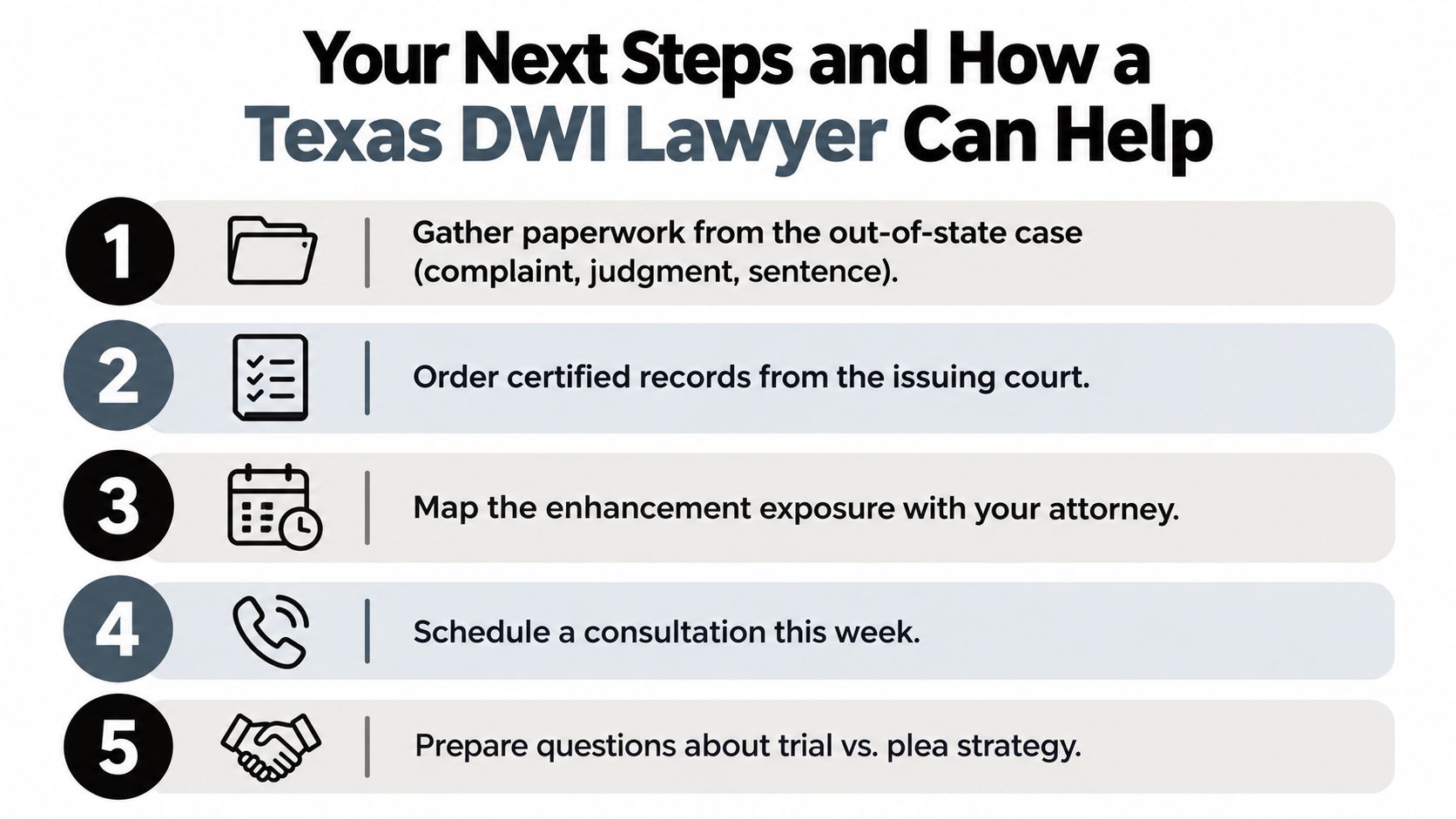
The phrase out of state DWI prior used for enhancement Texas describes a serious issue, but it doesn't describe an automatic result. A mismatched statute, defective certification, missing final judgment, or weak identity link can make the difference between a lower-level case and felony exposure. If you're searching for a Houston DWI lawyer, a Texas DUI attorney, or counsel to help you fight DWI charges in Texas, bring the records and get the enhancement analyzed before accepting the State's version of your history.
The Law Office of Bryan Fagan, PLLC offers consultations for Texans and out-of-state drivers facing DWI charges, including cases involving prior convictions, ALR proceedings, CDL concerns, and evidence challenges. Visit Law Office of Bryan Fagan, PLLC to request a free case evaluation and discuss your records with a Texas DWI defense team.
