
A DWI arrest can be overwhelming, and a conviction can make you feel as though every option has disappeared. You may be worried about your license, employment, family, insurance, or professional reputation. You don't have to face the post-conviction process alone, but you do need to act quickly because Texas deadlines depend on the court that entered the judgment and the date sentence was imposed.
A motion for new trial after a Texas DWI conviction is not the same as a general appeal. It's a targeted request asking the trial court to set aside the finding or verdict of guilt and rehear the criminal action. Used correctly, it can give the judge an opportunity to correct a serious error and help your defense team create a record for appellate review.
Why a Motion for New Trial Matters After a DWI Conviction
Consider a common post-trial situation. You've just been sentenced after a DWI trial. During the case, the court admitted breath-test evidence that your lawyer believes was unreliable, or a key witness changed an important part of the testimony. You leave the courtroom thinking the verdict is final, but your attorney identifies a specific issue that the trial judge needs to address before an appeal moves forward.
That is where a motion for new trial can matter. Texas courts describe a new trial as a rehearing of the criminal action after the trial court sets aside a finding or verdict of guilt. The motion can challenge legal or factual errors connected to the DWI trial, including newly discovered evidence, jury misconduct, ineffective assistance, and improper admission or exclusion of evidence. These grounds must be developed with facts and a usable record, not just with frustration about the result.

A motion is different from an appeal
A direct appeal generally asks an appellate court to review legal errors shown by the existing record. A motion for new trial gives the original trial judge a chance to correct an error first and, when necessary, allows counsel to develop testimony, affidavits, exhibits, or other evidence that wasn't fully presented during trial.
That difference creates an important trade-off. You may have only a short period to investigate a late-discovered breath-test maintenance issue, an undisclosed laboratory record, a questionable retrograde-extrapolation assumption, or new impeachment evidence. Yet waiting to develop every detail can leave the motion outside the filing deadline. Counsel must file a legally sufficient motion on time and continue building the supporting record for presentation and hearing.
Practical rule: A motion for new trial succeeds through specific grounds and evidence, not through a general statement that the verdict was unfair.
The motion also doesn't automatically erase the conviction, restore driving privileges, or resolve a separate Texas Department of Public Safety administrative matter. A criminal motion attacks the judgment in the DWI case. An administrative license suspension, often called an ALR matter, follows its own rules and concerns your driving privilege rather than the criminal judgment.
A new trial can return the case to its pretrial posture if the judge grants relief. That means your defense team may need to reassess suppression issues, discovery, plea options, expert analysis, and trial strategy. A careful review of post-conviction options after a DWI can help you understand how a motion fits with an appeal, habeas procedure, or other available remedies.
Critical Deadlines and Filing Requirements by Court Level
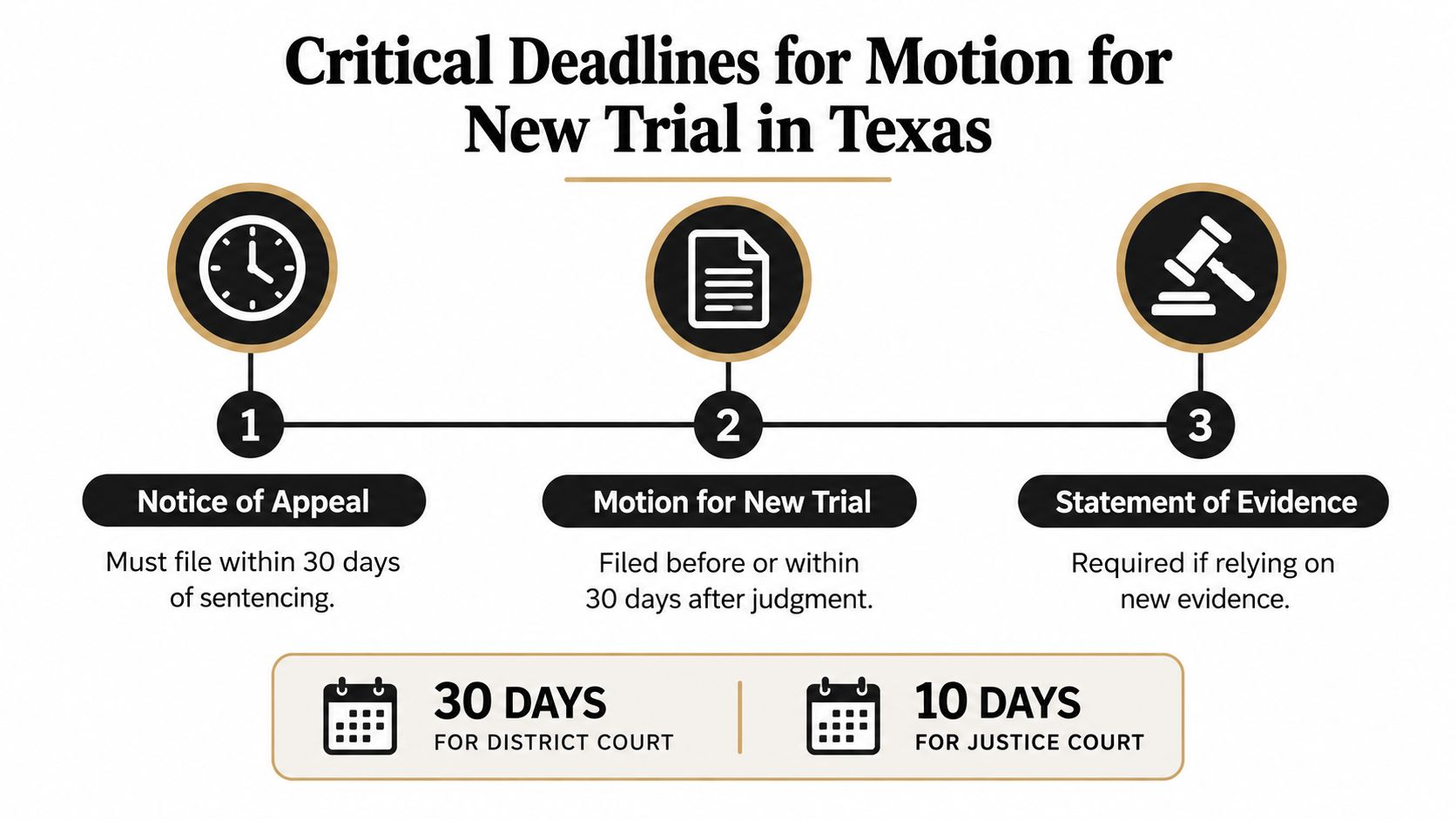
A missed deadline can end the motion before the court considers the underlying problem. In a Texas district or county criminal court, Rule 21 generally allows a written motion for new trial before sentencing or no later than 30 days after the trial court imposes or suspends sentence in open court. The deadline runs from sentencing, not just from the jury's guilty verdict. The applicable rule is set out in the Texas Rules of Appellate Procedure.
The motion generally must be presented to the trial court within 10 days after filing. The court must rule within 75 days after sentencing. If the judge has not signed an order granting or denying relief by then, the motion is overruled by operation of law. Filing the document is only the first step. Counsel must confirm presentation, request a ruling, and preserve any hearing and evidentiary record needed for later appellate review.
Lower courts use different clocks
A DWI case in justice or municipal court may proceed under Chapter 45A of the Texas Code of Criminal Procedure rather than the district-court procedure. Under that framework, the defendant must make the motion within five days after imposition of judgment and sentence. The judge may grant the motion for good cause shown, generally only through the 10th day after judgment. If the court has not granted it before the 11th day, the motion is deemed denied, and only one new trial may be granted in the same case. Review the applicable Chapter 45A provisions before applying a district-court deadline.
Municipal courts of record may follow a separate statutory framework. A written motion generally must be filed within 10 days after judgment, identify the points of error, and may be amended with court permission within the statutory limits. If the court does not rule during the required determination period, the motion is overruled by operation of law. Confirm the court level from the judgment and docket. The charge name alone does not establish the governing deadline.
| Court setting | Filing rule that may apply | Immediate concern |
|---|---|---|
| District or county criminal court | Before sentencing or within 30 days after sentence is imposed or suspended in open court | Record the sentencing date and present the motion promptly |
| Justice or municipal court under Chapter 45A | Within five days after judgment and sentence | Do not apply the district-court deadline |
| Municipal court of record | Generally within 10 days after judgment | State the points of error and track the ruling period |
Obtain the signed judgment first. Then confirm the court, record the exact sentencing date, and calculate both filing and presentation deadlines. A Texas DWI Defense Lawyer may defend a driver charged under Texas Penal Code 49.04, but post-trial counsel must also apply the procedural rules for the specific court.
Identifying Valid Legal and Factual Grounds for the Motion
A motion for new trial isn't a second opportunity to tell the judge that the jury made the wrong choice. It must identify a legally recognized error or newly developed fact that matters to the verdict or sentence. The motion should connect the ground to the record and explain why the problem could have affected the outcome.
Evidence and trial errors that may support relief
Newly discovered evidence can be important when it's material, favorable to the accused, and wasn't available through reasonable efforts before trial. In a DWI case, that might involve a late-discovered breath-test maintenance record, a laboratory document that wasn't disclosed, or a witness who becomes available with information that directly affects a central issue. The evidence must be more than cumulative or marginal. Counsel must explain its significance and why it could change the result.
Other possible grounds include:
- Chemical-test problems: The motion may address improper admission of blood or breath evidence, missing foundation, unreliable testing procedures, or a legal error concerning admissibility. The defense must identify the ruling and show how the record supports the complaint.
- Jury-charge error: An incorrect instruction, a denied requested instruction, or another charge defect may affect the jury's decision. The precise language and objection history matter.
- Jury misconduct: Outside information, improper communications, or other misconduct may require testimony or affidavits because the trial record may not contain the relevant facts.
- Ineffective assistance: A claim may involve a serious attorney error apparent from the record, such as failing to address a critical issue. Claims based on facts outside the record often require affidavits or an evidentiary hearing.
- Other preserved legal errors: Improper admission of prior DWI convictions, exclusion of defense evidence, or denial of a meaningful opportunity to present a defense may warrant careful review.
The record determines practical value
A generalized claim that the verdict was against the evidence usually does little by itself. The motion needs a specific complaint, supporting authority, and evidence showing what happened. If the issue depends on a conversation, a missing document, or an expert's explanation, filing only a legal brief may leave the judge without a basis to grant relief.
For example, saying that a breath test was unreliable isn't enough. The defense may need maintenance records, calibration information, testimony from a qualified witness, or a clear explanation of how the testing issue affects the evidence admitted at trial. A focused review of when DWI evidence can be suppressed can help identify whether the complaint concerns collection, testing, foundation, or courtroom admission.
The motion's purpose determines the work. One lawyer may use it to seek a new trial based on newly discovered evidence. Another may focus on preserving a claim for appeal. A third may need to develop an ineffective-assistance record. Those strategies aren't interchangeable, and a timely filing doesn't automatically preserve every issue.
Preparing the Required Documents and Supporting Evidence
The motion itself is only the framework. The supporting materials show the judge what happened, what changed, and why the issue deserves relief. If the claim depends on disputed facts, the court needs evidence it can evaluate.
Build the filing around the actual ground
A strong filing commonly includes:
- A written motion: State each ground separately. Identify the ruling, omission, newly discovered fact, or misconduct at issue. Explain the requested relief and connect the argument to the trial record.
- Sworn affidavits: Use affidavits from witnesses, experts, or other people with direct knowledge when the issue depends on facts outside the transcript. An affidavit should address what the person knows, how they know it, and why it matters.
- Exhibits: Attach relevant maintenance records, laboratory documents, correspondence, photographs, expert materials, or other admissible supporting documents. Label them clearly and identify their relationship to each ground.
- A request for an evidentiary hearing: Ask for a hearing when the judge must resolve factual disputes or assess testimony. A hearing request should explain what evidence will be presented and why the existing record isn't enough.
- A request for a written ruling: A written order makes the court's action clear and helps counsel manage appellate deadlines and the record.
A lawyer should also review the reporter's record and clerk's record, then determine which exhibits and testimony must be included for appellate review. Preservation isn't automatic just because an issue appears in the motion. If evidence is necessary, counsel must present the testimony, exhibits, or affidavits to the trial court.
The supporting record can be especially important in a claim involving a blood or breath test. A technical allegation without the underlying document or qualified explanation may not give the judge a reliable basis to act. The same problem arises when a client believes trial counsel failed to investigate. The motion must identify the missing investigation, show the available proof, and explain how the omission harmed the defense.
Evidence beats labels. Calling a problem “newly discovered” or “ineffective assistance” doesn't replace the affidavits, records, and testimony needed to prove it.
A timely motion also requires administrative follow-through. Confirm that the clerk received and docketed the filing, verify the hearing setting, arrange for the reporter's record when appropriate, and calendar the court's ruling deadline. The motion's practical value often depends on this careful coordination.
A short visual explanation of the post-trial process can supplement, but not replace, individualized legal advice.
Navigating the Hearing Process and Appellate Implications
A hearing turns the motion from a filing into a focused request for relief. Defense counsel presents the alleged error or newly discovered evidence, introduces the supporting materials, and explains why the court should set aside the conviction and order a new trial. The prosecutor may challenge the evidence, argue that the issue was already addressed, or contend that the alleged error did not affect the result.
The judge may decide the matter from the existing record, review affidavits, hear live testimony, or request clarification. The appropriate presentation depends on the ground raised. A legal error apparent from the transcript may call for targeted briefing. Alleged jury misconduct, an incomplete investigation, or another fact-dependent claim may require testimony and exhibits.
The hearing also gives the defense a chance to obtain a clear ruling on each disputed issue. That ruling can define what the appellate court can review and reveal which arguments require a different post-conviction procedure.
What the judge's ruling means
In district and county criminal courts, the trial court must rule within 75 days after sentencing. If the judge does not sign a written order granting or denying the motion during that period, the motion is overruled by operation of law. Counsel should request a written ruling, confirm the court's action, and preserve the hearing record instead of treating silence as an explanation of the court's reasoning. Municipal-court procedure may follow different rules, so the court level must be confirmed before relying on this deadline. The governing municipal-court framework is available through the Texas Chapter 45A criminal procedure statutes.
If the motion is granted, the case generally returns to its pretrial posture. That result does not guarantee dismissal or acquittal. The defense must decide whether to renew suppression litigation, pursue discovery, negotiate, or prepare for another trial using the court's ruling and any newly developed evidence.
If the motion is denied, appellate planning becomes central. A motion for new trial can preserve complaints and develop facts that do not appear in the trial transcript. Counsel must still separate issues shown by the existing record from claims that depend on testimony, affidavits, or exhibits. A direct appeal reviews the preserved record. It does not replace the need to develop every factual claim in the trial court.
Timing advantages and strategic limits
A timely motion for new trial can extend the period for filing the criminal notice of appeal to 90 days and the period for filing the appellate record to 120 days. Without a timely motion, the appellate record is generally due within 60 days after sentencing. The additional time can help appellate counsel obtain the hearing transcript, organize exhibits, and assess the trial court's ruling.
The extension does not justify filing an empty motion. It should have a defined purpose, such as seeking relief based on new evidence, obtaining a ruling on a serious legal error, or building a factual record for appellate review. It also does not suspend every consequence of the conviction or resolve an ALR proceeding.
For practical guidance on coordinating post-trial litigation with appellate review, see how to appeal a DWI conviction in Texas. Treat the motion, notice of appeal, record preparation, and any license-related proceeding as connected parts of one plan, while handling each under its own deadlines and procedural requirements.
When to Hire an Experienced Houston DWI Lawyer
Post-conviction practice leaves little room for informal assumptions. The court level may change the filing period, the sentencing date may control the deadline, and a new-evidence claim may fail if counsel doesn't present the proof needed for the judge to evaluate it. A person who waits for the written judgment, assumes a 30-day period applies everywhere, or treats an appeal as a complete substitute for a motion can lose valuable procedural protection.
An experienced Houston DWI lawyer can review the judgment, confirm the court, calculate the correct deadline, and identify whether the motion should focus on a legal error, factual development, jury misconduct, ineffective assistance, or newly discovered evidence. Counsel can also coordinate affidavits, expert review, exhibits, an evidentiary hearing, the reporter's record, and the notice of appeal.
You should also understand the related terminology. BAC, or blood alcohol concentration, refers to the alcohol concentration measured in a person's blood or reflected through an approved testing process. A field sobriety test is a group of roadside exercises officers may use to assess suspected impairment. Implied consent refers to Texas's statutory framework governing a driver's agreement to provide a specimen under specified circumstances, while an administrative license suspension is a separate DPS action involving driving privileges after an alleged refusal or failed chemical test.
A first DWI in Texas can create criminal and administrative concerns at the same time. If you're searching for a Texas DUI attorney, need to fight DWI charges in Texas, or are dealing with a DWI license suspension, get advice tied to your actual court and dates. Don't assume a motion for new trial will automatically restore your license, undo the conviction, or protect every appellate issue.
The Law Office of Bryan Fagan, PLLC offers DWI defense, ALR representation, trial counsel, and post-conviction guidance for Texans facing these decisions. Request a free consultation and bring your judgment, sentencing information, and any documents related to the alleged testing or trial error.
The Law Office of Bryan Fagan, PLLC can review your Texas DWI conviction, identify the correct post-trial deadline, and evaluate whether a motion for new trial or appellate strategy fits your case. Contact the firm for a free case evaluation so your rights, license concerns, and available defenses receive prompt attention.
