
A fatal crash ends with your phone ringing and a detective asking for a statement. Or you've bonded out and are trying to understand the paperwork in front of you. Before you respond, learn what manslaughter in Texas means and what the State must prove. The number of people who died and whether your case ends in a plea or trial can change your sentencing exposure. DPS license proceedings follow a separate timeline.
Manslaughter in Texas at a Glance
The offense line on your charging document identifies the statute the State has filed under. Under Penal Code §19.04, manslaughter means recklessly causing another person's death, and it is a second-degree felony.
Recklessly has a specific meaning. The State must allege that you were aware of a substantial, unjustifiable risk and went ahead anyway. That differs from an ordinary mistake or carelessness. The distinction can affect which offense applies to the facts of your case.
How to Read the Offense Ladder
The table compares homicide offenses and their listed punishment ranges. The felony level helps set the range, but the number of victims and the path your case takes can change your actual sentencing exposure. Multiple deaths in one criminal transaction can raise an intoxication manslaughter charge to a first-degree felony. A plea and a trial can also lead to different outcomes within the applicable range.
| Offense | Statute | Felony level | Prison range | Maximum fine |
|---|---|---|---|---|
| Manslaughter | Penal Code §19.04 | Second-degree felony | 2 to 20 years | Up to $10,000 |
| Intoxication manslaughter | Penal Code §49.08 | Second-degree felony | 2 to 20 years | Up to $10,000 |
| Intoxication manslaughter, more than one death in the same criminal transaction | Penal Code §49.08 (as amended effective Sept. 1, 2023) | First-degree felony | 5 to 99 years or life | Up to $10,000 |
| Criminally negligent homicide | Penal Code §19.05 | State jail felony | 180 days to 2 years | Up to $10,000 |
| Murder (for comparison) | Penal Code §19.02 | First-degree felony | 5 to 99 years or life | Up to $10,000 |
Use the row for the charged offense as the outer limit of the listed range, then compare it with the facts of your case. Two cases under the same statute can end differently. Judges and juries consider the evidence, prior record, and circumstances of the victim when determining the outcome.
Practical rule: Find the exact offense name and statute number in your charging paperwork first. Use that to identify the applicable row, rather than relying on a news headline or what an officer said at the scene.
Your First Check
- Match the paperwork: Confirm whether the charge cites §19.04, §49.08, or another statute.
- Confirm the level: Second-degree, first-degree, and state jail felony describe different offense levels.
- Ask about enhancements: Prior convictions or multiple deaths may affect the range that applies.
Take the charging paperwork to your attorney before relying on a range. A change in the charged offense can mean a substantial difference in years of exposure. If the case involves intoxication, keep the driver's license issue on your checklist too. The Texas Department of Public Safety license process runs separately from the criminal case, with its own deadlines. A Houston DWI lawyer or Texas DUI attorney can explain how the charge and license process apply to your situation.
How Texas Separates Manslaughter From Murder
Think of a dimmer switch. At the bright end is intent, where a person wants the result. In the middle is recklessness, where a person sees the danger and takes the chance anyway. At the dim end is criminal negligence, where a person should've noticed the danger but didn't.

Texas separates ordinary manslaughter from intoxication manslaughter through different provisions. Under Texas Penal Code Chapter 49 and §19.04, manslaughter generally involves recklessly causing another person's death and is a second-degree felony, while §49.08 covers operating a motor vehicle in a public place while intoxicated and, because of that intoxication, causing a death by accident or mistake.
The Mental State Table
| Offense | Mental state required | What the State must prove about the death | Typical example |
|---|---|---|---|
| Murder | Intent to kill or cause serious bodily injury, or conduct during a dangerous felony | The defendant's conduct caused the death with that mental state | Deliberate shooting during a dispute |
| Manslaughter | Recklessness, conscious disregard of a substantial, unjustifiable risk | The reckless conduct caused the death | Pointing a loaded gun at someone as a joke |
| Criminally negligent homicide | Criminal negligence, should have perceived the risk but did not | The failure to perceive the risk caused the death | Using faulty equipment without noticing the danger |
| Intoxication manslaughter | Intoxication while operating a vehicle in a public place; no intent to harm required | The intoxication caused the death by accident or mistake | Crossing the center line after drinking and striking an oncoming car |
A deliberate shooting sits at the intent end. Knowingly firing a gun near others as a joke shows the middle ground, because you saw the danger and acted anyway. Failing to notice faulty safety equipment is dimmer still. An intoxicated driver crossing the center line is different again, because the focus shifts to intoxication, operation, and causation.
A fatal accident doesn't automatically mean manslaughter. The State must prove the required mental state for ordinary manslaughter, or the required causal link for intoxication manslaughter. If you're also facing an injury allegation, learning how intoxication assault defense in Texas differs can clarify your paperwork.
For a plain walkthrough of what to expect at each stage of a Texas DWI criminal case, see The Texas DWI Court Process From Arrest to Resolution. Your defense often starts with one question. Which mental state, if any, does the evidence support?
Intoxication Manslaughter and the DWI Link
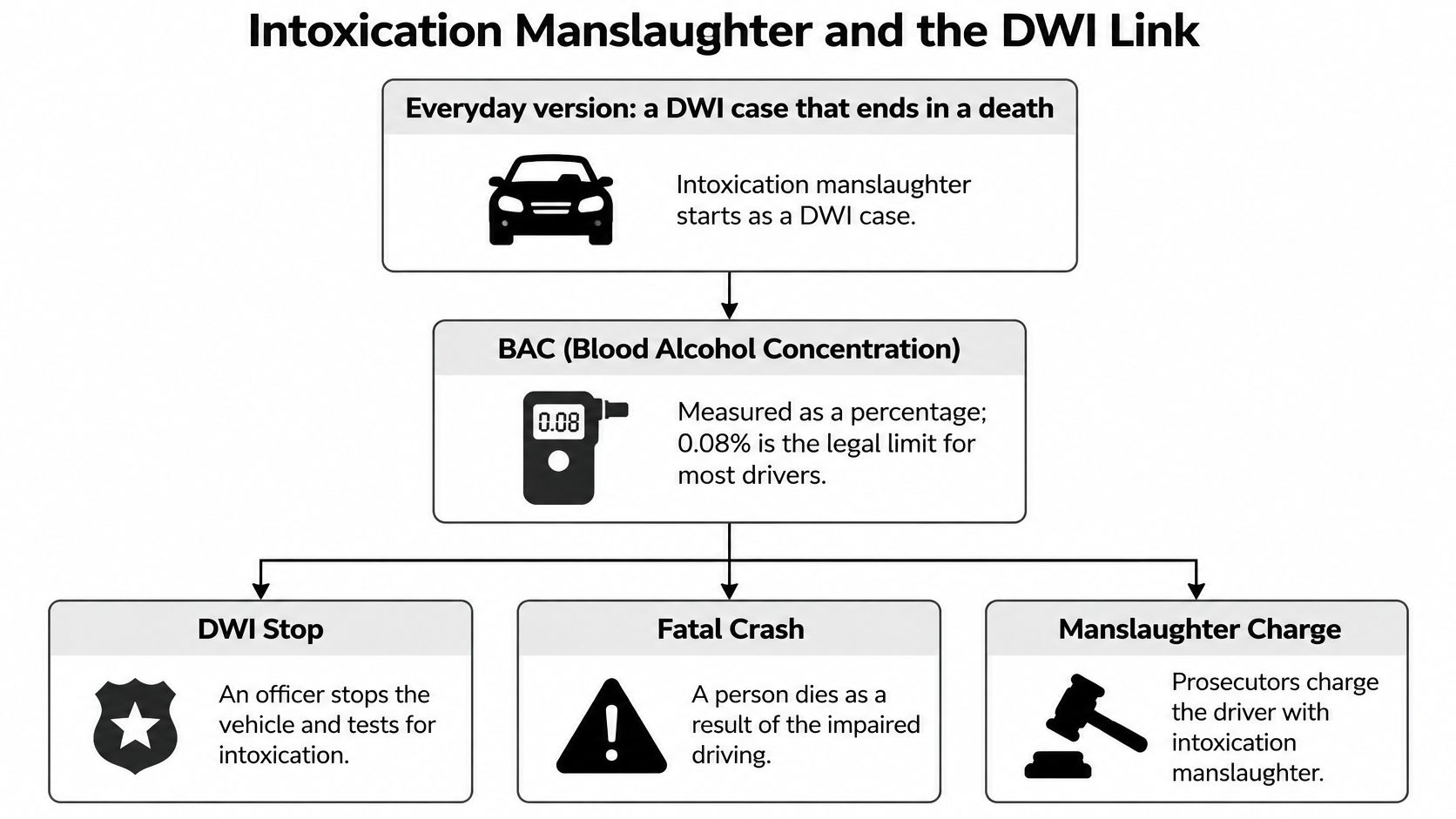
A night collision can lead to an intoxication manslaughter charge even when no one intended a death. For the charge to apply, the State must separately prove operation, intoxication, causation, and death. That is the key difference from ordinary manslaughter, which focuses on a person's mental state.
In everyday terms, intoxication manslaughter is a DWI case that ends in a death. Texas does not require proof that you meant to kill anyone. A prior record is not required either. BAC means blood alcohol concentration, measured as a percentage. For most drivers, 0.08% is the per-se intoxication level. A test number is not the only way to prove intoxication: alcohol or drugs can also leave you without the normal use of your mental or physical faculties.
The Four Links the State Needs
Each part requires proof:
- Operation: You operated a motor vehicle in a public place.
- Intoxication: You were legally intoxicated while operating it.
- Causation: Your intoxication caused the death.
- Death: Another person died by accident or mistake as a result.
The night-collision example shows why the links matter. Suppose visibility was poor, the other driver was speeding, and your last drink was hours earlier. Investigators may examine timing, crash reconstruction, and the other driver's conduct alongside any test result. Those details help establish how the collision happened and whether intoxication caused the death.
The statute covers more than cars. It also applies to aircraft, watercraft, amusement rides, and mobile amusement rides. Enhancements under §49.09 may raise the felony level in specified circumstances, including certain prior intoxication-related convictions. Your potential range depends on the applicable statute and your history.
Three Terms You'll Hear Immediately
Implied consent means that driving on Texas roads carries an agreement to provide a breath or blood specimen when lawfully requested after a DWI stop. Refusing can trigger a license penalty. A field sobriety test is a roadside exercise used to assess balance and coordination. In Texas, these tests are voluntary, and their results can be challenged.
Administrative license suspension is a civil penalty handled by DPS, separate from the criminal case. It affects your license and follows its own timeline, even while the criminal case is pending. That separate track is why a license deadline may arrive before the criminal case is resolved.
How Sentences Are Really Set After a Plea or Trial
Two cases with the same charge can lead to different sentencing exposure. The charging document, your record, the circumstances of the deaths, the evidence, and the judge's discretion all matter. In a case with multiple victims, the number of counts and whether you plead or go to trial also shape the possible total sentence.
Intoxication manslaughter is ordinarily a second-degree felony punishable by two to 20 years. A 2023 amendment created a first-degree felony classification when a defendant causes more than one person's death in the same criminal transaction, as described in Texas legislation analyzed by the Senate Research Center. For multiple counts, a guilty plea without an agreement with the State is limited to the maximum sentence for one count. After a trial, a judge may have discretion to stack sentences across counts.
Three Paths, Three Different Risks
| Resolution path | How the sentence is set | What you give up or risk |
|---|---|---|
| Plea agreement with the State | Sentence negotiated and agreed before the judge accepts the plea | Trial rights; a felony conviction is entered |
| Open guilty plea with no agreement | Judge sets the sentence within the range; for multiple counts, a plea is limited to the maximum for a single count | Trial rights and less control over the final number |
| Conviction after trial | Judge may have discretion to stack sentences across multiple counts | Highest aggregate risk when more than one death is involved |
A plea may limit the total exposure across multiple counts, but it requires you to give up trial rights and accept a criminal conviction. Going to trial lets you challenge the State's proof. If you are convicted on multiple counts, though, stacked sentences may increase the total time you face.
The number of victims and whether you plead or go to trial determine your total sentencing exposure.
Keep statutory exposure distinct from the likely result in your case. Community supervision, often called probation, depends on the offense and your prior record. Ask your attorney whether it may be available before making a plea decision.
The effects of a felony conviction can continue after a sentence ends. If you are a commercial driver, a licensed professional, or an out-of-state defendant, a conviction may affect your license, employment, or immigration status. Your attorney should assess those risks before you decide whether to plead.
Defenses That Challenge Causation and Intent
A defense isn't an excuse. It's a challenge to whether the State can prove every element beyond a reasonable doubt. In many fatal crash cases, causation, not the fact a crash happened, is where the case is decided.
Under Penal Code §49.08 as set out in the Texas statutes, the prosecution must establish operation of a covered vehicle in a public place, legal intoxication, and that by reason of that intoxication you caused another person's death by accident or mistake, and proof of intoxication and a fatal collision alone doesn't resolve whether intoxication was the producing cause.
Five Defense Categories to Review
- Causation: Reconstruction may show the other driver's speed, a sudden medical event, mechanical failure, weather, or a road defect caused the death, not your intoxication.
- Intoxication timing: Blood drawn hours after driving may not reflect your level while driving, and testing, labeling, or handling errors can be challenged.
- Mental state: In a reckless manslaughter case, evidence may show you didn't consciously disregard a known risk, which undermines the required recklessness.
- Evidence problems: An unlawful stop, a blood draw without a valid warrant or consent, or a broken chain of custody can support suppression of key evidence.
- Negotiation: Weak proof on mental state or causation may support reducing the charge to criminally negligent homicide or another lesser offense.
Consider a driver who tests over the limit at a hospital, but reconstruction shows the other car ran a red light at high speed. The test matters, but it doesn't answer whether intoxication produced the death. Roadway marks, vehicle data, visibility, and witness accounts can point in a different direction.
Timing works the same way. If you drank shortly before driving, alcohol may not have been absorbed yet while you were on the road, even if a later sample is higher. Your lawyer should compare stop time, crash time, and draw time line by line.
No category guarantees an outcome. Each depends on the specific evidence in your file, and a strategy that helps one client can hurt another. What you can control is getting that evidence reviewed early, before video is lost or vehicles are repaired or destroyed.
How a Manslaughter Case Moves From Arrest to Appeal
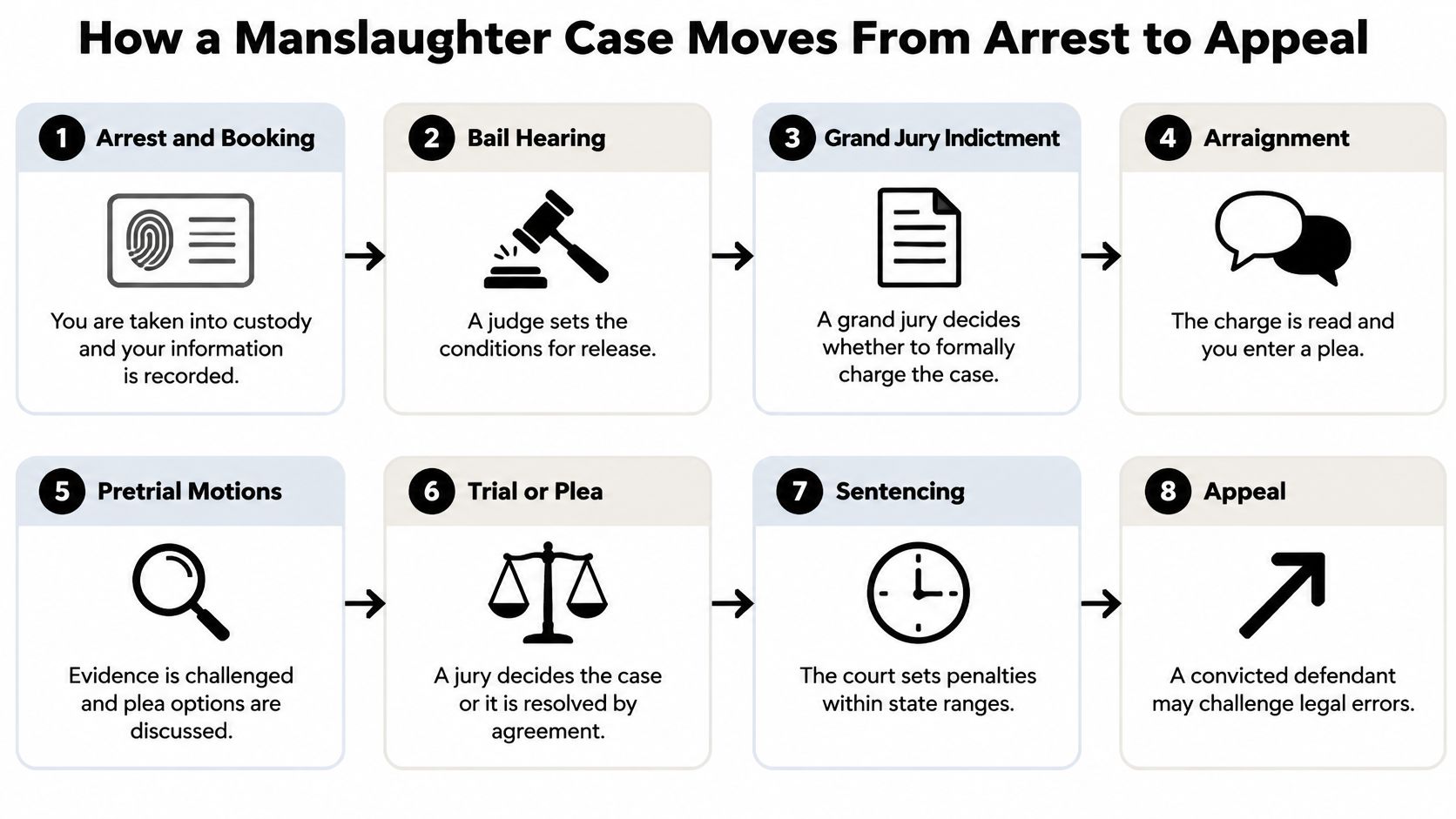
After a fatal crash, you may face a criminal case, bond rules, and a separate license proceeding at the same time. Each has its own steps and deadlines. Knowing what to expect can help you and your lawyer act in the right order.
The Criminal Track in Order
- Arrest and booking: You are taken into custody, and the charge is recorded.
- Bond setting: A magistrate sets release conditions, which may restrict driving or alcohol use.
- Grand jury indictment: A grand jury decides whether to formally charge you with a felony.
- Arraignment: The charge is read, and you enter a plea.
- Pretrial motions: Your lawyer may ask the court to suppress evidence obtained unlawfully.
- Plea negotiations: You and the prosecutor consider whether to resolve the case by agreement. The possible outcome depends on the evidence and the terms offered.
- Jury trial: If there is no agreement, a jury decides whether the state proved the charge.
- Sentencing: If you plead guilty or are found guilty, the court imposes punishment within the applicable range. The number of victims and whether the case ends in a plea or a trial can affect your exposure.
- Appeal: An appeal must begin within a short deadline after sentencing. Review how to appeal a DWI conviction in Texas promptly with your lawyer.
The Separate License Track
The Department of Public Safety's Administrative License Revocation, or ALR, process is a civil proceeding tied to a DWI arrest, not a stage in the manslaughter prosecution. Under the DPS Administrative License Revocation program, you generally have 15 days after receiving the suspension notice to request a hearing. If you miss that deadline, the suspension begins on the 40th day after service, and late requests are denied.
A hearing request is a formal step, not just a call asking DPS to wait. Your lawyer can file the request and prepare to challenge issues such as reasonable suspicion, probable cause, refusal procedures, or whether statutory conditions were met. The hearing gives you a chance to contest the proposed suspension.
| Track | Key deadline | If you miss it |
|---|---|---|
| Criminal case | Set by the court and charging document; appeal must start within a short deadline after sentencing | The appeal can be lost |
| ALR license track | 15 days after the suspension notice is served to request a hearing | Suspension begins on day 40, and late requests are denied |
| Bond conditions | Apply from release until the case ends | A violation can lead to revocation of bond |
Keep the court calendar, license deadline, and bond rules in view together. A step in one proceeding does not complete the requirements in another. Your lawyer can help track each obligation and explain what action is due next.
Take Your Next Step Before the Deadlines Pass
An arrest or an investigator's call can leave you unsure what to do first. Start with what you can control: keep your records together, avoid discussing the incident publicly, and track each deadline. The criminal case and your driver's license matter follow separate timelines.

Your First Days Checklist
- Keep one folder: Save arrest and bond paperwork, the ALR notice, and any written record of the stop together.
- Ask for counsel: Tell officers you want to speak with an attorney before answering questions about the crash.
- Stay off social media: Don't post about the crash, the victims, drinking, or driving.
- Follow bond exactly: Obey every condition involving driving, alcohol, travel, and check-ins.
- Check for an investigation: Ask an attorney whether a death investigation is open, even if no charge has been filed.
Contact a lawyer after an arrest, before deciding whether to plead, and in time to address any ALR deadline. Seek advice sooner if investigators continue contacting you or you hold a commercial or professional license. Ask whether the ALR request deadline has already been calculated from the date you were served.
A crash involving injury or death can create legal issues beyond the criminal charge. The overview of DWI accidents or injuries in Texas explains how the circumstances of a crash can affect a DWI case. You can also ask how DWI civil liability may relate to potential claims separate from the criminal prosecution.
The Law Office of Bryan Fagan, PLLC, led by Managing Attorney Bryan Fagan, offers free consultations and 24/7 support, with local experience in Houston, Dallas–Fort Worth, Austin, and San Antonio. If you need a Houston DWI lawyer or a Texas DUI attorney, the firm can review your manslaughter charge and explain the next steps. Visit Law Office of Bryan Fagan, PLLC to request a consultation and discuss your case.
