
Under Texas Code of Criminal Procedure Article 42.03, qualifying pre-sentence jail time generally must be credited toward the sentence, but confinement served as a condition of DWI probation is treated separately and does not automatically reduce a later sentence. The key question isn't how many days you spent in custody, but why you were held and what order placed you there.
A DWI arrest can be overwhelming, especially when you've spent nights in county jail and are now looking at a judgment, probation terms, and unfamiliar phrases such as “credit for time served.” You may be asking whether those days are already satisfied, whether they count toward probation, or whether they can reduce a sentence after a violation. Those questions are reasonable, but the answer depends on the legal category of each custody period.
Why Jail Time Credit in a Texas DWI Case Is More Complicated Than It Sounds
Suppose you were arrested, held in county jail, released on bond, and later accepted probation. Your paperwork might show one total number of days in custody. Texas law may treat those days differently because they happened at different points in the case or resulted from different court orders.
The phrase jail time credit sounds like one rule. It isn't. Texas separates ordinary pre-sentence custody from confinement ordered as a condition of community supervision, and it may treat post-revocation confinement under another rule altogether. The label attached to the jail stay can matter more than the calendar count.
Article 42.03 in plain English
Texas Code of Criminal Procedure Article 42.03, Section 2(a), generally requires the sentencing judge to credit time you spent confined in jail for the case, beginning with arrest and confinement and continuing through sentencing. The statutory text separately excludes confinement served as a condition of community supervision. You can review the statute in the Texas Code of Criminal Procedure.
That means qualifying custody before sentencing is not treated the same way as jail you serve because probation conditions require it. The statute uses “sentence” and “community supervision” as distinct concepts, so your judgment and written probation conditions deserve close attention.
Practical rule: Don't count every day you were physically behind bars until you know the legal reason for each stay.
Why the timing matters
A person may receive credit for arrest-related custody, while a separate jail condition imposed after probation begins may not automatically reduce a later sentence. If probation is later revoked, another statute can affect whether earlier probation-condition confinement receives credit against the revocation sentence.
For a reliable calculation, gather the arrest date, release date, sentencing date, probation order, and any revocation paperwork. The right question isn't only, “How many days did I serve?” It is, “Which order required those days, and which sentence is the credit supposed to reduce?”
The Three Categories of Jail Time in a Texas DWI
Most DWI custody questions become easier when you sort the days into three categories. The categories depend on when you were confined and why the court or jail held you.
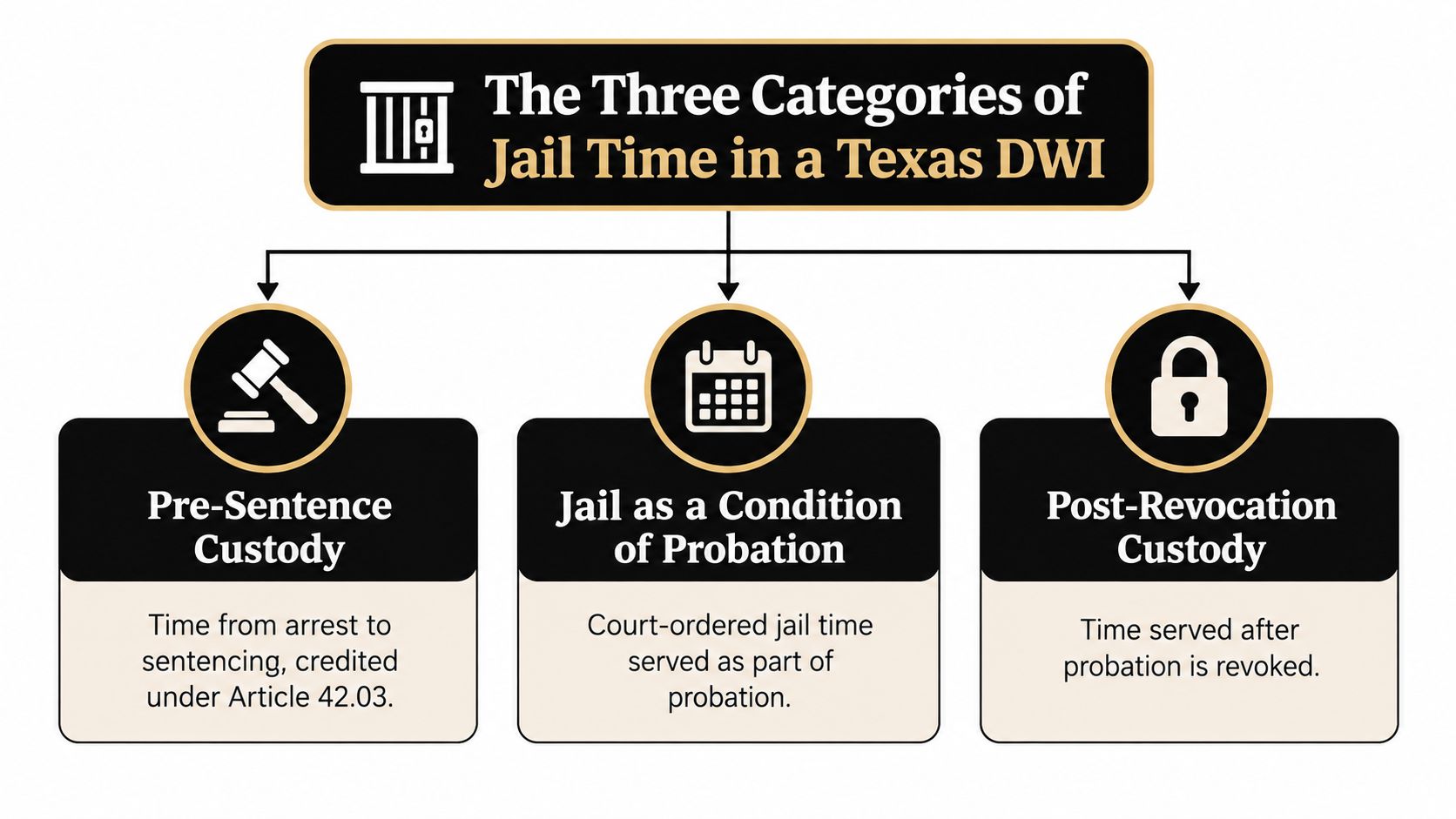
First category, pre-sentence custody
This is jail time after arrest and before the court pronounces sentence, when the confinement is for the DWI case. Article 42.03 generally requires that qualifying time to be credited against the sentence imposed.
For example, if you were arrested on a DWI charge, remained in the county jail, and were sentenced while still confined, those custody dates should be compared with the judgment's credit notation. If you were released on bond, the days you were out of custody aren't jail days for purposes of this calculation.
Second category, jail as a probation condition
A court may order jail confinement as an initial condition of community supervision. That confinement isn't automatically the same as pre-sentence custody under Article 42.03. Chapter 42A governs community supervision, and the written probation conditions should identify what the court ordered.
For example, a judgment might place you on probation and require you to complete a specified jail condition. Those days may satisfy that probation requirement, but you shouldn't assume they automatically reduce every later sentence. The court order and applicable statute control.
Third category, custody after revocation
If the State alleges a probation violation and the court revokes community supervision, the court may impose a new confinement term. Article 42A.401 addresses this situation and can prevent time served under a community-supervision confinement provision from being credited toward the revocation sentence.
| Custody category | Common reason for custody | Main legal question |
|---|---|---|
| Pre-sentence custody | Held after arrest and before sentencing | Was the time for this case and before sentence? |
| Probation-condition confinement | Jail ordered as part of community supervision | Did the written conditions create the jail requirement? |
| Post-revocation custody | Confinement imposed after an alleged violation | Does Article 42A.401 limit credit against the new sentence? |
The same number of calendar days can produce different results in these three categories. That is why the judgment, probation conditions, commitment papers, and jail records should be read together.
How DWI Minimums and Jail Credit Interact Under §49.04
The offense level comes before the credit calculation. Under Texas Penal Code Section 49.04, a standard DWI is generally a Class B misdemeanor with a minimum 72-hour confinement term. If an open container is involved, the minimum confinement increases to six days. If the alcohol concentration is 0.15 or more at the time of testing, the offense becomes a Class A misdemeanor. The applicable statutory language appears in the Texas Penal Code.
Start with the charged subsection
Before asking whether jail credit satisfies a minimum, confirm what the charging instrument alleges. The alcohol-concentration result may change the misdemeanor classification, while an open-container allegation may change the minimum confinement. A lawyer reviewing a Texas DWI Defense Lawyer resource will focus on the charge under Penal Code Section 49.04, but your own judgment and laboratory records control your case.
Qualifying pre-sentence custody can satisfy all or part of a mandatory minimum. That doesn't change the classification of the offense, erase community-supervision requirements, or cancel license consequences.
A simple calendar example
Assume a person is arrested on a Friday and remains confined through Monday sentencing. If those dates represent qualifying pre-sentence custody for the DWI case, the time should be compared with the 72-hour minimum for a standard Class B DWI. The exact official count depends on the jail records, the sentencing date, and the judgment.
That credit calculation still doesn't answer every question. Even if the pre-sentence custody satisfies the minimum confinement, probation may continue with reporting, treatment, alcohol monitoring, ignition-interlock obligations, fees, or other conditions. Criminal jail credit and community supervision are separate parts of the case.
A sentence credit can reduce confinement without shortening the rest of your probation obligations.
If the case involves an open container or a BAC of 0.15 or more, don't use the standard Class B framework without checking the charged subsection and the test result. A precise review compares the statutory minimum, the actual qualifying custody, the judgment, and any separate probation condition.
Jail Credit vs. Good Conduct Credit vs. Diligent Participation Credit
People often use “credit” as though it describes one benefit. In Texas, it can refer to different legal mechanisms with different eligibility rules.
Article 42.03 jail credit concerns qualifying pre-sentence confinement tied to the case. It is calculated from the actual custody period and is applied against the sentence imposed. It isn't the same as a reduction earned through conduct or programming while serving a sentence.
Good-conduct credit generally relates to time served under correctional rules. It doesn't transform probation-condition confinement into mandatory pre-sentence credit, and it doesn't automatically shorten reporting requirements or other supervision terms.
Diligent-participation credit is a separate state-jail framework. Texas began allowing eligible state-jail prisoners to earn this credit in 2011 through approved work, educational, vocational, or treatment programs. The Texas Comptroller explains that the credit can reduce a state-jail sentence by up to 20 percent, subject to statutory requirements and judicial approval after program completion. The Texas Comptroller's explanation of the state-jail system describes that framework.
Compare the legal source before counting anything
Article 42A.559 treats diligent participation as limited and conditional. It can be relevant to certain state-jail or imprisonment sentences, but it isn't a general rule that a routine misdemeanor DWI probationer automatically receives a 20-percent reduction.
| Type of credit | What it addresses | What it doesn't automatically do |
|---|---|---|
| Article 42.03 credit | Qualifying pre-sentence custody | Erase supervision conditions |
| Good-conduct credit | Conduct during an eligible sentence | Convert probation jail into pre-sentence credit |
| Diligent-participation credit | Approved state-jail work, education, vocational, or treatment activity | Apply automatically to a routine misdemeanor DWI |
The same caution applies to probation paperwork. Credit against a sentence doesn't automatically shorten community supervision, remove ignition-interlock requirements, end treatment, or stop reporting. If you're trying to understand Texas DUI probation supervision, keep the sentence calculation separate from the conditions you must complete.
A Worked Example of Jail Time Credit Toward Texas DWI Probation
Consider a first-offense DWI case. The person is arrested on a Saturday morning, spends three days in custody before sentencing, is released on bond, and later receives probation with a 30-day jail condition and six months of community supervision.
The numbers in this example illustrate the categories. They don't replace the signed judgment or the official jail records.

Step one, identify the pre-sentence days
The person spent three days in custody before sentence. If all three days were for the DWI case and qualify under Article 42.03, those days should be recorded as credit toward the sentence. For a standard Class B DWI with a 72-hour minimum, those three days may satisfy that minimum, subject to the court's official calculation.
The person then posts bond. Time spent out on bond isn't jail custody. It doesn't add to the three days, even though the criminal case remains pending.
Step two, separate the probation condition
Later, the court imposes a 30-day jail condition as part of community supervision. Those days belong in a different column. Completing them may satisfy the condition, but they aren't automatically added to the Article 42.03 pre-sentence credit total.
A proposed judgment might identify the pre-sentence credit in language such as: “The defendant is credited with qualifying time served in custody from the applicable arrest and confinement dates through sentencing.” The exact language should be prepared and reviewed by counsel because the court's signed judgment controls.
| Custody period | Reason for detention | Counts toward sentence under 42.03 | Counts toward probation condition | Counts toward later revocation sentence |
|---|---|---|---|---|
| Three pre-sentence days | Held for the DWI before sentencing | Generally yes | No, not as a probation condition | Depends on the later order and applicable law |
| Time released on bond | Not confined | No | No | No |
| 30-day jail condition | Initial community-supervision requirement | Not automatically | Yes, if completed as ordered | May not reduce a later sentence under Article 42A.401 |
Step three, check the documents
The person should compare the arrest and release records with the judgment. Bond paperwork helps show when custody ended, while the probation order identifies the source of the 30-day requirement. If a later revocation occurs, the revocation order must be read separately rather than treating every prior day as interchangeable.
The six-month supervision period also remains a supervision obligation. Jail credit doesn't automatically end reporting, treatment, monitoring, or other written conditions.
When Probation Is Revoked After Jail Time Has Already Been Served
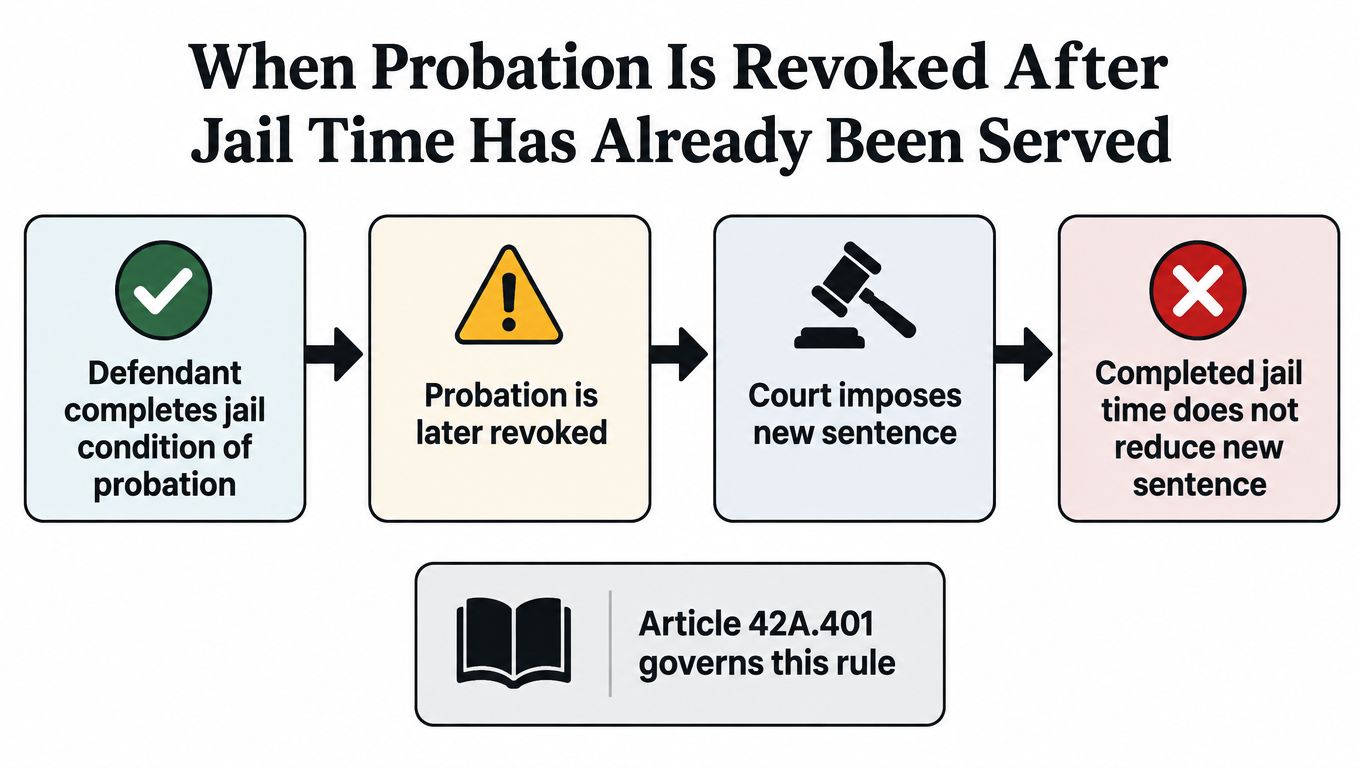
Many people receive an unwelcome surprise. A person can complete a mandatory jail condition during probation and later face a new confinement term after revocation. The earlier jail days don't necessarily reduce that later sentence.
Article 42A.401 addresses confinement imposed upon revocation and provides that time served under the statute's community-supervision confinement provision may not be credited toward the revocation sentence. The legal characterization of the earlier custody matters. It was served as a probation condition, not necessarily as pre-sentence custody against the later sentence.
Why the result feels counterintuitive
The person remembers spending time in jail and reasonably believes that time should count somewhere. But “time served,” “credit for time served,” and “jail as a condition of probation” aren't interchangeable labels.
The risk deserves particular attention in repeat DWI cases, felony DWI cases, and deferred-adjudication matters. The original judgment, written conditions of supervision, commitment papers, and revocation order may each answer a different part of the calculation.
Before you sign a revocation agreement or plead true to an alleged violation, have the proposed confinement and credit language compared with the original judgment.
If the paperwork contains an error, an informal conversation with a probation officer may not correct the sentence. Counsel may need to seek correction or judicial review through the appropriate court procedure. A lawyer reviewing a Texas DWI probation violation matter will need the complete record, not just the number of days remembered by the client.
The safest approach is to make a timeline before the revocation hearing. Mark the arrest-related custody, bond periods, probation-condition confinement, alleged violation date, and any post-revocation custody separately. Then compare each period with the order that created it.
Making Sure Jail Credit Is Actually Recorded
A correct legal theory doesn't help if the judgment leaves out the dates or describes the custody incorrectly. Credit should be checked before sentencing when possible, and promptly reviewed afterward if the signed judgment doesn't match the jail records.
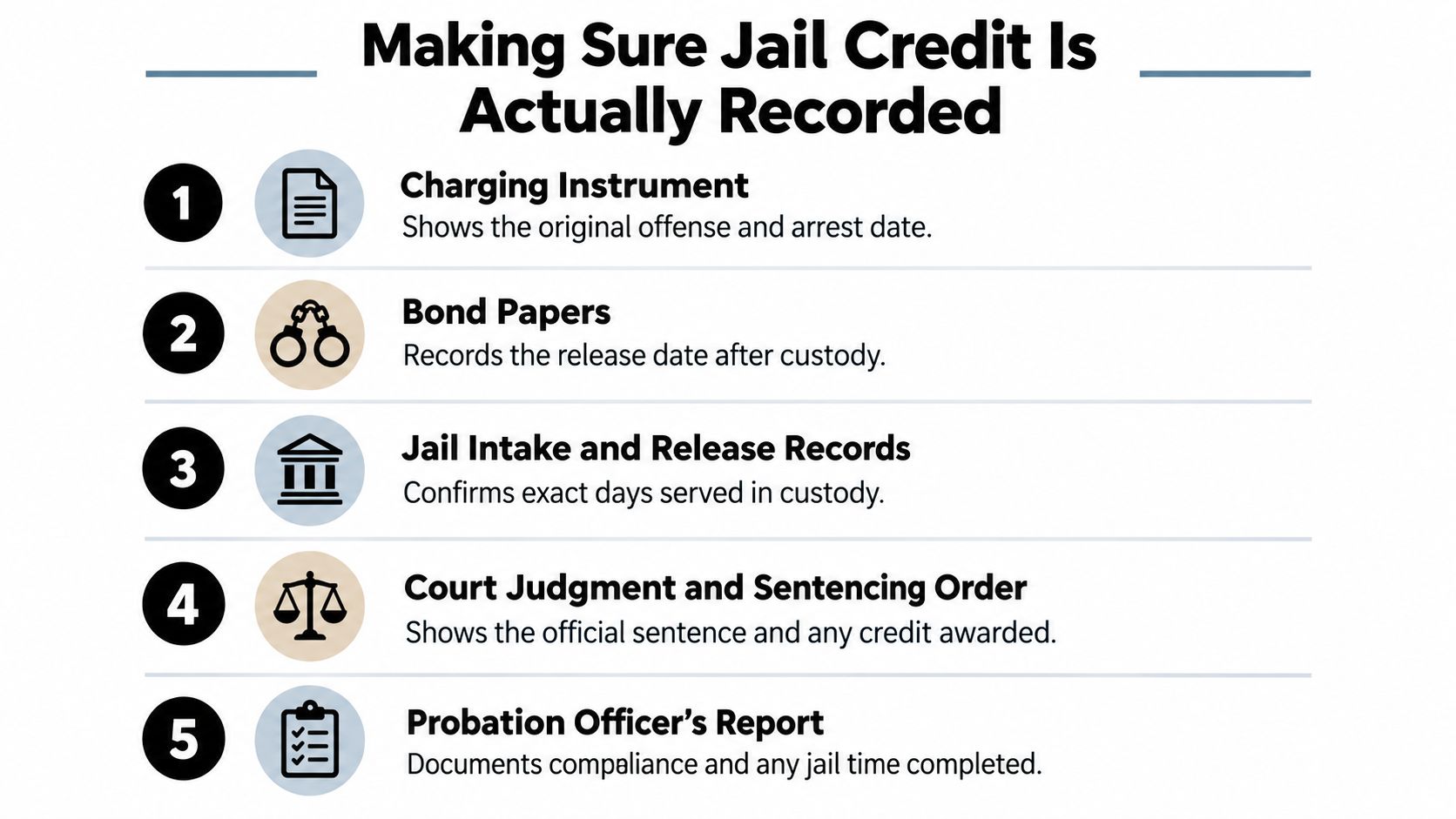
Build the custody file
Start with these records:
- Charging instrument: Confirm the offense, cause number, and arrest-related allegations.
- Bond papers: Establish when you were released and identify periods that were not custody.
- Jail intake and release records: Confirm the exact dates you entered and left custody.
- Court judgment and sentencing order: Show the sentence, credit awarded, and probation terms.
- Probation officer's report: Document compliance and any jail time completed under supervision.
The district or county clerk's file, jail records, and signed judgment should be compared line by line. If two documents conflict, don't rely on memory or an online calculation. Ask counsel to determine which record needs correction and what procedure applies.
Ask for express language
A judgment should state the qualifying credit clearly rather than leaving the issue to inference. Counsel can ask the court to identify the applicable arrest and confinement dates, the total credit awarded, and whether any separate jail term is a probation condition.
Bring a dated timeline to a credit review meeting. Include every booking and release date, the cause number, bond status, judgment, probation conditions, and any revocation or commitment order. Those documents let counsel distinguish a missing entry from a genuine disagreement about whether the time qualifies.
If the judgment omits qualifying pre-sentence credit, the appropriate remedy depends on the posture of the case and the nature of the error. Prompt review is valuable because the signed judgment and official records control the calculation.
Where Jail Credit Fits in the Bigger Texas DWI Picture
Jail credit is important, but it is only one part of a Texas DWI defense. The criminal case, probation case, and driver's-license case can move on separate tracks.
Texas DPS describes Administrative License Revocation, or ALR, as a civil process that may follow a refusal or failure to complete a qualifying blood or breath test, or a test showing a BAC of at least 0.08% for a noncommercial vehicle or 0.04% for a commercial motor vehicle. BAC means blood-alcohol concentration, the amount of alcohol measured in a person's blood or breath under the applicable testing method. The Texas DPS ALR program explains this separate process.
Know the license deadline
An ALR hearing is an administrative proceeding before the State Office of Administrative Hearings. DPS generally gives an arrested driver 15 days after service of the suspension notice to request the hearing. If no timely request is made, the suspension takes effect on the 40th day after service.
That deadline doesn't pause because you're disputing jail credit. A criminal dismissal, probation agreement, or sentence credit also doesn't automatically restore driving privileges.
The terms involved in the arrest deserve separate attention:
- Implied consent: Texas's statutory framework treats drivers as having agreed to provide a specimen in certain DWI investigations, subject to the required procedures and consequences for refusal.
- Field sobriety test: Roadside coordination and divided-attention exercises used to investigate possible impairment. These aren't the same as a chemical BAC test.
- DWI license suspension: The administrative consequence that may arise from a refusal or qualifying test result, separate from criminal punishment.
After an arrest, the criminal matter may move through booking, bond, court settings, evidence review, negotiations, motions, and trial if no acceptable resolution is reached. A coordinated defense should review the arrest report, video, chemical-test records, jail dates, bond paperwork, judgment, and DPS notice together. The Texas DWI probation rules can help organize the supervision side, but your lawyer must apply the rules to your actual documents.
If you need a Houston DWI lawyer, Texas DUI attorney, or counsel to help you fight DWI Texas, request a free consultation with the Law Office of Bryan Fagan, PLLC to review your custody dates, judgment, ALR notice, and available defense options.
The Law Office of Bryan Fagan, PLLC offers free consultations and case evaluations for Texas DWI matters, including jail-credit reviews, ALR hearings, probation issues, and criminal defense strategy. Contact the firm with your arrest records, jail dates, judgment, and DPS notice so a Texas defense attorney can help identify the next step.
