
A DWI arrest can be overwhelming, but you don't have to face it alone. Maybe you've just received a call from a family member after a fatal crash, or investigators have come to your door asking questions. A charge of intoxication manslaughter is far more serious than an ordinary DWI, but understanding what the State must prove and what happens next can help you make informed decisions.
This guide explains the law, the potential punishment, the evidence prosecutors may rely on, and the separate process that can affect your driver's license. Every case turns on its own facts. If you're looking up intoxication manslaughter charges in Texas for yourself or someone close to you, you deserve a careful review, not assumptions about guilt or outcome.
When a DWI Becomes Something Far More Serious
A parent may get a call from a hospital parking lot. A spouse may hear that a loved one is in custody after a fatal collision. Or a driver may find investigators at the door, asking about what happened. In those moments, it's hard to know what to do first.
An intoxication manslaughter case isn't a DWI with a tragic result. The State must prove a death, a connection between the alleged intoxication and that death, and the other elements required by Texas law. The charge is a felony, with a potential prison sentence and lasting effects on your record and future.
A crash by itself doesn't establish guilt. Nor does an allegation that someone was intoxicated answer the separate question of what caused the death. Investigators and prosecutors may examine the driving, the scene, chemical testing, witness accounts, and the timing of events. A defense should examine those same details rather than accept a single version of what happened.
Start with the evidence, not the accusation. A serious charge calls for a serious investigation, but the State still has to prove its case beyond a reasonable doubt.
The legal and emotional stakes can also differ from those in an injury case. A DWI involving an accident or injury in Texas may raise difficult questions about what happened and who was harmed, but intoxication manslaughter specifically involves an alleged death caused by intoxication.
You may have made a mistake, or you may be wrongly accused. Either way, the next steps are structured: understand the charge, preserve relevant information, address any license notice promptly, and get advice before answering questions about the incident. The sections below cover the law, punishment, evidence, potential defenses, and the path from arrest through court.
What Texas Law Requires for Intoxication Manslaughter
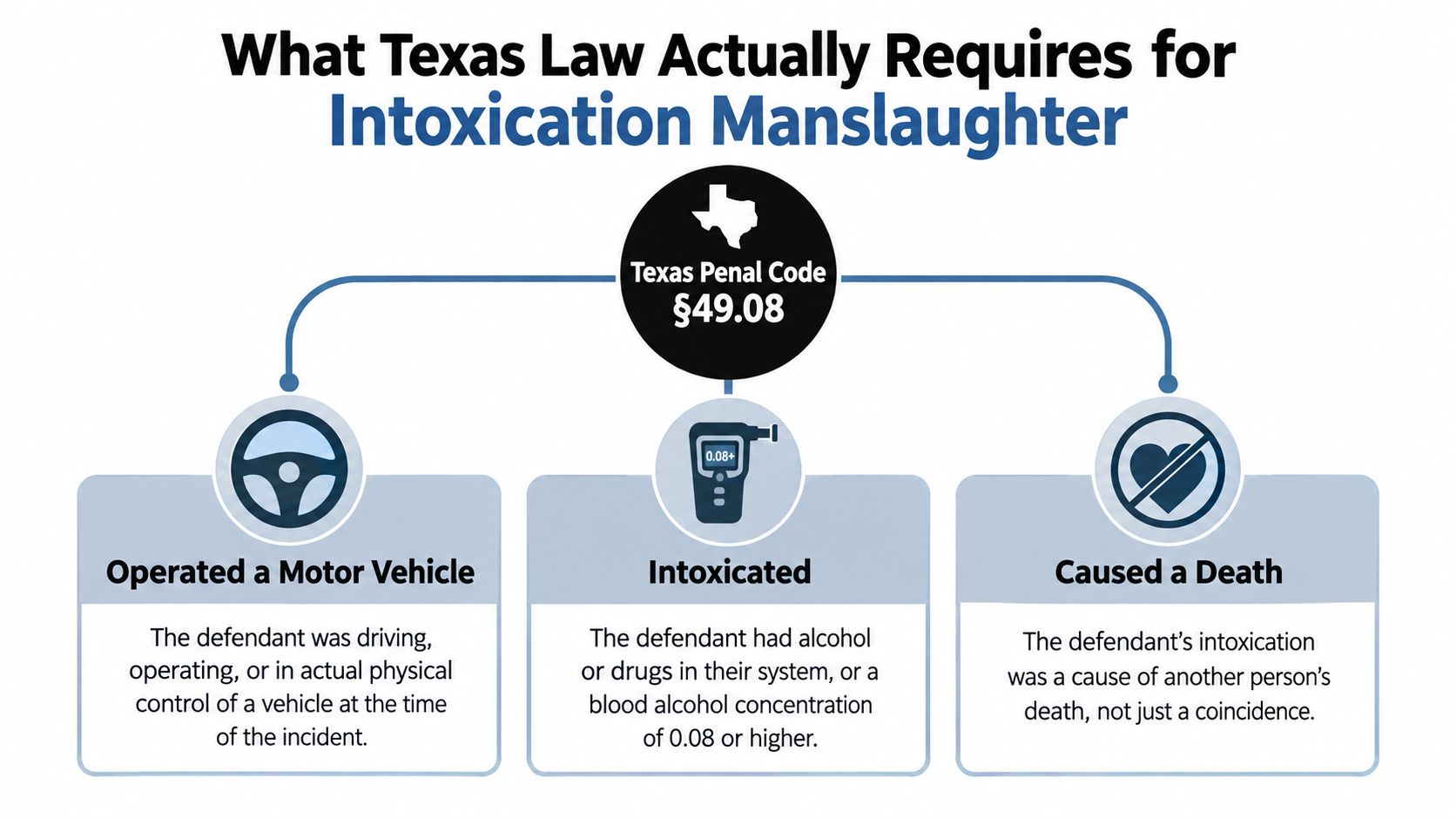
A fatal crash does not, by itself, establish intoxication manslaughter. Under Texas Penal Code §49.08, the State must prove beyond a reasonable doubt that the accused operated a covered vehicle or conveyance in a public place while intoxicated, and that the intoxication caused another person's death by accident or mistake. The law applies to motor vehicles, aircraft, watercraft, and amusement rides.
The three required connections
The State's case has three links: operation, intoxication, and causation. Prosecutors must show that the person operated a covered vehicle or conveyance in a public place, was intoxicated at the relevant time, and caused the death through that intoxication. A collision and a positive chemical test may be evidence, but neither alone proves every element.
Texas defines intoxication in two ways. Under Texas Penal Code §49.01, it can mean an alcohol concentration of 0.08 or more, or the loss of normal use of mental or physical faculties because of alcohol, a drug, or another specified substance. The second definition matters because prosecutors may allege impairment even when a measured alcohol concentration is below the stated threshold.
BAC, or blood alcohol concentration, describes the alcohol concentration measured in a specimen. The statutory measurement depends on the specimen: 210 liters of breath, 100 milliliters of blood, or 67 milliliters of urine. A test taken after driving may not settle what the person's condition was behind the wheel. The timing and circumstances of the test can matter.
Why causation matters
“Accident or mistake” means the State does not have to prove an intent to kill. It still must connect intoxication to the death. Showing that intoxication and a fatal crash occurred together does not automatically establish that connection.
To build that link, a prosecutor may rely on driving evidence, witness accounts, chemical testing, crash analysis, or expert testimony. Each piece must support the claim that intoxication caused the fatal outcome. The defense can examine how those pieces fit together, including whether the test reflects the driver's condition at the time and whether the crash evidence supports the State's explanation. A DWI involving an accident or injury in Texas may involve different statutory elements depending on the harm alleged, so the precise charge matters.
Felony Grades and Sentencing Exposure in 2026
A fatal crash can carry different felony grades depending on the facts and the law in effect on the offense date. The ordinary intoxication-manslaughter charge is a second-degree felony, generally punishable by 2 to 20 years in prison and a fine of up to $10,000. That is the baseline, not a prediction of what a particular person will receive. Prior qualifying convictions or other allegations may affect the sentencing range.
A change effective September 1, 2025, added a significant enhancement under Senate Bill 745. Intoxication manslaughter may be a first-degree felony if the defendant causes more than one person's death in the same criminal transaction or kills a protected victim covered by the statute. A first-degree felony is generally punishable by 5 to 99 years or life in prison. The change is reflected in Texas Penal Code §49.08.
| Scenario | Felony grade | Prison range | Fine maximum |
|---|---|---|---|
| Intoxication manslaughter without an applicable enhancement | Second degree | 2 to 20 years | Up to $10,000 |
| Qualifying case involving more than one death in the same criminal transaction or a protected victim | First degree | 5 to 99 years or life | Up to $10,000 under the general felony fine provision |
| Prior convictions or other qualifying enhancement allegations | Depends on the applicable statute and case facts | Requires case-specific review | Requires case-specific review |
The enhancement does not apply automatically to every fatal crash. The State must allege and prove facts that fit the statute. In a case involving multiple deaths, the number of people who died is not the only question. The State must also establish that the deaths arose from the same criminal transaction, a legal issue that depends on the incident's facts.
The offense date controls
The new rule applies to offenses committed on or after September 1, 2025. Earlier offenses remain subject to the prior law, even if an indictment, plea, or trial comes later. That makes the date of the alleged conduct a key part of assessing the possible felony grade and sentencing range.
Prior intoxication-related convictions and other applicable enhancement allegations may also affect exposure. A lawyer must compare the specific allegations and criminal history with the governing statute. The table gives general ranges; it cannot determine the outcome of an individual case.
How Prosecutors Build an Intoxication Manslaughter Case
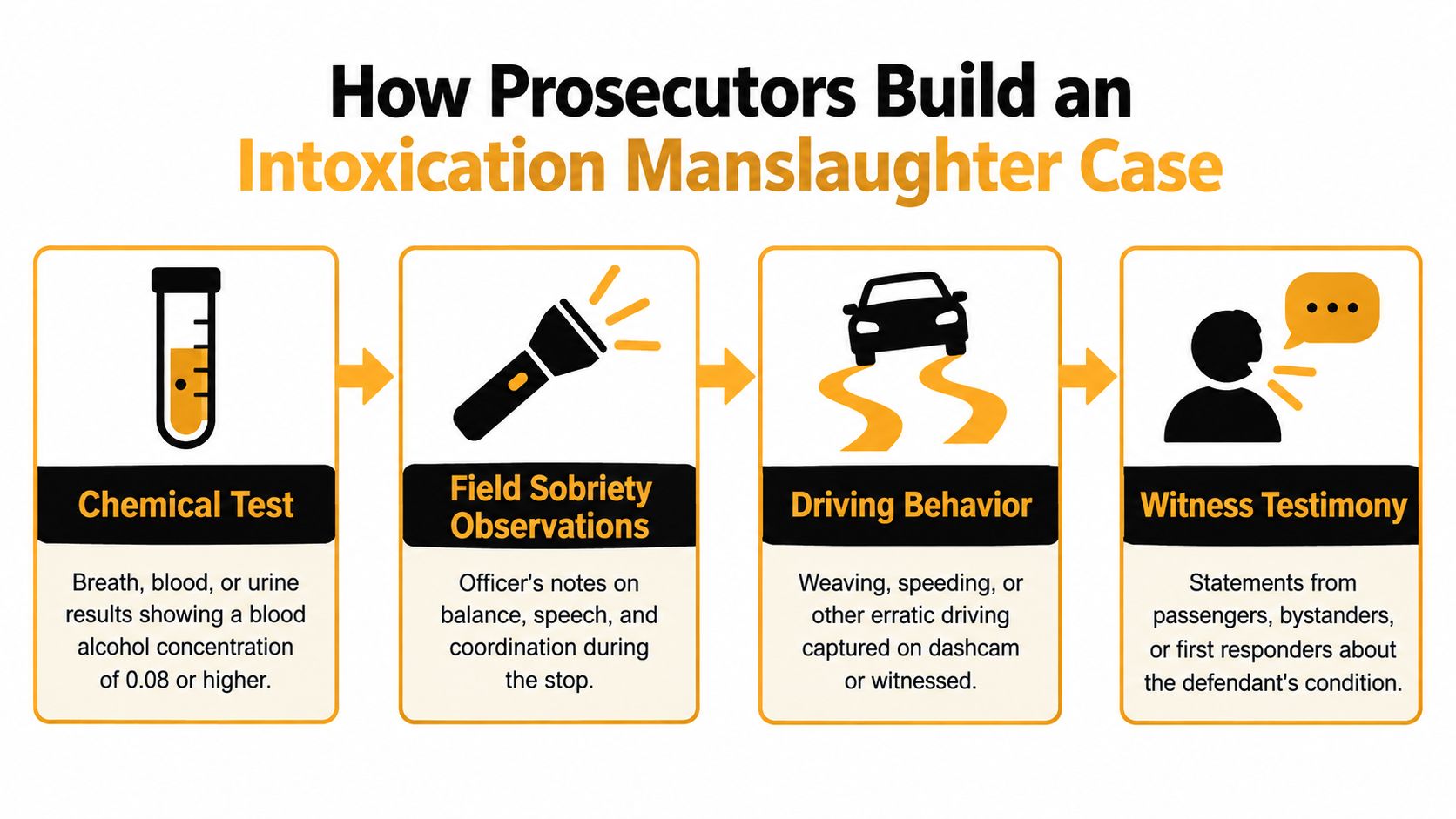
Prosecutors generally assemble several types of evidence and ask whether they support one account of the event. A chemical test may be a central piece, but it's only part of the case. The State may also rely on field sobriety observations, driving behavior, witness statements, and crash reconstruction.
Testing and observations
A field sobriety test is an officer's assessment of a person's balance, coordination, or ability to follow instructions during an investigation. Officers may also describe speech, attention, or other behavior. Those observations can support an impairment theory, but the defense can examine how the tests were given and recorded, along with the circumstances at the scene.
A breath, blood, or urine result may support an alcohol or substance allegation. It doesn't automatically prove intoxication at the time of driving or establish that intoxication caused the death. Alcohol absorption and elimination, specimen delay and preservation, and assumptions used to estimate an earlier concentration may all matter.
Reconstruction and timing
Crash reconstruction specialists may examine vehicle movement, damage, the point of impact, road conditions, and other scene evidence. Their work can help the State argue how the collision happened, but the defense can review the underlying data and assumptions. The central question isn't just how the crash occurred. It's whether the available evidence proves the charged causal connection.
The timeline can be just as important. Investigators may compare when the person drove, when officers observed them, when a sample was collected, and what witnesses say they saw. A later test may not directly show a person's condition at the earlier time, so the assumptions behind any timing analysis deserve close scrutiny.
For cases involving conduct on or after September 1, 2025, prosecutors may also examine whether the allegations fit the first-degree enhancement for multiple deaths in the same criminal transaction or a protected victim. The statutory change raises the importance of reviewing both the evidence and the specific legal theory. TxDOT's impaired-driving safety information describes statewide fatal-crash patterns, but those figures don't establish guilt or causation in an individual case.
This video offers additional context on the legal and evidentiary issues:
Defense Strategies That Target the State's Evidence
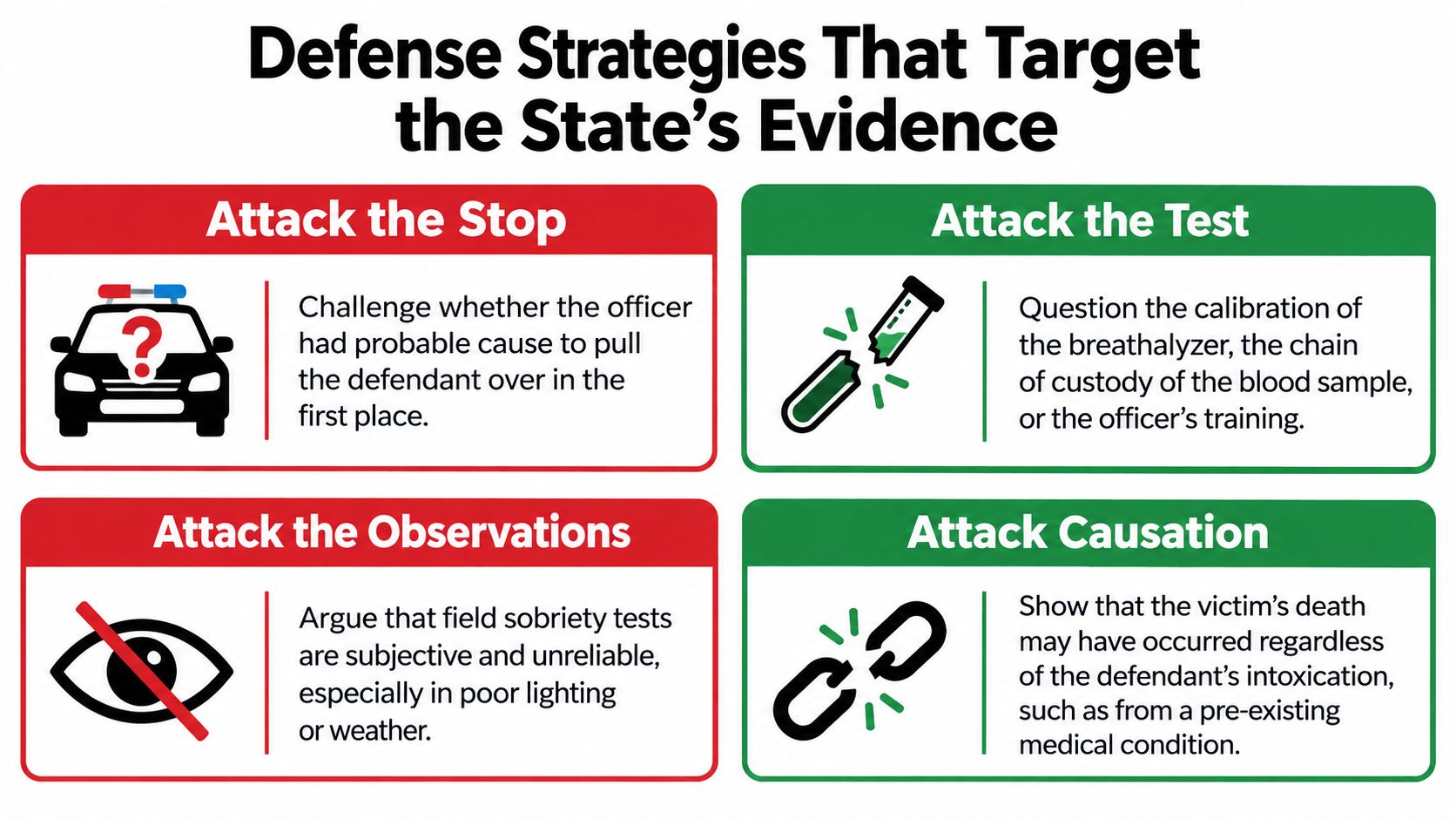
A strong defense isn't limited to disputing a BAC result. The case may turn on whether the stop was lawful, whether observations are reliable, whether the testing process was sound, and whether the State can prove intoxication caused the death.
Test the evidence chain
A defense review can begin with the stop and arrest. Did officers have the legal basis required for their actions? Were statements or samples obtained lawfully? The answers may affect whether evidence can be challenged in court.
Next, counsel can examine the complete chemical-testing record. That may include whether a warrant or valid consent supported collection, how the sample was identified and preserved, laboratory accreditation and quality controls, instrument calibration, and the analyst's qualifications. The defense can also examine whether the method measured ethanol or detected another substance without proving impairment.
A numerical result isn't conclusive on its own. The fact-finder must be satisfied beyond a reasonable doubt that the result is trustworthy and supports an inference about the person's alcohol concentration at the time of driving, rather than only at the later time of collection. A Texas appellate decision addressing chemical-test evidence explains why reliability and timing are important to that analysis.
| Defense focus | What it tests |
|---|---|
| Stop and arrest | Whether officers had the required legal basis and followed proper procedures |
| Field sobriety observations | Whether the tests were administered and interpreted reliably |
| Chemical testing | Sample identity, collection, preservation, lab methods, calibration, and timing |
| Causation | Whether the evidence connects alleged impairment to the death |
Examine causation, not just intoxication
A crash reconstruction review can test the State's account against the physical evidence. The defense may examine whether another driver's actions, vehicle movement, road conditions, or a separate event affected the collision. Even if the State's evidence supports an intoxication allegation, that doesn't automatically prove intoxication caused a death.
If the evidence supports it, counsel may also explore whether a lesser charge or a different account of the event fits the facts better. The right approach depends on the record, not a preset strategy. A Texas DUI attorney handling a felony case should assess the full chain of proof and identify which challenges are supported by the evidence.
The ALR License Fight and Why It Cannot Wait
The criminal case isn't the only process that can affect your driving privileges. Administrative license suspension refers to a civil license suspension or disqualification through Texas's Administrative License Revocation program, separate from the criminal case. The Texas Department of Public Safety may take action after a driver refuses or fails to complete a breath or blood test, or after a test meets the applicable threshold. The DPS ALR program sets out how that process works.
Implied consent is the rule that, by driving in Texas, a person is treated as having consented to a breath or blood test under the circumstances covered by law. Refusing a test or failing to complete one can trigger the ALR process. For a noncommercial vehicle, the relevant threshold is 0.08 BAC; for a commercial motor vehicle, it is 0.04 BAC.
Check the notice and deadline
In a typical case, you generally have 15 days from service of the notice to request an ALR hearing. If you don't request a hearing, the suspension generally starts on the 40th day after service. In blood-test cases, DPS explains that the notice may arrive after results are received, with 20 days from mailing of the suspension notice to request a hearing.
The hearing can address the statutory basis for the suspension. It doesn't decide guilt in the criminal case, which proceeds separately. Missing the deadline can mean losing the opportunity for a hearing, so read the notice and get advice promptly. Learn about the Texas ALR hearing process.
A coordinated defense can assess overlapping issues, such as the stop, probable cause, and testing, while keeping the civil and criminal proceedings distinct. A DWI license suspension can move forward even while the criminal case is unresolved, so don't assume one process will pause the other.
From Bond to Plea or Trial
After arrest, a judge may set bond conditions that shape daily life while the case is pending. Depending on the case, conditions may include alcohol monitoring, an ignition interlock device, curfews, or restrictions on contact with the victim's family. You need to understand each condition and follow it unless the court changes it.
Pretrial work then focuses on the evidence and the legal issues. Counsel reviews discovery, checks whether police followed proper procedures, and decides whether to file motions challenging the stop, statements, field sobriety evidence, or chemical testing. In a fatal crash, expert review may also examine the State's reconstruction analysis and its account of causation.
Don't treat a plea offer as a decision you must make before the evidence is reviewed. The consequences can be serious, and a fact-based assessment helps you understand the options.
A plea could involve the charged offense or, if the evidence and law support it, a reduced charge such as reckless driving or intoxication assault. Deferred adjudication isn't available for every offense, and you should never assume it applies to intoxication manslaughter. A lawyer should explain the legal eligibility and consequences of any proposed resolution before you decide.
If the case goes to trial, the State must prove the charge beyond a reasonable doubt. The defense can challenge the evidence, question witnesses and experts, and argue that one or more required elements haven't been established. The trial decision should follow a careful review of the evidence and the risks of the available options, not pressure or speculation.
The alleged offense date also matters to the punishment analysis. For a case involving alleged conduct on or after the effective date of SB 745, counsel should assess whether the facts could support the first-degree enhancement. That question may shape how the defense evaluates the case from the outset.
Post-Conviction Consequences and the Case for Acting Now
A conviction or plea can affect more than time in custody. A felony record may complicate employment, professional licensing, commercial driving, or immigration status. Court conditions and other consequences depend on the offense, the outcome, and the individual facts.
Expunction and nondisclosure aren't automatic. Whether either option is available depends on the case result and applicable law, so get legal advice before assuming a record can be cleared or sealed. The effect of a crash may also raise separate civil questions, which are different from the criminal case. Texas DWI civil liability can involve issues beyond the criminal charge.
The Law Office of Bryan Fagan, PLLC represents people facing DWI and related felony charges and helps clients evaluate evidence, license proceedings, and court options. Its attorneys serve Houston, Dallas–Fort Worth, Austin, San Antonio, and surrounding counties. If you're facing a charge or trying to help someone you love, a timely conversation can help you understand your rights and the next steps.
The Law Office of Bryan Fagan, PLLC offers free consultations and 24/7 support for people facing intoxication manslaughter charges in Texas. Contact the team to discuss your case, review the evidence, and plan a defense focused on protecting your rights.
