
A DWI arrest can be overwhelming, but you don't have to face it alone. The most popular advice about an ignition interlock camera is also often too simple: people say Texas requires every interlock to have a camera. That isn't a blanket Texas rule. The camera may be required by a judge, a monitoring program, a vendor's approved device, or the exact conditions attached to your case.
That distinction matters if you already have an interlock order, or if one may soon be issued in Harris, Dallas, Tarrant, Travis, or Bexar County. You need to know what triggered the interlock, how the camera works, what compliance can cost, whether your specific order requires photographs, how to build a defensible record, and when a Texas DWI attorney should become involved.
What Texas Drivers Need to Know Right Now
Texas law focuses on the ignition interlock as a deep-lung breath device that detects ethyl alcohol and prevents operation when alcohol is detected. The statute addresses judicial orders, restricted licenses, approved devices, vendors, installation, data downloads, maintenance, and reporting. The cited Texas statutory materials don't create a universal rule requiring every ignition interlock device to include a camera. You can review the statutory framework in the Texas Transportation Code.
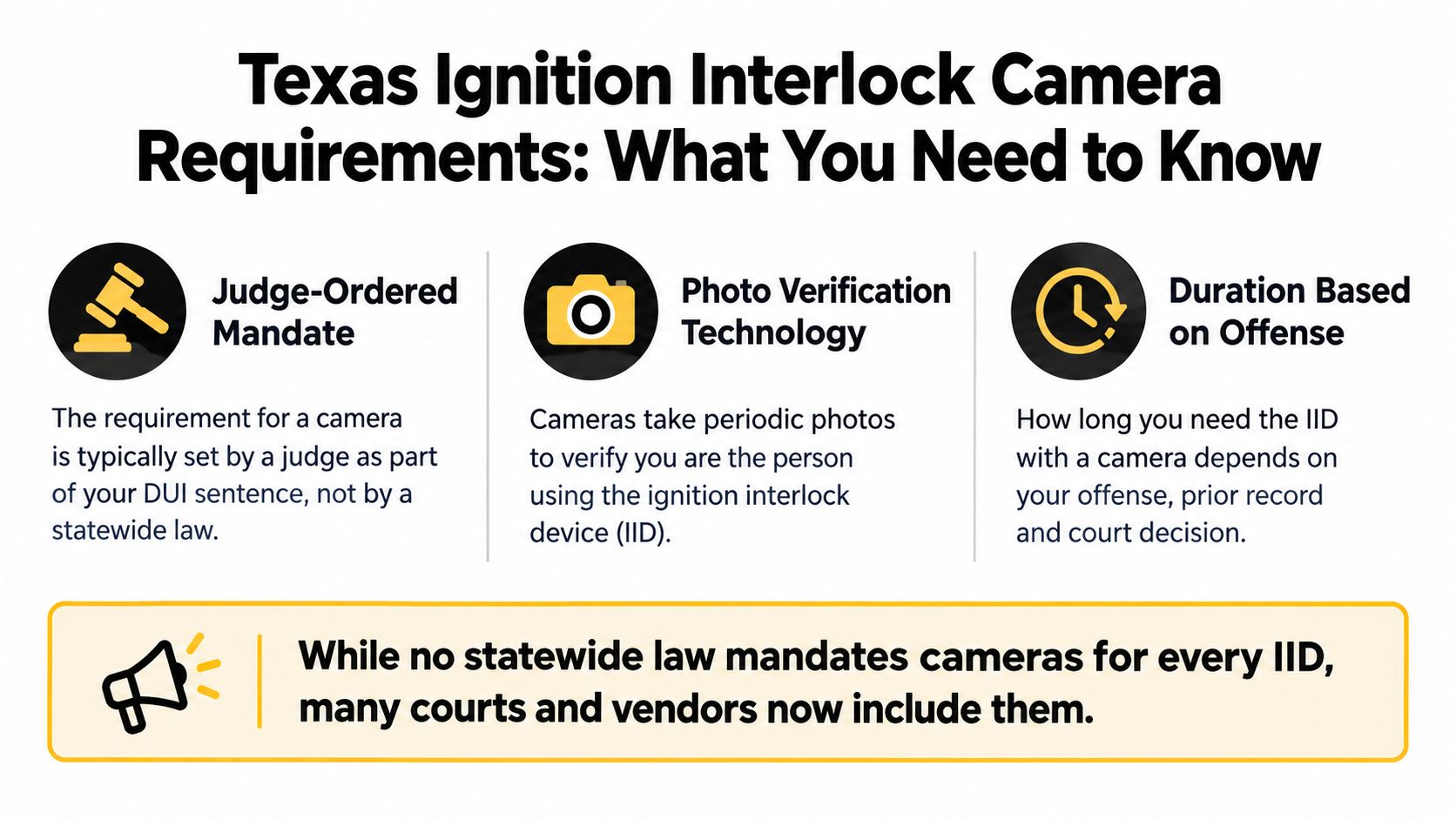
That doesn't mean a Texas driver will never encounter a camera. A court order may call for image verification, or an approved vendor may provide a camera-equipped unit under the applicable monitoring conditions. The practical question is not "Does Texas require cameras?" It is, "What does my order require, what device model was approved, and what conditions control my monitoring?"
A practical starting point
If you're facing an interlock requirement, begin with these questions:
- Who ordered it: Identify whether the condition came from a criminal court, a bond order, probation, a license proceeding, or another supervision authority.
- What device is specified: Ask for the approved vendor and exact device model, not just the general phrase “ignition interlock.”
- What the camera records: Confirm whether the device captures images during startup tests, rolling tests, or alleged violation events.
- What the records show: Request written information about reports, photographs, data transmission, and disputed events.
- What deadlines apply: Coordinate installation, license requirements, ALR deadlines, and criminal court dates.
- Who can help: A Texas DWI attorney can compare the order with the vendor's requirements before a questionable report becomes a larger problem.
Clear paperwork reduces uncertainty. It also prevents a vendor feature from being mistaken for a statewide statutory command.
Key Terms Every Texas DWI Defendant Should Understand
An ignition interlock device, or IID, is a car-mounted breath-testing system connected to the vehicle's starter. Think of it as a breathalyzer that lives in your dashboard and controls whether the engine can start. You provide an initial breath sample, and the device may require additional samples while you drive.
A camera-equipped IID adds an identity check. The breath test measures alcohol in the sample. The camera takes an image intended to show that you, rather than another person, provided that sample. The camera doesn't measure alcohol and can't independently prove intoxication.
Administrative License Revocation, commonly called ALR, is the civil side of a DWI stop. Texas DPS describes ALR as a process that can suspend or disqualify a license after a driver refuses or fails to complete a blood or breath test, or after a non-commercial driver provides a test showing a blood-alcohol concentration of 0.08% or more in the stated circumstance. The ALR case is separate from the criminal DWI prosecution.
Implied consent is the rule that driving in Texas means you've already agreed to certain chemical testing under the conditions established by law. That doesn't mean every requested test is automatically valid, or that you lose the right to challenge how an officer handled the request. It means a refusal can create separate license consequences.
The vocabulary you'll hear in court
- BAC: Blood alcohol concentration, the amount of alcohol measured in a person's blood. The familiar adult threshold for the stated non-commercial circumstance is 0.08%, but the legal effect of a test depends on the driver, the vehicle, the evidence, and the proceeding.
- Field sobriety test: A group of roadside exercises used by an officer to assess possible impairment. These exercises aren't the same as a chemical test, and the officer's observations can be challenged based on conditions, instructions, medical issues, footwear, lighting, and other details.
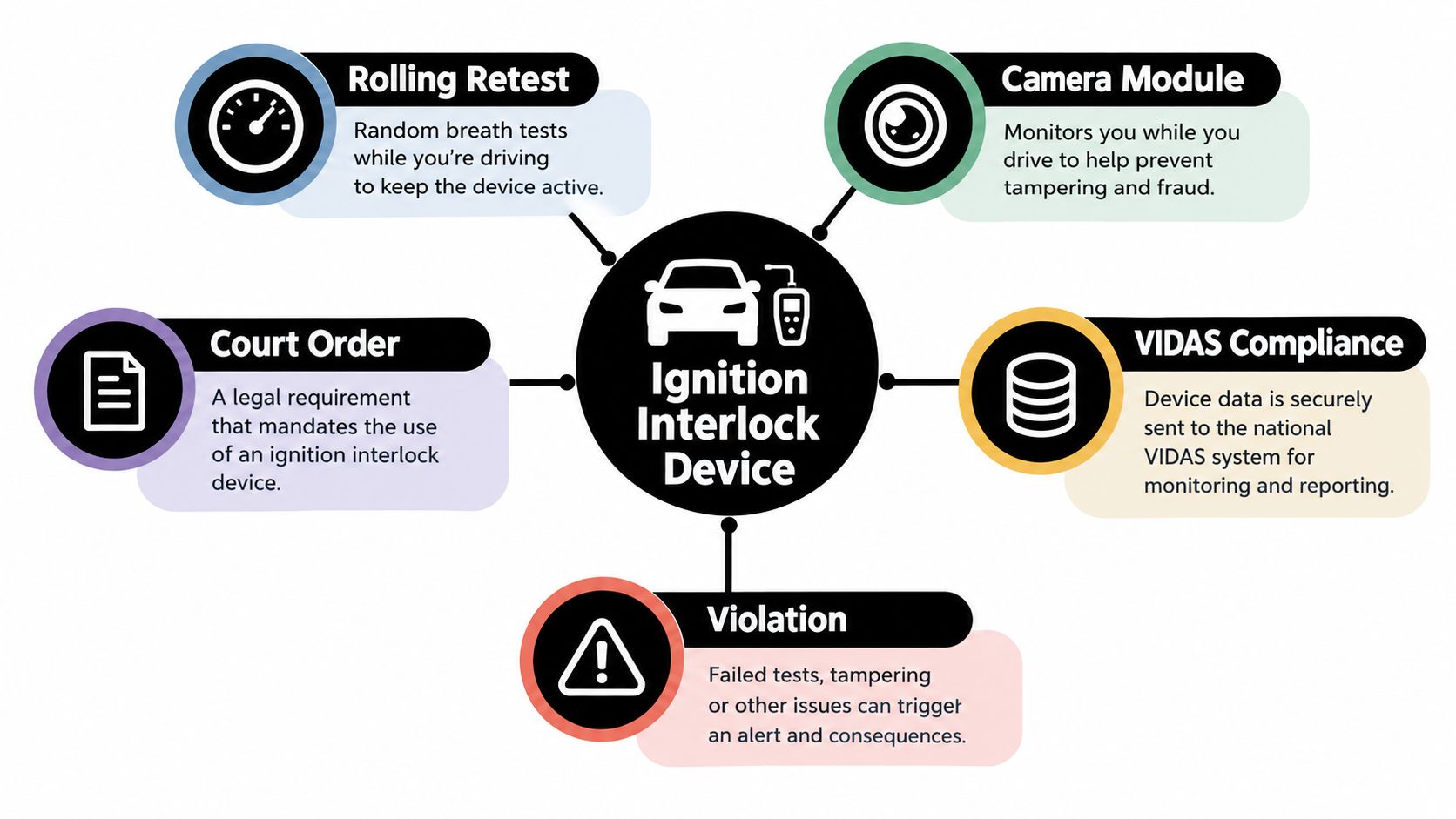
- Rolling retest: A breath sample requested after the vehicle has started. The purpose is to check continued compliance while the vehicle is operating.
- Violation: A device event that may be reported as a failed test, missed test, tampering concern, equipment problem, or another compliance issue. A report is not the same as an automatically proven court violation.
- Restricted license: A license that permits driving only under stated conditions, including operation of a vehicle equipped with an approved interlock when that restriction applies.
Texas treats DWI and DUI as different offenses, and DWI vs. DUI in Texas: What's the Difference? explains that distinction in factual terms.
Which DWI Offenses Trigger an Interlock in Texas
The interlock question usually begins with the legal event that put the restriction on your license or vehicle. Texas law requires a judge to impose an interlock restriction in specified repeat-offense situations. The verified statutory materials identify situations involving two or more convictions under specified intoxication-related Penal Code provisions, and situations involving a license suspension after a repeat-offender DWI conviction. The law also permits a judge to order an interlock for good cause outside the mandatory categories.
A first DWI doesn't always produce the same result for every driver. A judge may make an interlock part of probation or another court order, and a driver seeking a special restricted license may need to operate only a vehicle equipped with an approved device. That restricted license carries a $10 fee, according to the cited Texas statutory material. The court may also waive the interlock requirement in limited circumstances when it finds the device isn't necessary for community safety and the waiver serves the interests of justice.
The offense and the order must be read together
Felony DWI, intoxication assault, intoxication manslaughter, and DWI involving a child passenger can create more serious legal exposure than a straightforward first-offense misdemeanor case. The exact interlock condition still depends on the court's order, the license proceeding, the supervision terms, and the approved equipment. Don't assume the offense label alone tells you whether a camera is mandatory or how long a device must remain installed.
| Offense Type | Statutory Trigger | Typical IID Duration | Camera Likely |
|---|---|---|---|
| First DWI | May involve a judicial, probation, bond, or restricted-license condition | Order-specific | Depends on the order and approved device |
| Repeat DWI | Mandatory restriction can apply after two or more qualifying convictions or a repeat-offender license suspension | Order-specific | Depends on the order, vendor, and monitoring terms |
| Felony DWI | Felony allegations or convictions may carry more demanding supervision conditions | Order-specific | Depends on the court and program |
| Intoxication assault or manslaughter | Serious injury or death allegation creates substantial criminal exposure and individualized conditions | Order-specific | Depends on the court and monitoring terms |
| DWI with a child passenger | Additional offense consequences may affect the overall case and supervision plan | Order-specific | Depends on the order and device specification |
An ALR suspension can overlap with the criminal case, but it doesn't replace it. A driver may face license action before the criminal charge has reached trial, which is why the order and the timeline deserve immediate review.
How a Camera-Equipped Ignition Interlock Actually Works
A camera-equipped interlock usually follows a simple sequence, although the exact equipment and programming can vary. First, you turn on the vehicle and provide a breath sample through the mouthpiece. The device analyzes deep-lung breath for alcohol, and the ignition remains unavailable if the device detects alcohol under its programmed compliance rules.
If the vehicle starts, the device may request additional breath samples while you're driving. These rolling tests are designed to reduce the chance that another person supplied the initial sample. You should follow the device's instructions carefully and never try to handle a rolling test in a way that creates a traffic or safety risk.
What the photograph does and doesn't prove
The image is primarily an attribution record. It is intended to connect a breath event to the driver using the vehicle. It doesn't measure BAC, and it doesn't independently establish intoxication. A photograph may support a report, but the complete event record still matters.
A compliance review should examine the breath-test log, image, timestamp, violation code, calibration or service history, and transmission record together. Poor lighting, an obstructed face, glasses, a camera angle, an inaccurate timestamp, or a cellular upload failure can affect how much weight a photograph deserves. Texas supervision materials describe initial and subsequent breath testing, image capture by some technologies, and reporting of court-ordered devices to DPS. They also emphasize installation, monitoring, and compliance procedures in the Texas Community Supervision Bench Manual.
The device may record failed or missed tests, suspected tampering, service events, and other data required by the program. The vendor then downloads or transmits the information to the monitoring authority. If a report alleges that someone else provided a sample, don't treat the allegation as conclusive before reviewing the underlying records.
This video offers a general visual explanation of interlock operation:
Costs, Affordability, and the Hidden Compliance Barrier
“Just install the device” is not a complete compliance plan. Installation is the first charge, not necessarily the last. Depending on the vendor, equipment, service location, court order, and problem involved, a driver may also face monitoring, calibration, service, repair, replacement, data-download, restricted-license, and lockout-related expenses. A camera condition may affect the equipment or monitoring arrangement, but that cost depends on what the vendor and case order require.
Texas rules generally place device and operating expenses on the driver. The law allows limited judicial relief when requiring payment would not serve the best interest of justice. After finding that a person cannot pay, a court may also establish a payment schedule. The cited bond-related provisions address installation timing and expense as well. Review the Texas Transportation Code provisions on interlock expenses and restrictions with counsel before assuming every charge is fixed or unavoidable.
A better way to present financial hardship
Affordability becomes a legal issue when the cost prevents compliance. A general statement that the device is expensive usually does not show a court what is happening. Bring organized proof of income, essential transportation needs, household obligations, vendor quotes, repair invoices, service-center distance, and any reason a missed appointment or delayed installation was not willful.
The goal is to show the court the difference between unwillingness and inability. A payment schedule, a best-interest-of-justice finding, or a practical modification may then be available for counsel to request. The same documentation can matter during plea discussions and sentencing review.
A low-income driver, a rural resident who must travel for service, a CDL holder, or a household sharing one vehicle may face costs and logistical barriers that do not appear in the court file. Keep receipts, emails, appointment records, mileage details, and notices from the vendor. A clear record gives your attorney something specific to present.
| Cost Item | Frequency |
|---|---|
| Installation | Usually at the start of the program |
| Monitoring | Recurring |
| Calibration or service | As required by the program |
| Repair or replacement | When needed |
| Lockout or violation response | Only if applicable |
| Restricted-license fee | As required |
The amounts are set by the vendor, service arrangement, and applicable court or licensing order, so a frequency table is more accurate than a single statewide range. For a practical discussion of ignition interlock device costs in Texas, compare the expected charges with the written terms for your case.
A missed payment or appointment should not sit unexplained. Document the problem, contact the vendor promptly, and tell your attorney before it is treated as intentional noncompliance.
Is a Camera Actually Required in Texas
The short answer is not automatically for every Texas interlock installation. Texas statutes define the device around alcohol detection and regulate judicial restrictions, licensing, approved equipment, vendors, maintenance, downloads, and reporting. The cited official materials don't establish a blanket statewide camera mandate.
Camera requirements are nevertheless a substantial feature of interlock programs nationally. NHTSA reported that, as of May 2019, 22 states required camera-equipped ignition interlocks. The same federal material reported that all 50 states and the District of Columbia allowed interlocks for at least some impaired-driving offenders, while 34 states and the District of Columbia required them for all convicted offenders, including first offenders. Those figures show why drivers may hear that cameras are standard, but they don't turn a national program feature into a universal Texas command. Review the federal discussion in NHTSA's ignition interlock countermeasures materials.
How to determine your own requirement
Get the answer from the documents controlling your case:
- Read the certified court, bond, probation, or license order. Look for language about photographs, facial recognition, image verification, or a specific device model.
- Ask the approved vendor for written specifications. Confirm whether the offered device includes a camera and when it captures images.
- Request the monitoring policy. Ask who receives reports, what events trigger review, and how disputed records are handled.
- Compare the paperwork. If the order doesn't mention a camera but the vendor treats it as mandatory, ask counsel to determine whether the feature is required by another valid condition.
- Preserve the answer. Keep the order, vendor agreement, device information, and written communications together.
County practices can affect how an order is administered, but a county practice shouldn't be confused with a statute. The Texas ignition interlock requirements by county resource can help you identify the local questions to ask, while your own order remains the controlling starting point.
Building a Smart Compliance and Defense Plan
Compliance protects more than your ability to start a car. A clean record can prevent a technical report from becoming a point of contention in a probation dispute, license proceeding, or plea negotiation. The strongest plan treats every device event as evidence that may later need to be explained.
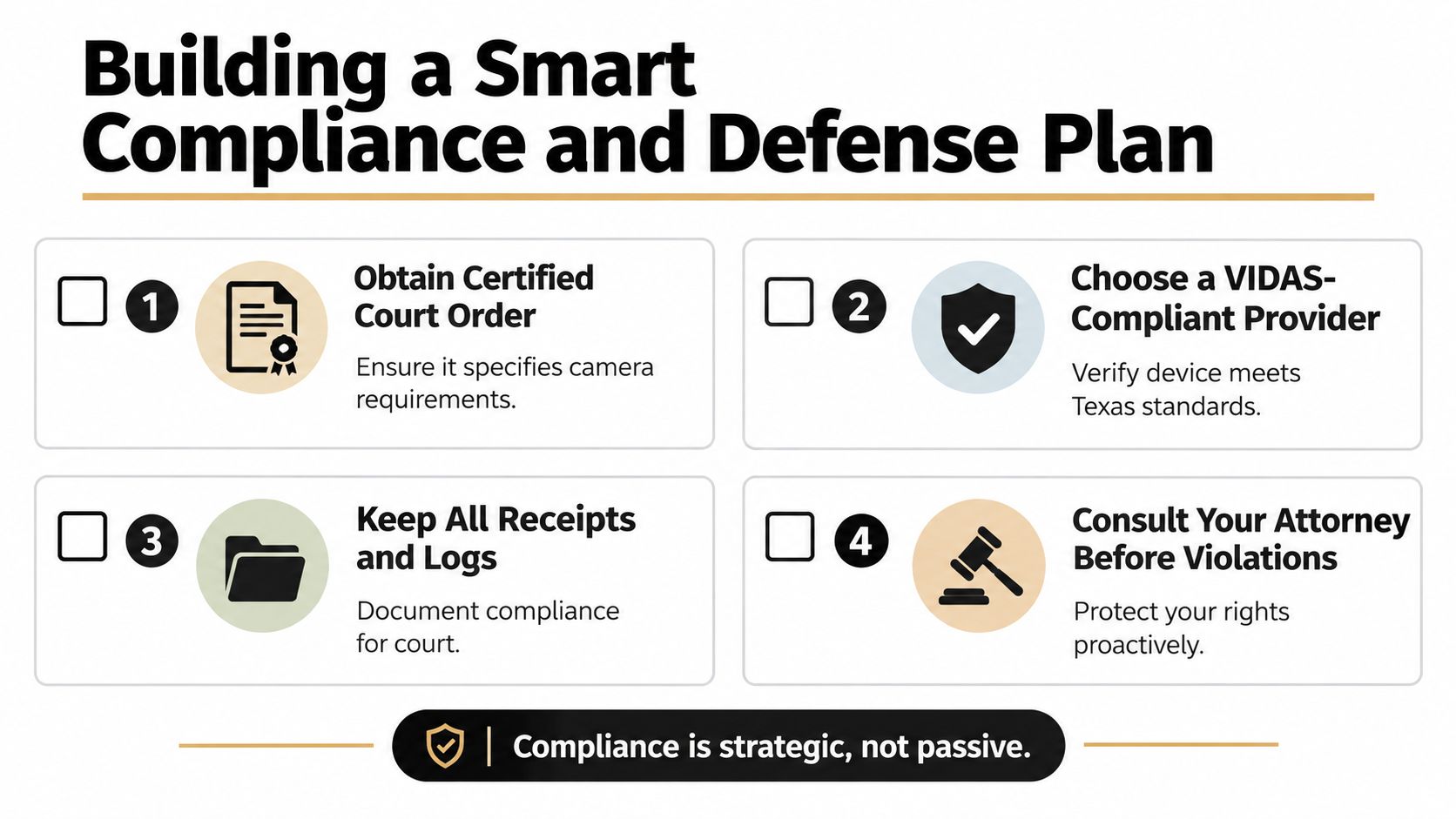
Four moves that protect your position
First, collect the controlling paperwork. Obtain the certified court order, bond conditions, probation terms, restricted-license documents, and ALR paperwork. Read each document line by line. Confirm whether it requires a camera, identifies a vendor or device, establishes an installation deadline, or imposes conditions tied to a particular test or alleged alcohol level.
Second, use an approved provider and create a service file. Schedule installation through a certified service center and keep the appointment confirmation. Save every calibration receipt, repair record, lockout notice, payment record, and message with the vendor. A personal log should record the date, vehicle, event, service location, and what the vendor told you.
Third, preserve the complete data trail. Request monthly or periodic download reports when available, along with photographs and violation descriptions. Keep copies of transmission notices and any outage information. If a report says you tampered with the device, the defense may need to compare the image, timestamp, breath event, calibration history, service record, and data-upload status.
Fourth, coordinate device compliance with the criminal case. An ALR deadline, a bond hearing, an occupational-license need, and a criminal court setting can move on different tracks. Tell counsel about every notice immediately. A device issue should be addressed before it becomes a claimed probation violation or a reason to reject a more favorable resolution.
Practical rule: Never argue with a violation report from memory alone. Obtain the underlying records, preserve your explanation in writing, and let counsel test whether the data actually supports the conclusion.
A photograph can be blurry. A timestamp can be wrong. A transmission can fail. Those possibilities don't excuse noncompliance, but they explain why a fair review must examine more than a single flagged image.
Taking the Next Step With a Texas DWI Attorney
Early legal advice can change how an interlock problem is handled. A Texas DWI attorney can review discovery, examine the ALR affidavit, identify the source of the interlock condition, and determine whether the court order requires a camera-equipped device. That review may also reveal whether the device condition is tied to a bond, probation, restricted license, or another proceeding.
The lawyer's role isn't limited to reacting after a violation. Counsel may be able to address an overbroad condition before installation, ask whether a non-camera device satisfies the valid order, present documented financial hardship, or request a practical payment arrangement. If a camera is required, counsel can still protect the record by preserving calibration information, service records, transmission data, and photographs.
Your DWI case has more than one timeline
The criminal case may involve a field sobriety test, a breath or blood test, probable cause, search issues, officer instructions, and trial or negotiated resolution. The ALR case is separate. Texas DPS states that a driver generally has 15 days after receiving notice of an impending ALR suspension to request a hearing, and late requests are denied. A timely request produces a hearing notice, and scheduling may take approximately 30 to 60 days, according to Texas DPS ALR hearing information.
That deadline makes the first days after arrest important. A lawyer can help preserve the ALR hearing, evaluate whether the officer had lawful grounds, examine whether an arrest occurred, review the opportunity to provide a specimen, and assess whether the reported result meets the legal requirements. The attorney can then coordinate that work with the criminal defense rather than treating the license case as an afterthought.
You don't need to wait for a violation notice to ask for help. Gather your court order, bond or probation paperwork, ALR notice, vendor agreement, installation records, and any device report. Write down what happened while the details are fresh, and don't alter, disconnect, or remove the device without legal and vendor guidance.
The Law Office of Bryan Fagan, PLLC offers free consultations and case evaluations for Texans dealing with DWI charges, ALR proceedings, and ignition interlock conditions. Visit Law Office of Bryan Fagan, PLLC to discuss your order, protect your license, and build a defense plan with a Texas team serving Houston, Dallas–Fort Worth, Austin, San Antonio, and surrounding counties.
