 Skip to content
A DWI arrest can be overwhelming, but you don't have to face it alone.
You may be sitting at your kitchen table with a citation in front of you, wondering whether one bad night just turned into months of court dates, a DWI license suspension, and a permanent record. That's the moment when a dwi plea bargain texas case stops feeling abstract and starts affecting your job, your family schedule, and your ability to drive to work.
The good news is that Texas DWI cases often move through negotiation, not trial. The central question is not whether plea talks happen, it's whether you understand your rights early enough to protect yourself while those talks are still on the table.
Introduction to DWI Plea Negotiations in Texas
A lot of people think a DWI arrest means the outcome is already locked in. It doesn't. In Texas, the criminal case is still a process, and the prosecutor's first offer is just that, an offer.
A house repair estimate illustrates the process. If the contractor spots a weak roof beam, missing shingles, or water damage, the price changes. DWI plea negotiations work the same way, because the strength of the state's evidence changes what a prosecutor is willing to accept.
That's why early legal help matters. A Houston DWI lawyer or Texas DUI attorney can look at the stop, the arrest, the testing, and the paperwork before the state starts treating the case like a routine conviction. If the evidence has problems, the defense can push for a reduction, a better probation structure, or, in some cases, a dismissal path.
One practical example is a driver who gets arrested after leaving a dinner with friends. The driver is worried about jail, but the bigger issue may be whether the stop was legal, whether the officer followed the right testing steps, and whether the driver's license is now at risk in a separate administrative case. Those are not the same questions, and they don't all get answered in the same courtroom.
The first conversation after a DWI arrest should focus on leverage, not panic.
For readers who want to understand the defense side of that planning, this guide on DUI defense strategy planning in Texas basics is a useful starting point.
Understanding Texas DWI Plea Bargaining
A plea bargain is a negotiated resolution. In a Texas DWI case, that usually means the defense and the prosecutor agree on a result that avoids a full trial, often with a reduced charge, a structured sentence, or, less often, dismissal.
The numbers show why this matters. The Texas Department of Public Safety reported 85,858 DWI charges in 2024, with 14,476 guilty pleas, 26,447 convictions of the original offense, 4,279 convictions of a different offense, and 2,555 dismissals Texas DPS DWI summary. In plain English, plea bargaining isn't a side conversation in Texas DWI practice, it's one of the main ways these cases are resolved.

Key terms that shape the discussion
Implied consent means Texas law treats driving as consent to chemical testing after a lawful arrest. BAC means blood alcohol concentration, the number prosecutors often focus on when they're evaluating a case. A field sobriety test is the set of roadside exercises officers use to look for impairment, and those tests can be challenged if they weren't administered correctly.
Administrative license suspension is the separate DPS process that can affect your driver's license even while the criminal case is still pending. That's why a plea discussion isn't just about guilt or innocence, it's about the range between conviction, reduction, and dismissal.
A prosecutor can only bargain with the leverage in the file. If the stop, the arrest, or the testing looks weak, the offer can change.
A Texas defense page like Texas DWI Defense Lawyer describes defense for drivers charged with DWI under Texas Penal Code 49.04, which is the adult DWI offense many readers are facing. For reduction-focused guidance, this page on whether a DWI can be reduced in Texas fits naturally with the negotiation question.
Typical Plea Options and Penalties
The most common plea outcomes in Texas DWI cases usually involve moving away from the DWI label. That can mean pleading to a lesser offense such as obstruction of a passageway, reckless driving, or a Class C alcohol-related offense, which can reduce collateral consequences because the result no longer carries the same stigma as a DWI conviction Texas DUI plea bargain options explained.
The exact punishment depends on the charge, the county, and the judge's approval. A plea bargain is not just a handshake with the prosecutor, either, because the court has to approve it, and if the judge rejects the deal, the defendant may withdraw the plea Comal County plea DWI document.
Comparison of Common DWI Plea Options
| Plea Option | Offense Class | Jail Time | Fine Range | Probation |
|---|---|---|---|---|
| Obstruction of a passageway | Misdemeanor, usually less damaging than a DWI label | Varies by case | Varies by case | Often available |
| Reckless driving | Misdemeanor | Varies by case | Varies by case | Often available |
| Class C alcohol-related offense | Lower-level offense | No jail in many cases | Varies by case | Sometimes available |
| Straight DWI plea | DWI offense | Possible jail | Possible fines | Commonly includes supervision |
One thing that confuses people is that a “better” plea isn't always the one with the lightest sentence on paper. If you hold a CDL or a professional license, avoiding the DWI label may matter more than shaving off a few court conditions.
A useful way to read the table is this. First, ask whether the plea keeps the DWI label off your record. Second, ask what the judge will require during probation. Third, ask what the outcome means for driving privileges, insurance, and your job.
DWI Plea Negotiation Process and Key Considerations
Negotiation doesn't begin with a dramatic meeting across a table. It starts with paperwork, videos, test records, and the small details that tell both sides how strong the case really is.
The defense and the prosecutor usually review police reports, body-cam video, breath or blood test records, and calibration data before any serious bargaining begins Harber Law on reduced charges. That matters because a weak report or a testing problem can change what the state is willing to offer.
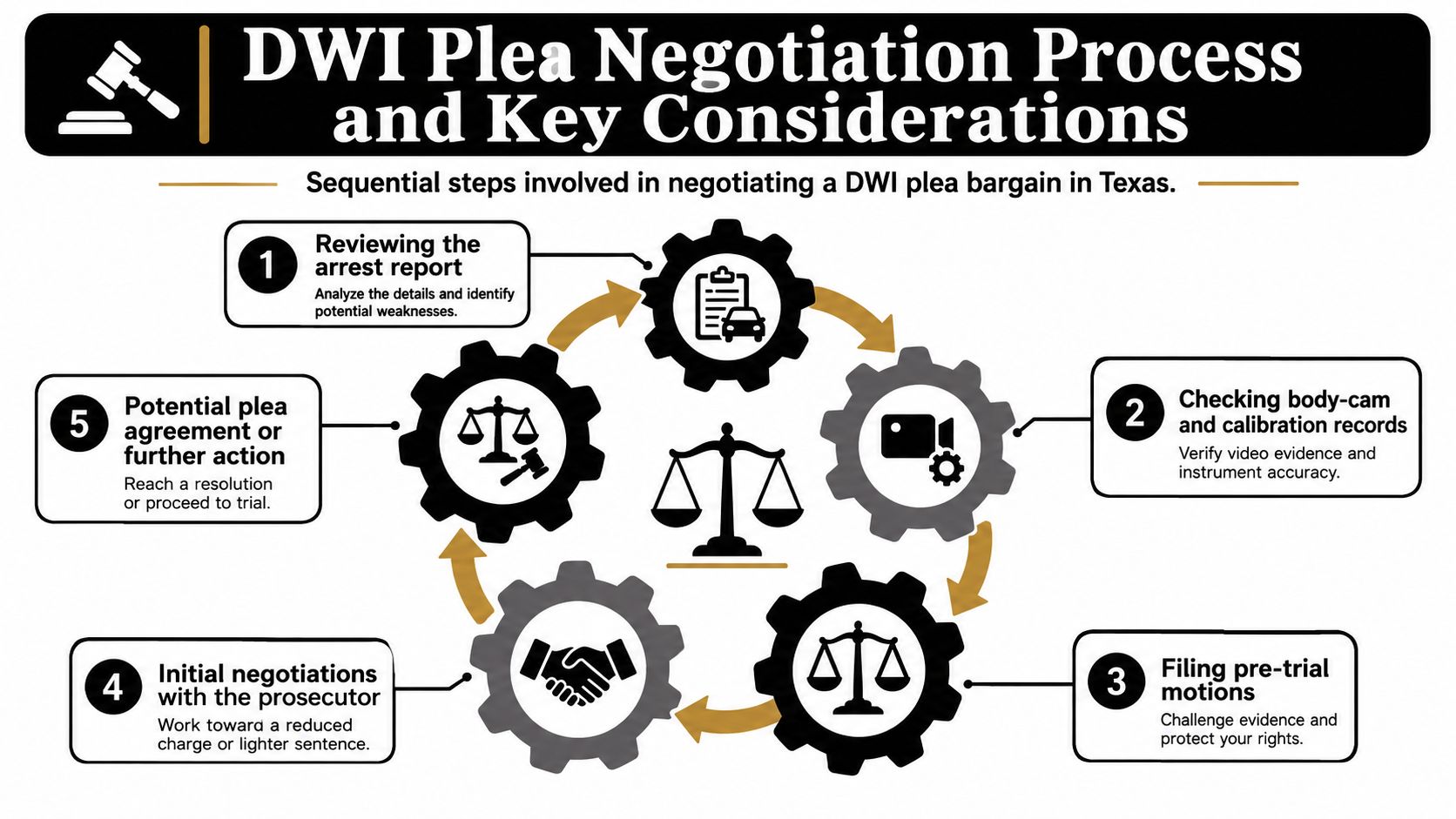
A practical way to think about the process is as a sequence, not a single event. First comes discovery review. Then comes a decision about whether to challenge the stop, the arrest, or the testing through a motion to suppress.
The pressure points that change bargaining power
If the suppression issue looks strong, the defense's negotiating position improves. If the issue is unresolved, the state often has more room to insist on a reduced charge or a structured sentence instead of a dismissal. That's why timing matters so much, because lawyers are often negotiating while they're also deciding whether to file and argue pretrial motions.
Here's the five-step flow in simple terms:
- Review the arrest report for gaps, inconsistencies, and officer observations.
- Check body-cam and calibration records for testing and procedure problems.
- File pretrial motions when the evidence needs a legal challenge.
- Start negotiations with the prosecutor after the defense knows the weak spots.
- Reach a plea agreement or continue fighting if the offer doesn't protect the client.
The video below walks through how plea negotiations fit into the broader defense strategy.
If the file is thin, the first offer may improve. If the file is strong, the defense has to create pressure the hard way, through motions and proof.
For readers comparing timing strategies, this page on DWI plea negotiation timing in Texas is a practical next read.
Collateral Consequences for Record and License
A plea deal can solve the criminal charge and still leave you dealing with other fallout. That's the part many people miss, especially CDL holders, licensed professionals, and out-of-state drivers.
A separate concern is the ALR process, short for administrative license revocation. That process can affect your driving privileges apart from the criminal case, and Texas plea paperwork warns that a DWI plea can trigger license consequences tied to an alcohol education program and DPS proof of completion Comal County plea DWI document.
Another hidden issue is professional reporting. A nurse, teacher, pilot, realtor, or CDL driver may need to answer to a licensing board, employer, insurer, or out-of-state licensing agency. A plea that looks modest in court can still create a serious paper trail outside of court.
Who feels the collateral impact most
CDL holders often face the hardest tradeoff because their livelihood depends on clean driving status. Licensed professionals may have to report the case even if it ends in a reduction. Out-of-state drivers can deal with problems both in Texas and back home, since a plea in one state can still create consequences elsewhere.
That's why the key question is not only “Can I avoid jail?” It's also “What does this plea do to my license, my work, and my record six months from now?”
A reduced charge can help, but it doesn't erase every consequence. The safer move is to look at the whole ripple effect before you agree to anything.
For a broader discussion of those non-criminal tradeoffs, this source notes that existing content often underexplains the fallout for CDL holders, licensed professionals, and out-of-state drivers Texas DWI site on plea deal tradeoffs.
Pros and Cons of Common Plea Outcomes with Scenarios
The best plea outcome depends on who you are, not just what happened during the stop. A first-time offender, a CDL driver, and a licensed professional can all face the same charge, but they don't face the same consequences.

Three common situations
First-time offender. The upside is obvious. A negotiated reduction may avoid a full DWI label and can keep the case more manageable than a trial. The downside is that a plea can still leave you with probation, conditions, and a criminal record.
CDL driver. Here, a plea that reduces the charge may help protect employment, but the risk is still serious because CDL exposure can affect work even when the court outcome looks better than a conviction. The practical decision often turns on whether the plea protects the ability to keep driving for a living.
Professional license holder. A negotiated plea can limit courtroom penalties, but the reporting burden may remain. In other words, the case can end in court and still continue in front of an employer or licensing board.
What makes one option better than another
A straight DWI plea may be acceptable if the evidence is strong and the negotiated sentence is predictable. A reduced charge may be better if the main goal is to avoid the DWI label itself. Deferred options, where available, can be valuable, but they're highly county-specific and not guaranteed.
The right answer usually comes from a simple question. Which consequence hurts more, a courtroom penalty today or a career problem later?
That's why a client's background matters so much. A college student, a traveling nurse, and an oilfield CDL driver may all hear the same offer and reach completely different conclusions.
Tactical Tips for Negotiating Better Terms
The strongest plea discussions usually start before the prosecutor makes an offer. If you walk into negotiations with mitigation already in hand, you've given the defense more to work with.

Actions that can help before talks begin
- Complete an alcohol evaluation early: This shows the prosecutor you're taking the case seriously and may help shape a treatment-focused offer.
- Bring proof of community ties: Stable work, family responsibilities, and local roots can support a more measured recommendation.
- Gather character references: Letters from employers, clergy, or long-term neighbors can help frame you as more than the arrest report.
- Show real remorse and follow-through: A voluntary counseling step can matter more than a vague apology.
- Know your rights and options: A careful review of the case keeps you from accepting the first offer just because you're scared.
The reason this matters is that some prosecutors do respond to treatment-based screening. A Texas prosecutor-training source reports that 60% were somewhat influenced by screening or assessment results TTI prosecutor training source. That's not a guarantee, but it does show that mitigation can shape the conversation.
If you're comparing lawyers, ask how they use mitigation before the first plea meeting. Some firms, including the Law Office of Bryan Fagan, PLLC, handle defense by reviewing the arrest, the license issue, and the negotiation path together, which is the right frame for a DWI case.
The best time to build leverage is before the state decides what your case is worth.
County-by-county differences still matter. A defense strategy that fits one courthouse may fall flat in another, so the local court culture should always be part of the plan.
FAQs and Next Steps
Can a judge reject a plea deal in Texas? Yes. The court has to approve the agreement, and if the judge rejects it, you may be able to withdraw the plea and decide whether to keep fighting or negotiate again Comal County plea DWI document.
What happens if I miss the license deadline after an arrest? The administrative side can move without waiting for the criminal case, so the safest move is to act immediately after arrest and request the hearing on time. That's the part many people lose because they focus only on the court date.
Does deferred adjudication guarantee record sealing? No. It can help, but sealing is a separate issue and depends on the type of case and the legal outcome. That's why readers who care about record relief should also look at expunction and non-disclosure options and the firm's resources on first-time DWI in Texas if they're dealing with a first offense.
Should I take the first offer? Usually not without a careful review. A first offer may be a starting point, not the ceiling, especially if the evidence has weak spots or your job makes collateral consequences more serious.
If you're trying to fight DWI Texas charges, the smartest next step is a case-specific review with a lawyer who understands both the criminal court and the license process. The right strategy can change what you're offered and what you're asked to give up.
The Law Office of Bryan Fagan, PLLC helps Texans evaluate DWI plea bargains, challenge license risks, and weigh reductions against the hidden consequences for work and driving. If you're dealing with a first DWI in Texas or trying to protect a CDL or professional license, visit Law Office of Bryan Fagan, PLLC to request a free consultation and get a clear plan for your case.

