
A DWI arrest can be overwhelming, but you don't have to face it alone. Maybe you're sitting at home after a traffic stop on I-35, looking at paperwork from the officer and wondering whether you'll lose your license, miss work, affect your CDL, or explain the arrest to your family. You may also be unsure whether the breath or blood result tells the whole story.
For people searching for a DWI lawyer in Round Rock, TX, the first priority is understanding that the case usually moves along two separate tracks. One is the criminal prosecution in Williamson County. The other is an administrative license fight with the Texas Department of Public Safety, commonly called an ALR case. The deadlines, evidence, and decision-makers differ, so a defense plan must address both.
Why Round Rock Drivers Need a Local DWI Lawyer
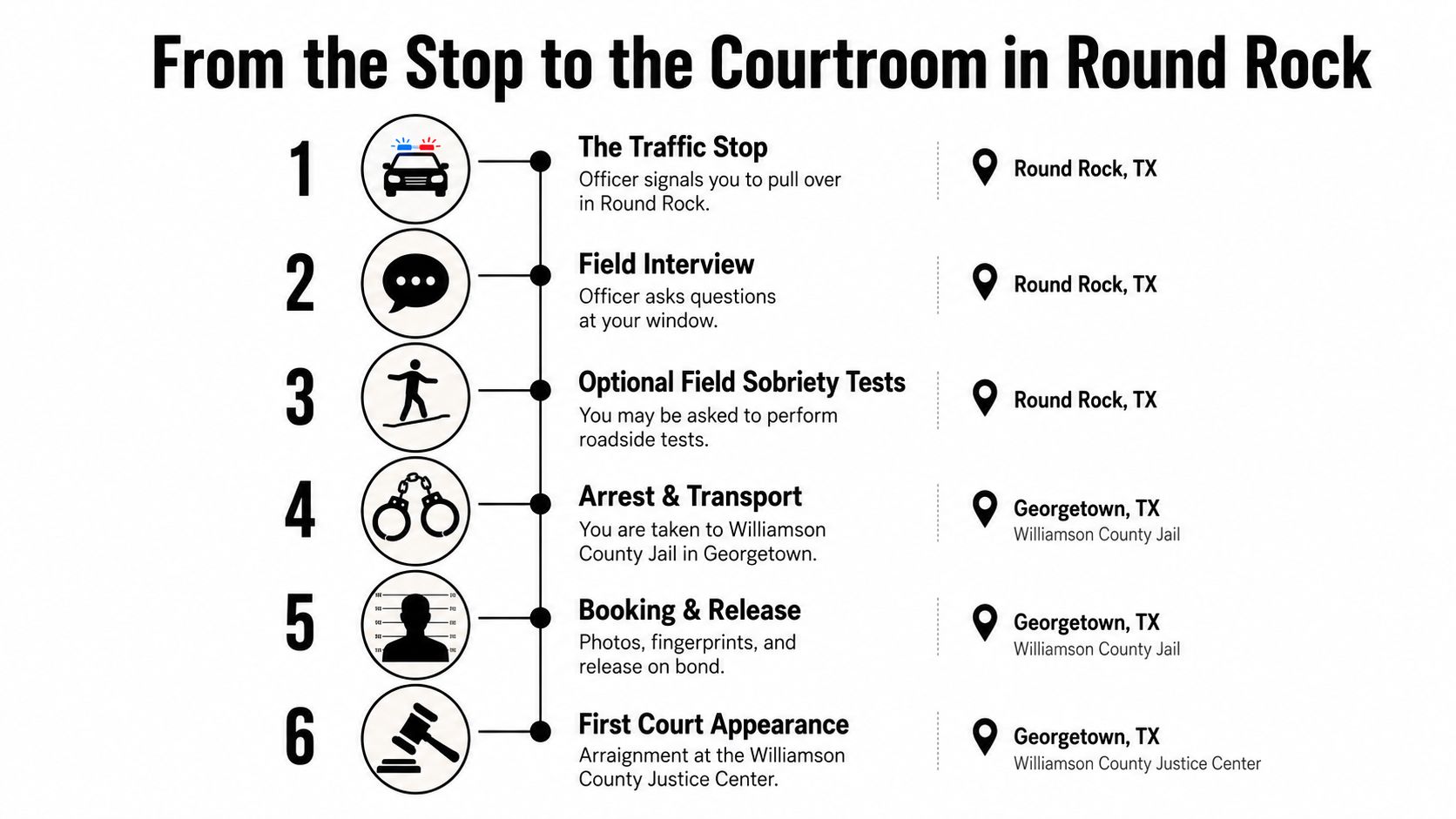
A traffic stop can feel brief, but the legal consequences begin immediately. An officer may pull you over on I-35, RM 620, or a neighborhood street near downtown Round Rock. After questions, roadside testing, and possibly an arrest, you may be transported to the Williamson County Jail in Georgetown while your car, license, and employment remain behind.
The criminal case and the license case are not the same proceeding. The ALR process concerns whether DPS can suspend your driving privileges. The criminal case addresses whether the state can prove DWI beyond a reasonable doubt. Missing the ALR hearing deadline can cause a license suspension even when the criminal case later produces a dismissal, reduction, or acquittal. DPS explains that a hearing request must be submitted within 15 days after service of notice, and without a hearing request, the suspension takes effect on the 40th day after service. Texas DPS ALR information provides the governing administrative timeline.
The first question after an arrest is not only “What will happen in court?” It's also “What must be filed before the license deadline?”
Local representation matters because the defense must fit the place where the case is filed. A lawyer familiar with Williamson County courts can review the arrest report, video, breath or blood records, bond conditions, and court settings with the local process in mind. The attorney may also know how prosecutors handle discovery, which pretrial requirements commonly appear, and what issues deserve a suppression motion.
That doesn't mean a local lawyer can promise a particular result. It means your defense starts with the correct courthouse, agency, records, and deadlines. A useful overview of local representation is available through this guide to Texas DWI lawyers and local courts.
Texas treats impaired driving seriously because the underlying harm is severe. The Texas Impaired Driving Task Force reported 1,699 alcohol-impaired driving fatalities in 2023, representing 40% of all motor-vehicle fatalities in the state. The Texas Impaired Driving Plan provides that statewide context. Your case still requires an individualized review, not an assumption based on statistics.
Key Texas DWI Terms Explained in Plain English
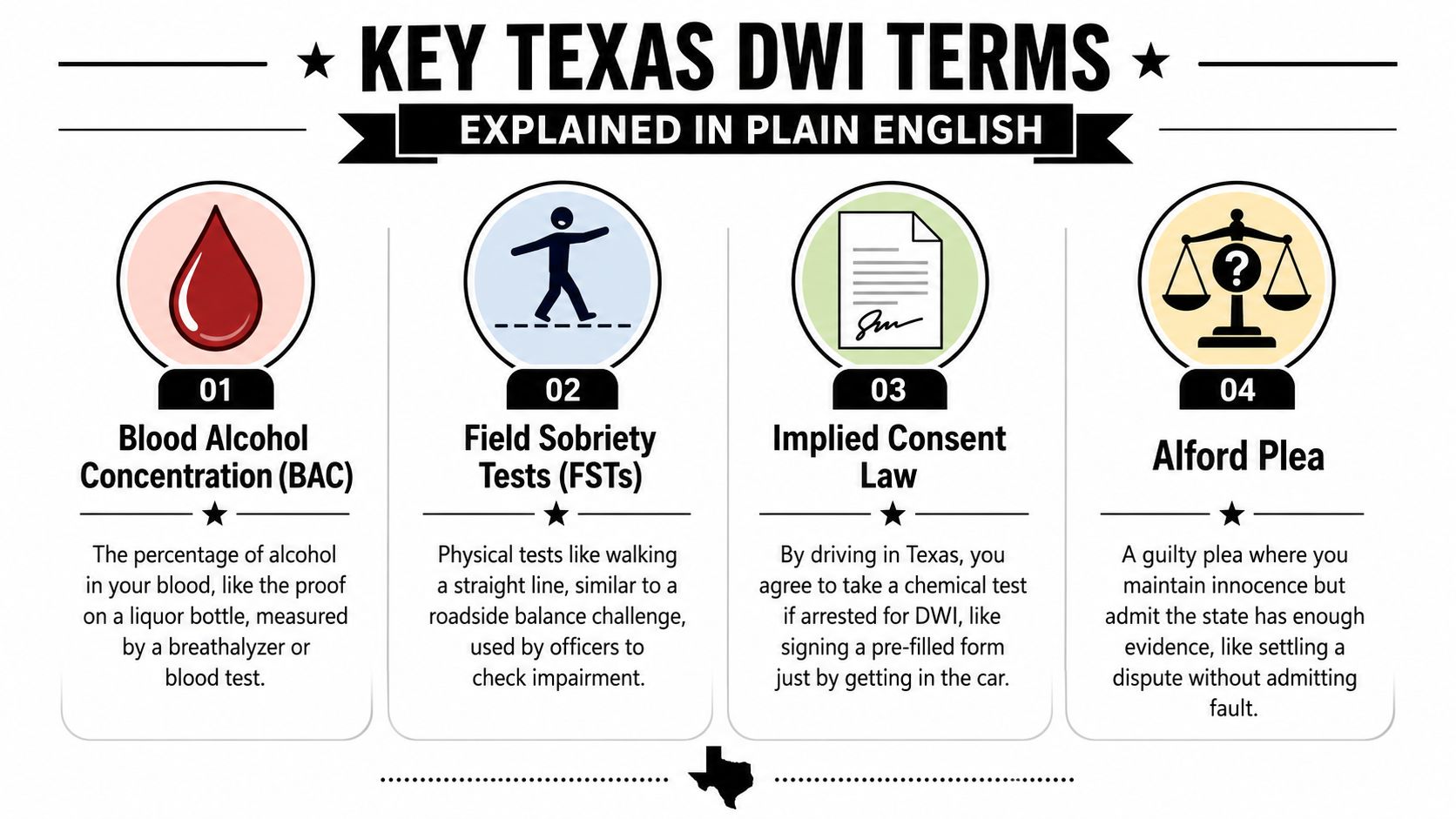
Legal vocabulary can make an already stressful situation harder to understand. These four terms are the ones you'll hear most often during the first days after a DWI arrest.
BAC, or blood alcohol concentration, is the amount of alcohol measured in your blood. A breath instrument estimates that concentration through your breath, while a blood test measures a sample. Texas law treats a BAC of 0.08 as the legal limit for an adult driver, and a result of 0.15 or higher can increase the seriousness of a first-offense charge. The Texas DWI BAC levels and enhanced charges guide explains how BAC affects charges and penalties.
A field sobriety test, or FST, is a roadside exercise used by an officer to look for possible impairment. Common examples include the walk-and-turn, one-leg stand, and horizontal gaze nystagmus test, which tracks involuntary eye movement. These tests aren't the same as a chemical measurement, and performance can be affected by age, injuries, footwear, lighting, weather, pavement, or instructions.
Implied consent means Texas law treats you as having agreed to chemical testing by driving on Texas roads, if law enforcement lawfully arrests you for suspected DWI. A refusal can lead to an administrative license suspension even if the criminal case later ends differently. The Texas Impaired Driving Task Force discusses this Texas implied-consent and DWI framework.
An ALR hearing, or Administrative License Revocation hearing, is a separate administrative proceeding about your driving privilege. It's handled through the State Office of Administrative Hearings, not the Williamson County criminal court. Think of ALR as a fast referee reviewing the arrest and test-related requirements, while the criminal court examines the broader DWI prosecution under different rules.
Texas DPS materials identify a first-offense refusal suspension of 180 days, with the period potentially extending to 2 years when the driving record includes one or more alcohol- or drug-related enforcement contacts during the prior 10 years. DPS refusal information explains that administrative penalty structure. A Round Rock DWI lawyer should address the ALR track and the criminal track together.
From the Stop to the Courtroom in Round Rock
The process usually begins with a traffic stop. The officer may ask where you're coming from, whether you've been drinking, and whether you know why you were stopped. You have the right to avoid volunteering information that could later be used against you, and you should remain calm, provide required identification, and avoid arguing on the roadside.
The officer may request field sobriety tests. These are observations, not definitive proof of intoxication. After an arrest, officers may request a breath test at the jail using an Intoxilyzer 9000, or seek a warrant for a blood draw. The type of chemical evidence, the collection method, the timing, and the reliability of the records can shape the defense.
Booking and release
After transport to the Williamson County Jail in Georgetown, booking generally includes identification procedures, photographs, fingerprints, and processing of the arrest paperwork. A magistrate or court process then addresses release conditions and bond. Conditions can include an ignition interlock device, alcohol monitoring such as SCRAM, or restrictions tied to driving.
An ignition interlock is a device that requires a breath sample before a vehicle starts. It's different from an ALR suspension, and it may be imposed as a bond condition or connected to license eligibility. Because the exact conditions depend on the case and court order, read every document carefully and ask counsel before violating a condition.
This video provides another visual explanation of the Texas DWI process:
The license deadline and criminal timeline
The ALR deadline deserves immediate attention. You generally have 15 days from service of the notice to request the hearing, according to Texas DPS administrative license guidance. Gather the temporary driving permit and suspension notice as soon as possible so counsel can identify the service date.
The criminal case then moves through court settings, discovery, possible motions to suppress, negotiations, and either a plea or trial. The timeline varies by case, evidence, and court availability. A lawyer should coordinate each filing and appearance rather than treating the ALR case as an afterthought. More detail about the criminal sequence appears in this Texas DWI court process timeline.
DWI Penalties and License Consequences in Texas
Texas DWI penalties depend on the alleged facts, prior history, test result, and whether anyone was injured. A first DWI is generally a Class B misdemeanor when the case doesn't involve the high-BAC enhancement. The law provides a mandatory minimum jail term of 72 hours, a maximum of 180 days, and a fine of up to $2,000. A BAC of 0.15 or higher can enhance the first offense to a Class A misdemeanor, with jail exposure up to one year and a fine up to $4,000. These figures are summarized in this Texas DWI defense guide.
| Offense Tier | Jail / Fine | License Suspension | CDL Impact |
|---|---|---|---|
| First DWI, generally Class B | 72 hours minimum to 180 days, fine up to $2,000 | Administrative consequences depend on the test or refusal and the driver's record | A CDL holder may face serious employment consequences and must obtain case-specific advice |
| First DWI with BAC of 0.15 or higher, generally Class A | Up to one year, fine up to $4,000 | The license case proceeds separately through DPS | The enhanced criminal allegation can compound professional driving concerns |
| Felony-level DWI allegations | Penalties depend on the alleged felony and case facts | DPS consequences remain separate | A conviction or disqualifying event can threaten commercial driving work |
A child passenger, a third or subsequent DWI allegation, intoxication assault, or intoxication manslaughter can move the case into felony territory. Those cases require immediate legal review because the potential consequences extend beyond a short license dispute.
The consequences outside the courtroom
You may also face insurance complications, ignition-interlock requirements, employment disruption, and questions about professional licensing. A commercial driver has additional concerns because a DWI arrest or conviction can affect the ability to operate commercially, even when the driver's personal license remains usable under certain conditions.
The ALR process can move faster than the criminal case. A refusal may create a separate administrative suspension, while a chemical-test result can create another basis for DPS action. Don't assume that winning the criminal case automatically resolves every license issue.
Defenses That Work on a Round Rock DWI
A driver leaving Round Rock on I-35, RM 620, or a nearby street may face a case built around one short traffic stop. The defense begins by testing each part of that account. Did the officer have legally sufficient facts to stop or detain you? Did the detention last longer than the original reason allowed? An unlawful stop or extension may support a motion to suppress evidence.
The roadside evidence
Field sobriety tests can appear convincing in a report while presenting a different picture on video. Counsel should examine the officer's instructions, demonstration, timing, surface conditions, lighting, footwear, weather, medical limitations, and recording. The walk-and-turn and one-leg stand measure balance and divided attention. Horizontal gaze nystagmus requires careful administration and interpretation.
A video may show details omitted from the report. It can reveal whether you understood the instructions, whether the officer interrupted you, and whether traffic, pavement, or another condition affected your performance. It may also show whether the interaction continued after the legal basis for the detention had ended.
Breath and blood evidence
A breath result requires its own review. The defense may examine instrument records, maintenance history, operator qualifications, testing sequence, and the required observation period. The 15-minute observation rule matters because the operator must follow specified procedures before the evidentiary breath test.
Blood evidence raises different questions. The defense can trace how the sample was collected, labeled, stored, transported, and analyzed. Timing may also create a rising-BAC issue, meaning the alcohol level while driving could differ from the level measured later. These issues do not guarantee a dismissal. They can identify weaknesses the prosecutor must explain and may affect a suppression motion, negotiation, or trial strategy.
The ALR hearing
The ALR hearing addresses the separate administrative license case before DPS. It can involve the stop, arrest, notice, and chemical-test request. The hearing has its own deadline and procedure, so a driver should not treat it as part of the criminal court schedule. A successful challenge may protect the driving privilege while the Williamson County criminal case continues.
Preserve the evidence early. Dash-camera footage, jail records, breath-machine records, and blood documentation can become harder to obtain or evaluate as time passes.
Prompt investigation lets a lawyer compare the report with video, request missing records, and choose the appropriate response. The aim is not to promise that every case will be dismissed. It is to require the state to prove each element with admissible, reliable evidence while addressing the criminal case and the separate ALR clock.
Expunction and Nondisclosure After a Texas DWI
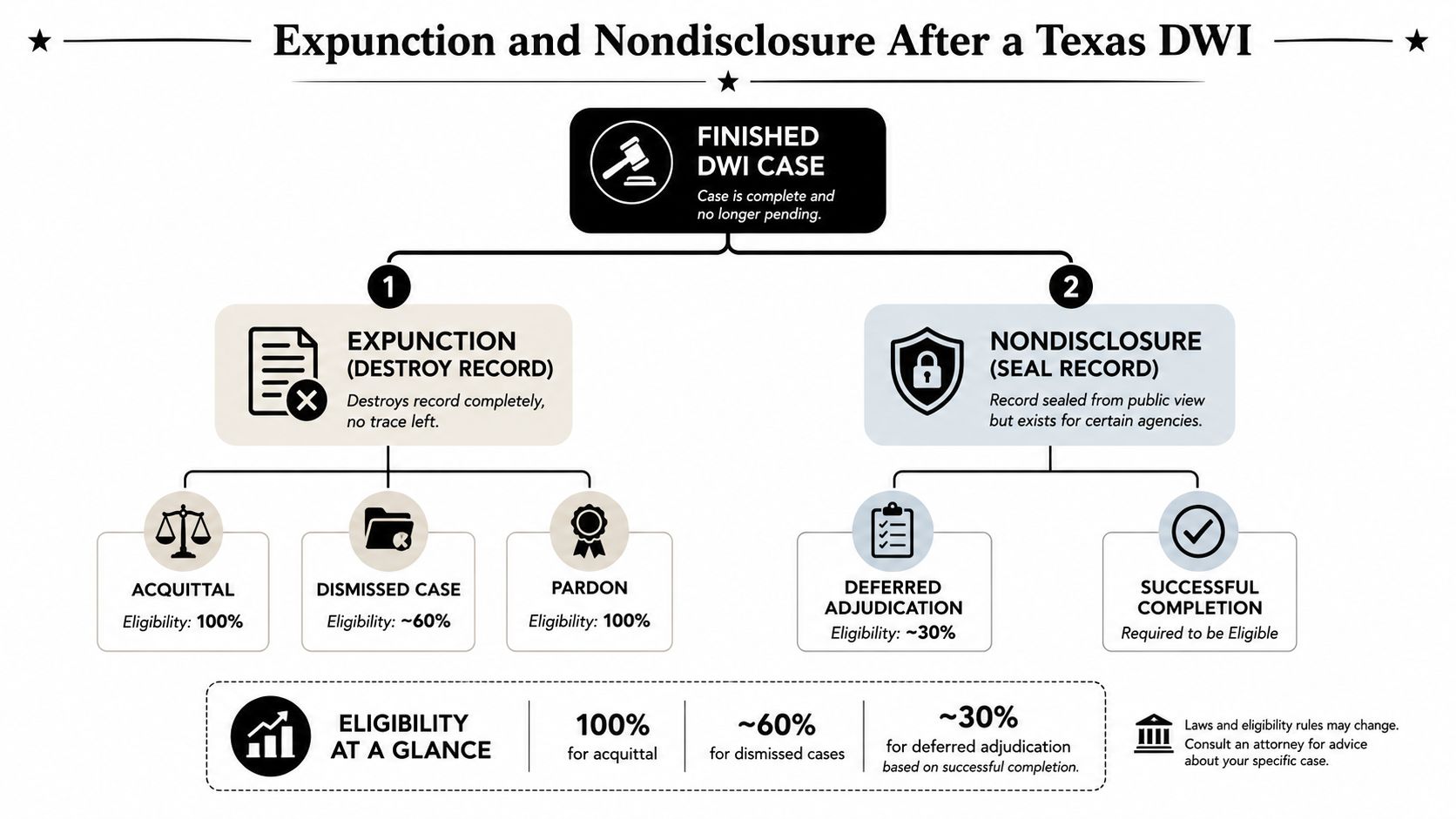
Record relief depends heavily on how the case ended. Expunction is designed to remove qualifying records from official systems. Nondisclosure generally seals qualifying records from public view, although certain government agencies may still access them. They're different remedies, and a person who qualifies for one may not qualify for the other.
Texas changed its record-relief framework in 2025. Chapter 55A replaced the older expunction provisions, while Chapter 411 continues to control nondisclosure. The practical starting point is simple: a traditional DWI conviction can't be expunged, and not every dismissal or deferred outcome automatically qualifies. Texas expunction and nondisclosure information discusses the distinction and the changed framework.
The decision points
Start with the final disposition and then ask:
- No charge or dismissal: Some people whose cases were never charged, dismissed, or otherwise terminated may qualify for expunction, but eligibility depends on the specific legal basis and waiting requirements.
- Acquittal: An acquittal may support expunction because the factfinder did not convict you.
- Deferred adjudication: Certain first-time DWI outcomes may qualify for nondisclosure after the required waiting period and successful completion of the court terms. Deferred adjudication isn't the same as expunction.
- Conviction: A traditional DWI conviction generally blocks both expunction and nondisclosure for that offense.
The infographic's percentages should not be treated as legal eligibility rules. Eligibility isn't determined by a broad estimate. It depends on the charge, disposition, plea paperwork, waiting period, and statutory requirements that apply to your record.
If the case qualifies, the petition is generally filed in the Williamson County court that handled the matter or in the court with authority under the applicable procedure. A lawyer should review the final judgment, dismissal order, probation terms, and DPS records before telling you which remedy is available. Learn more about the filing process through this Texas DWI expunction process guide.
Why Bryan Fagan and Your Next Steps After an Arrest
The next decision should be practical, not emotional. Write down what happened while the details are fresh, including where the stop occurred, what the officer asked, which tests you performed, whether you provided a breath or blood sample, and what paperwork you received.
Keep the temporary driving permit, suspension notice, bond papers, and booking documents. Photograph each page and store the images somewhere secure. Don't post about the arrest online, delete messages, or discuss the facts with prosecutors before speaking with counsel.
Protect the deadline first
The ALR request window runs whether or not you've hired a lawyer. If you were served with suspension paperwork, calculate the 15-day deadline immediately and seek legal help before it expires. A missed filing can affect your license before the criminal court has resolved the underlying DWI allegation.
The Law Office of Bryan Fagan, PLLC handles DWI defense, ALR hearings, chemical-test challenges, and criminal court representation for Texas drivers. The firm offers free consultations and 24/7 support, and its intake process can help identify the arrest-report issues and license deadlines that require immediate attention.
You may be comparing a Round Rock DWI lawyer with a Houston DWI lawyer, an Austin attorney, or a Texas DUI attorney located elsewhere. The important question is whether the lawyer will review both tracks, understand the Williamson County process, and investigate the evidence before advising you about a plea or trial. Don't choose a strategy based only on the charge name or a breath number.
Gather your documents and call (512) 598-1410 as soon as possible. The next day can determine whether the ALR deadline is protected and whether vital evidence is preserved.
Request a free consultation and case evaluation from the Law Office of Bryan Fagan, PLLC to review your Round Rock DWI arrest, ALR deadline, and available defense options. Call (512) 598-1410 with your paperwork so the team can help you take the next step before an avoidable deadline passes.