
A DWI arrest can be overwhelming, but you don't have to face it alone. You may be sitting at your kitchen table with a court notice, a driver's license warning, and questions about whether your job or professional license is at risk. The most urgent question may be whether DWI deferred adjudication in Texas can help you avoid a final conviction.
The answer depends on the charge, your record, the evidence, and what the prosecutor is willing to offer. Deferred adjudication can create a path toward dismissal for some qualifying first-offense DWI cases, but it doesn't erase the arrest, protect your license automatically, or remove every future consequence. The details matter from the first days after arrest through the final day of supervision.
When a DWI Charge Feels Like It Just Took Over Your Life
You might have left work expecting an ordinary evening. Instead, you ended up in a patrol car, answering questions under flashing lights, while your vehicle went to a tow yard. By the time you got home, you had paperwork from the jail, a court date you didn't fully understand, and a warning that your license could be suspended.
The next morning brings practical worries. How will you get to work? What will you tell your family? Will your employer find out? If you hold a commercial driver's license or a professional credential, will one arrest affect your ability to earn a living? Those concerns are real, and they deserve clear answers rather than panic.
A DWI arrest starts two separate legal tracks. The criminal case determines whether you face a conviction, dismissal, trial, or deferred adjudication. The administrative license process, known as ALR, involves the Texas Department of Public Safety and can affect your driving privileges even if the criminal case later ends favorably.
Practical rule: Treat every notice as time-sensitive. A favorable criminal resolution doesn't automatically resolve the license case.
Deferred adjudication is one possible criminal resolution. In the right first-offense case, you may enter a plea, complete court-ordered supervision, and finish without a final DWI conviction. That result can be important for employment, licensing, and background checks. It isn't the same as being found not guilty, however, and the arrest and supervision history may remain visible unless you later qualify for separate record relief.
This guide focuses on the questions that usually keep people awake: what deferred adjudication means, who may qualify, what supervision requires, how the license process works, and why immigration or professional licensing can change the decision. If you're searching for a Houston DWI lawyer, a Texas DUI attorney, or practical guidance on how to fight DWI charges in Texas, start by understanding the legal mechanics before accepting any offer.
What DWI Deferred Adjudication Means in Texas
If you are offered deferred adjudication after a Texas DWI arrest, the paperwork may look like a dismissal is guaranteed. It is not. Deferred adjudication begins with a guilty or no-contest plea. The judge accepts the plea, withholds a formal finding of guilt, and places you on community supervision. Finish every condition, and the case may end in dismissal rather than a final conviction, as explained in Texas deferred adjudication guidance.
The arrangement works like a supervised opportunity, not an acquittal. You remain responsible for court requirements throughout the supervision term. A violation can lead to adjudication, a finding of guilt, and sentencing on the original offense. Your risk shifts from contesting the charge at trial to making an informed plea and completing supervision without violations.
Texas law once excluded DWI offenses from deferred adjudication. Article 42A.102 of the Texas Code of Criminal Procedure covered offenses under Chapter 49, including DWI, intoxication assault, and intoxication manslaughter. House Bill 3582 changed that rule when it took effect on September 1, 2019. That reform created a statewide route to DWI deferred adjudication after the earlier prohibition. Texas DWI deferred adjudication history discusses the change.
The eligibility window remains narrow. The charge generally must be a first-offense DWI under Penal Code §49.04, with no prior DWI conviction or prior DWI deferred adjudication. Prosecutors commonly review the blood alcohol concentration and may expect it to be below 0.15, but that figure should not be treated as an automatic statutory guarantee. Even if the facts appear to fit, the prosecutor must agree to the disposition and the judge must approve it.
The consequences reach beyond the criminal case. A deferred result may affect how your record appears, whether you can obtain record relief, your driver's license situation, immigration status, and a professional license. Those issues should be reviewed before you accept terms.
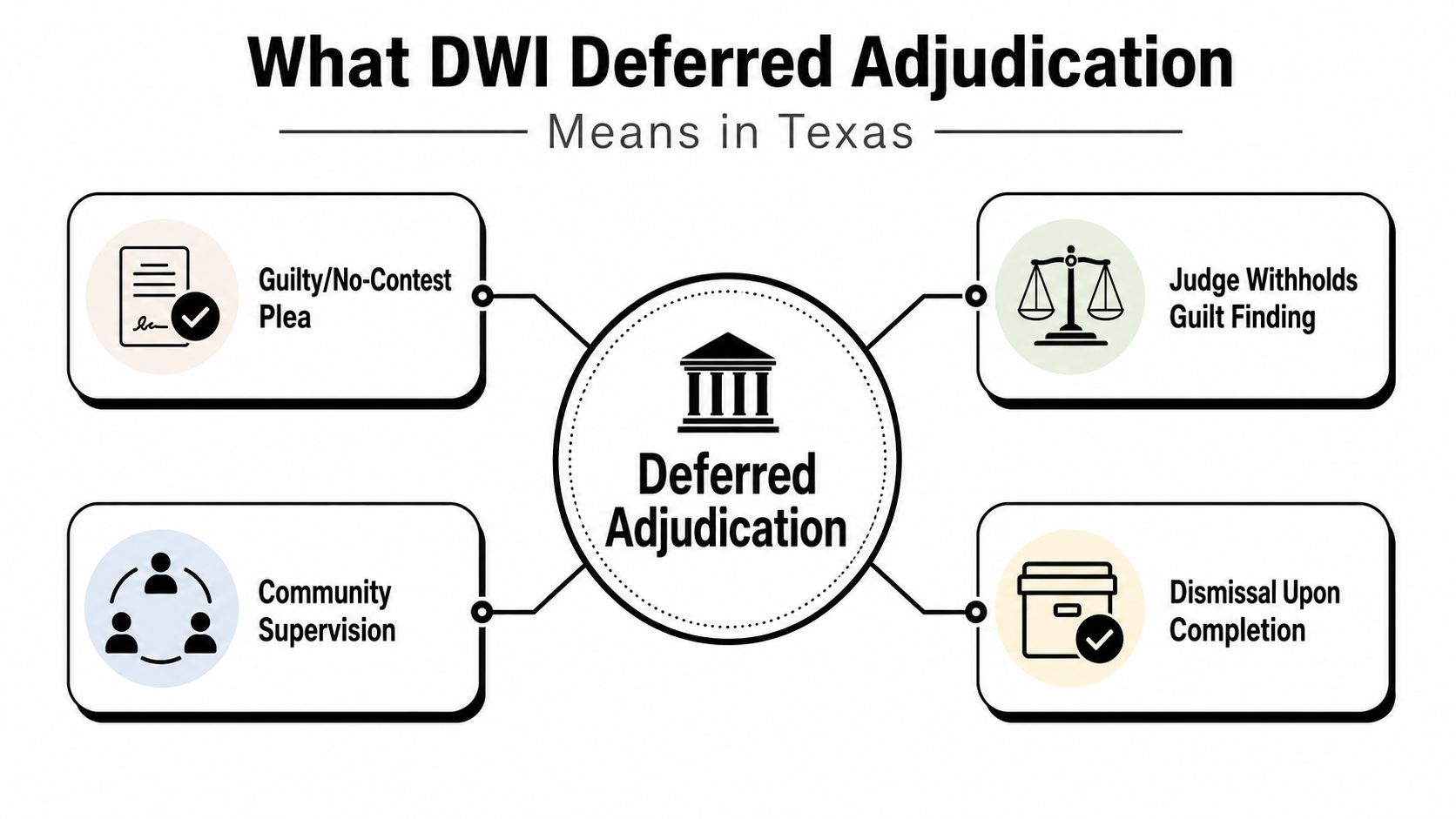
A Texas DWI Defense Lawyer can assess whether this limited option fits the charge, evidence, and practical consequences you may face.
How the Legal Process and Timeline Unfold
A DWI deferred adjudication case moves through several decisions before supervision begins. The court schedule can vary by county and case, so the key question is not only when a hearing occurs, but who controls each step. Eligibility does not give you an automatic right to deferred adjudication.
The main decision points
Your attorney first examines the police report, video, field sobriety evidence, chemical testing, and prior record. The prosecutor may offer deferred adjudication, propose another resolution, or make no favorable offer. After receiving legal advice, you decide whether the proposed terms fit your case and your practical concerns, including driving, record visibility, immigration, or a professional license.
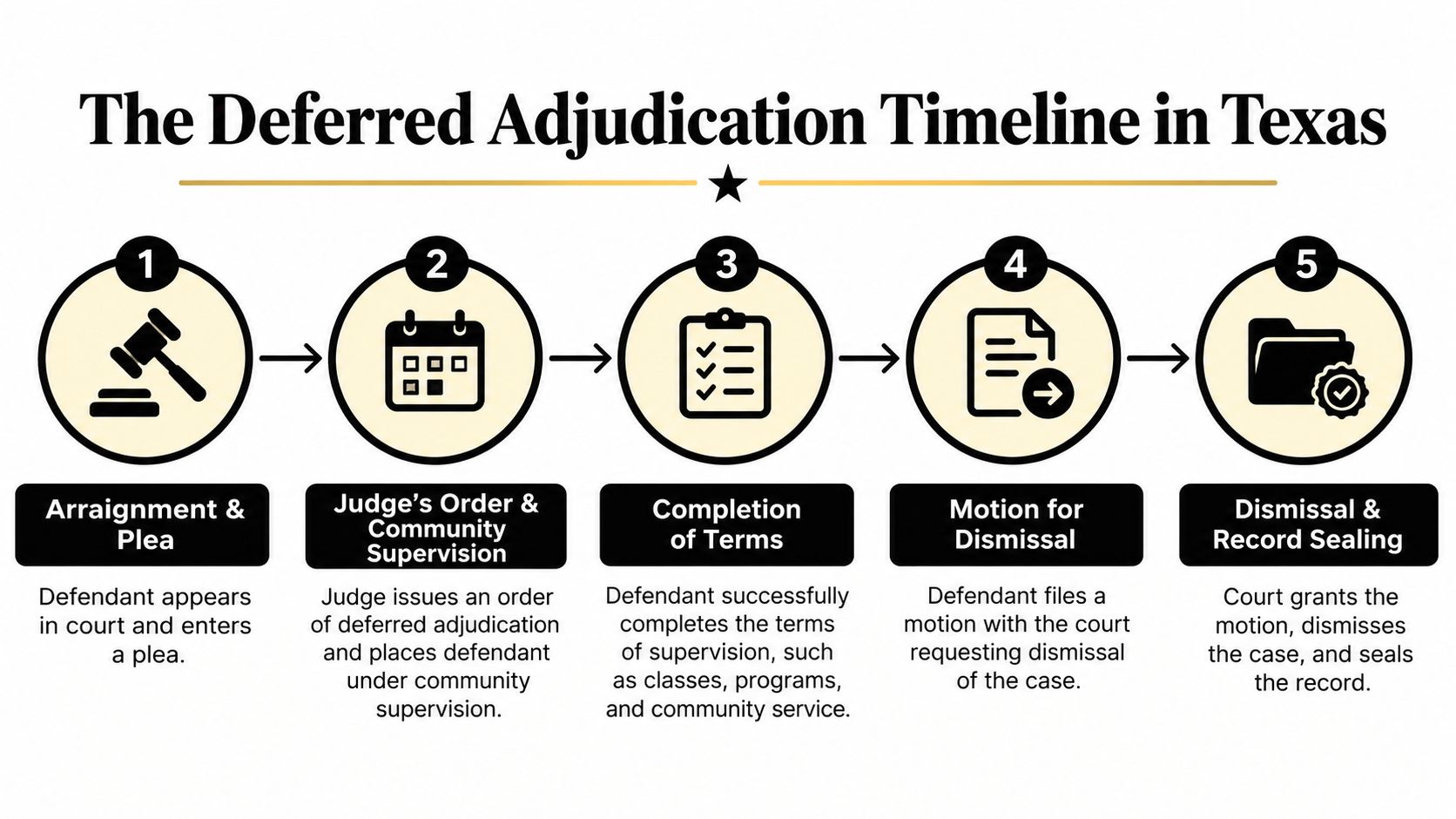
If you accept the offer, you enter a guilty or no-contest plea before the judge. The judge withholds a finding of guilt and orders community supervision. This is probation supervised by the court, not an acquittal. The supervision order sets the rules you must follow, including reporting, testing, driving restrictions, classes, and other conditions.
The supervision period depends on the charge level. For misdemeanor cases, the maximum is generally two years. Felony cases can carry a maximum supervision period of ten years, as explained in this Texas DWI court process timeline. A qualifying first-offense DWI is typically treated as a misdemeanor, but the charge and facts still require individual review.
Completion requires documented compliance
Finishing deferred adjudication means completing every court-ordered condition, not just avoiding a new arrest. You may need to report to supervision, complete education, install an interlock device, perform community service, submit to testing, and pay court-ordered amounts. Keep receipts, certificates, testing records, and appointment confirmations. Those documents can help show compliance if a question later arises.
After successful completion, the court may dismiss the case. A dismissal does not automatically seal every record, and a separate nondisclosure process may be available only if the offense and statutory requirements qualify.
If the State alleges a supervision violation, the judge can consider a motion to adjudicate. Because your plea is already on record, the case may proceed toward conviction without a trial on guilt. Review and negotiate the terms before entering that plea.
Probation Terms That Typically Come With a DWI Deferred
The supervision order is what brings deferred adjudication into your daily routine. Common conditions include an ignition interlock device, DWI education, community service, court costs, fines, drug or alcohol testing, regular supervision appointments, and an order against consuming alcohol or illegal drugs. The exact requirements depend on the court's order and the facts of your case.
The interlock device can affect your schedule more than many other supervision conditions. It requires a breath sample before the vehicle starts and may request more samples while you drive. Work travel, family transportation, vehicle access, and privacy can all become practical concerns. The device also creates records, so ask what happens after a missed test, failed sample, or maintenance problem.
Conditions and their practical effect
| Condition | What it usually looks like | Why it matters |
|---|---|---|
| Ignition interlock | A device installed in the vehicle you drive, with breath testing before operation | Missed service, false readings, or noncompliance can create supervision problems |
| DWI education | Completion of a court-approved course | The certificate may be required to prove compliance |
| Community service | Court-ordered service completed through an approved organization | You need reliable documentation of hours and completion |
| Testing | Drug or alcohol testing when ordered by supervision | A missed or positive test can trigger allegations of violation |
| Financial conditions | Court costs, fines, and other ordered payments | Falling behind can become a compliance issue |
| Travel and reporting rules | Regular meetings and permission requirements for certain travel | Missed appointments or unauthorized travel can carry legal consequences |
Record-relief timing can also depend on the interlock requirement. For many eligible misdemeanor DWI deferred-adjudication cases, the post-dismissal waiting period is generally two years if you used an interlock for at least six months during supervision, compared with five years if no interlock was used. The waiting-period information appears in this Texas deferred adjudication and record relief guide.
Compliance is the case. Keep a calendar, save every document, communicate before a missed appointment, and ask your lawyer about any condition you cannot meet.
These terms affect whether the case ends in dismissal and how long related records remain publicly visible. Review the requirements in Texas DWI probation rules before agreeing to supervision. A condition that seems manageable on paper can create problems with transportation, work, testing, or payment unless you understand how to satisfy it and document your compliance.
How Deferred Adjudication Affects Your Record and Driver's License
The short answer to “Does deferred adjudication make the DWI disappear?” is no, not immediately. Successful completion can result in dismissal instead of a final conviction, but the arrest, court filings, plea, supervision, and outcome may remain part of the public record until separate record relief is obtained.
Texas reporting rules create another source of confusion. The Texas Department of Public Safety treats deferred adjudications as public information, and conviction counts can include both convictions and deferred adjudications under Government Code 411.135. That means a reported “conviction” figure may include deferred outcomes even when a later dismissal isn't counted as a final dismissal.
One Texas reporting source cited 19,184 first-offense DWI deferred placements statewide in FY25, showing that deferred adjudication is now a measurable post-2019 outcome rather than a rare exception. The same source reported that 27.3% of first-offense misdemeanor DWI resolutions ended in dismissal, 17,663 of 64,665. These figures come with an important warning: Texas records and agencies classify and count outcomes in ways that can differ from the result a person sees on a final court disposition. See Texas criminal case dismissal statistics for the reporting discussion.
The license case is separate
A criminal deferred disposition doesn't automatically stop a DWI license suspension. The ALR process is an administrative matter handled through DPS. You may need to challenge that process separately, even while negotiating the criminal charge.
That distinction matters for anyone who drives for work, transports family members, or holds a CDL. It also matters for nurses, teachers, and other licensed professionals whose employers or boards may review driving-related records.
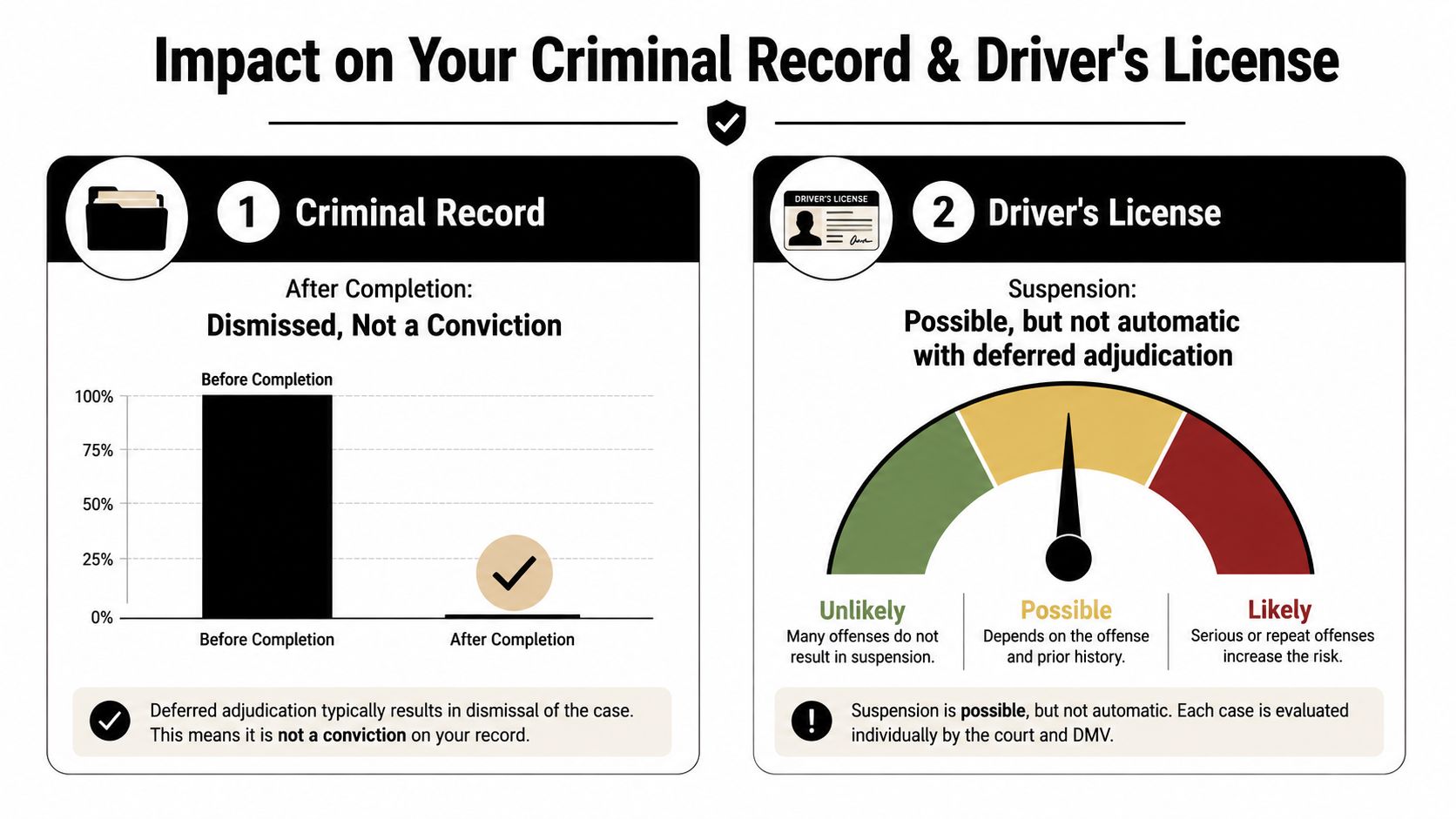
The difference between dismissal, nondisclosure, and expunction can be difficult to apply to a specific DWI. This Texas DWI nondisclosure guide can help explain the terminology, but your eligibility depends on the actual disposition, supervision history, and statutory requirements.
Impact on Professional Licenses and Immigration Status
A deferred DWI can look better than a final conviction in some settings, but “better” doesn't mean “invisible.” A licensing board, immigration officer, employer, or government agency may ask about the arrest, the plea, the supervision, and the dismissal. You must answer those questions accurately and consistently.
Licensed professionals and CDL holders
Nurses, teachers, medical professionals, security-cleared workers, and other licensed professionals may face disclosure duties that differ from ordinary employment applications. A board may examine the underlying conduct even when a criminal court later dismisses the case. The board may also care about compliance, substance-use concerns, and whether the applicant disclosed the matter.
A commercial driver faces a separate problem. A CDL holder may have federal and state reporting obligations that don't match the criminal court's terminology. A deferred result may avoid a final conviction in the criminal case, yet still affect commercial driving eligibility or employer reporting. If driving is your livelihood, don't evaluate deferred adjudication only by asking whether the court will dismiss the case.
A criminal disposition is one piece of your professional record. It isn't necessarily the last audience that will review the event.
Before accepting an offer, identify every organization that may receive or request information. That may include a nursing board, a teaching authority, a hospital credentialing office, a transportation employer, or a licensing agency. The right strategy may involve criminal defense advice plus separate guidance about disclosure duties.
Immigration consequences require careful review
Non-citizens should involve an immigration lawyer before entering a plea. Deferred adjudication may be preferable to a straight conviction in some circumstances, but immigration law can treat pleas, admissions, and deferred dispositions differently from Texas criminal law.
A dismissed DWI may still appear during an immigration review, including an adjustment-of-status application or a good-moral-character assessment. Immigration officials may examine the arrest record, court documents, police reports, and the facts behind the disposition. A criminal defense attorney shouldn't promise that deferred adjudication will have no immigration effect.
Comparing the three main paths
| Option | Possible advantage | Main concern | When it may deserve consideration |
|---|---|---|---|
| Straight guilty or no-contest plea | Fast and predictable resolution | Produces a final conviction and related collateral consequences | When the evidence is strong and avoiding a conviction isn't realistic |
| Deferred adjudication | Successful completion can avoid a final conviction and lead to dismissal | Requires a plea and strict supervision, with serious risk if supervision is violated | When the case qualifies, the prosecutor offers it, and record protection matters |
| Trial | Creates a chance of acquittal or dismissal without a plea-based disposition | The result is uncertain, and a conviction remains possible | When stop, testing, identification, officer conduct, or other evidence creates meaningful defenses |
The strongest result may be an outright dismissal or acquittal because it can create better opportunities for expunction and avoid the consequences tied to a DWI disposition. But trial decisions should follow an evidence review, not fear or optimism.
A prosecutor may be more willing to negotiate when the defense identifies weaknesses in the traffic stop, field sobriety test, breath or blood testing, or chain of custody. Local practice also matters. Policies and offers can differ among Harris, Dallas, Tarrant, Travis, and Bexar County courts, so a lawyer who regularly practices in the relevant jurisdiction can help forecast realistic outcomes.
The decision is personal and practical. Consider your driving needs, career license, immigration status, prior record, ability to comply with supervision, and the strength of the State's evidence before accepting a plea.

Steps You Should Take Right After a Texas DWI Arrest
The first days after arrest are about deadlines and preservation. Don't wait for the criminal court date to think about your license.
Start with the ALR deadline
You generally have 15 days after notice of suspension is served to request an ALR hearing. If you miss that deadline, DPS can impose an automatic administrative license suspension without a hearing on the merits. The deadline and consequence are explained in Texas implied-consent law guidance.
Use this short checklist:
- Save every document. Keep the citation, release papers, suspension notice, bond paperwork, and court settings together.
- Request the ALR hearing promptly. Don't assume the criminal case or a deferred offer will protect your license.
- Preserve evidence. Write down where you were stopped, what the officer said, what tests were requested, and whether you received medical treatment.
- Avoid public discussion. Don't post about the arrest or send detailed explanations to coworkers, insurers, or social media contacts.
- Track every deadline. Use one calendar for court, ALR, lawyer appointments, testing, and supervision requirements.
- Avoid new legal trouble. A new arrest or missed appearance can make negotiations more difficult.
- Speak with counsel before entering a plea. Deferred adjudication requires a plea, so you should understand the evidence and consequences first.
A field sobriety test is a set of roadside exercises used by officers to assess possible impairment. It isn't the same as a chemical test, and poor performance can have explanations unrelated to alcohol, including balance problems, medical conditions, fatigue, footwear, weather, or confusing instructions.
BAC, or blood alcohol concentration, refers to the amount of alcohol measured in a person's blood or breath under the applicable testing method. The reported result, how the sample was obtained, and whether testing procedures were followed can all matter.
How a Texas DWI Attorney Helps You Pursue Deferred Adjudication
A DWI attorney's work begins before a plea offer is accepted. Counsel can review whether the officer had a lawful basis for the stop, whether the arrest had probable cause, how field sobriety tests were administered, and whether breath or blood testing raises reliability or procedure concerns.
That review creates more than a list of technical objections. It helps you understand whether trial is realistic, whether suppression issues create negotiation power, and whether deferred adjudication is worth pursuing if the evidence remains strong. A prosecutor may be more open to a favorable resolution when the defense has identified a genuine weakness in the State's case.
Negotiation and supervision planning
Your lawyer can also examine eligibility under the narrow post-2019 rules, discuss the difference between deferred adjudication and a straight conviction, and negotiate conditions that you can realistically complete. Once supervision begins, counsel can help you respond to alleged violations, clarify court requirements, and protect the dismissal opportunity.
The ALR hearing runs on a separate track. A lawyer can request the hearing before the deadline, examine the administrative evidence, and challenge the proposed administrative license suspension when the facts support it. Protecting your license may require action even while the criminal case is being negotiated.
Local experience has practical value. Prosecutors and courts in Harris, Dallas, Tarrant, Travis, and Bexar counties may handle offers, supervision terms, and scheduling differently. A lawyer familiar with the court handling your case can explain what options are realistically available instead of promising an outcome no one can guarantee.
A Texas DUI attorney can also help coordinate questions involving professional licensing, CDL work, or immigration counsel. The best disposition for your criminal case may not be the best answer for every part of your life, so those consequences should be discussed before you plead.
If you're facing a first DWI in Texas, don't wait until supervision begins to learn what deferred adjudication requires. The Law Office of Bryan Fagan, PLLC offers free consultations and case evaluations for DWI arrests, including criminal defense, ALR matters, plea negotiations, and record-relief planning. Visit Law Office of Bryan Fagan, PLLC to discuss your case, your license, and the next step with a Texas defense team.