
A standard DWI conviction is not automatically a crime involving moral turpitude for U.S. immigration purposes. Certain aggravating circumstances, such as knowingly driving while legally prohibited from driving, can change that classification entirely.
A DWI arrest can be overwhelming, especially if you're a lawful permanent resident, applying for a green card, preparing for naturalization, or worried that a criminal case could affect your family. You may be sitting at home with court paperwork, a driver's license notice, and no clear idea whether the case is merely serious or threatens your immigration status.
The answer depends on the exact statute, mental state, plea language, and conviction record. A Texas DWI lawyer must protect your criminal rights while also recognizing that a state-court disposition can be reviewed under federal immigration law. The right strategy often begins before any plea is entered.
Understanding DWI Arrest and Immigration Concerns
You may have been released after an overnight arrest and still feel as though the consequences are only beginning. Perhaps an officer took your driver's license, your family is asking whether you can keep working, and you're wondering whether a DWI could affect your green card or citizenship application. Those concerns are reasonable, but a DWI arrest isn't the same as a DWI conviction, and a standard conviction isn't automatically a crime involving moral turpitude, or CIMT.

Consider a common situation. A driver is arrested after an officer claims the driver showed signs of impairment. The driver faces a criminal charge in Texas and a separate possible DWI license suspension through the Department of Public Safety. At the same time, an immigration application is pending. A careless plea could create a problem that the driver never intended to create.
A qualified Houston DWI lawyer should review both sides of the case. Criminal defense involves questions such as whether the traffic stop was lawful, whether field sobriety testing was reliable, and whether the State can prove intoxication. Immigration review asks different questions, including what conduct the statute requires, what the plea admitted, and whether the disposition counts as a federal immigration conviction.
Practical rule: Don't accept a plea offer until counsel has reviewed its immigration consequences, especially if you have a green card, a pending application, or prior convictions.
The first steps usually include preserving court documents, identifying every prior alcohol- or drug-related driving case, and determining whether an ALR deadline applies. A DWI involving an accident can raise separate concerns, so factual details such as injuries, passengers, and alleged property damage should be disclosed at the first consultation. The DWI Green Card Issues Guide can help you identify questions to raise with counsel, but your own records and legal advice control the analysis.
What Is a Crime Involving Moral Turpitude
U.S. immigration law doesn't provide one simple statutory definition of a crime involving moral turpitude. USCIS explains that adjudicators generally look at whether the offense involves reprehensible conduct and a culpable mental state. The focus is not merely on whether conduct was dangerous or unlawful. The required elements must show the type of blameworthiness that immigration law treats as turpitudinous. USCIS guidance on crimes involving moral turpitude describes this case-law-based approach.
A useful way to understand the distinction is to compare an accidental rule violation with deliberate misconduct. An offense based on ordinary negligence may be serious, but it may not require intent, knowledge, willfulness, or the kind of recklessness needed for a CIMT. By contrast, a statute requiring a person to knowingly violate a legal restriction can create a much stronger immigration argument that moral turpitude is present.
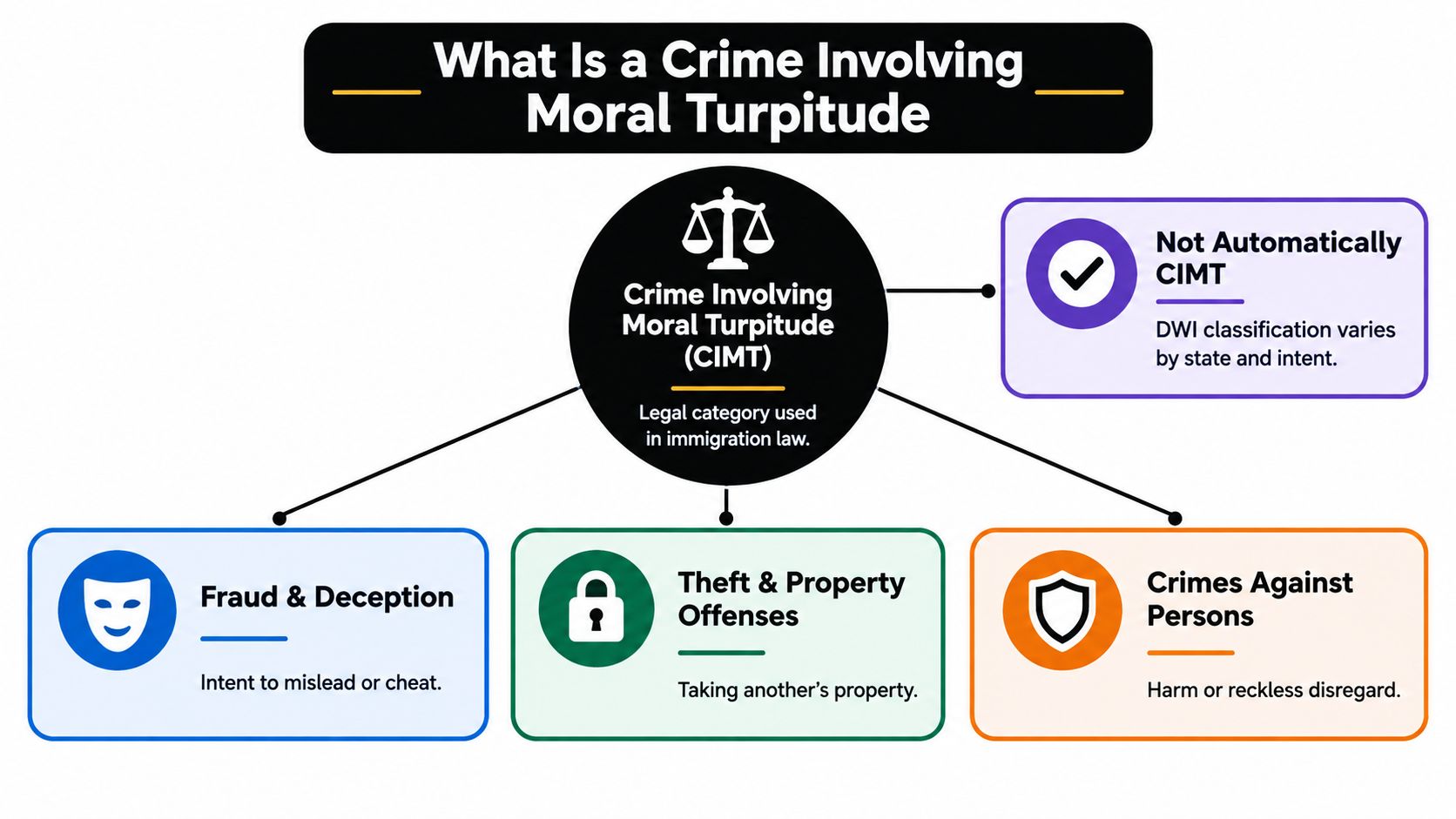
The elements matter more than the label
Immigration adjudicators generally use a categorical analysis. They examine the minimum conduct criminalized by the statute and the mental state required for conviction. They don't rely solely on the arrest report's most alarming details.
That means the word “DWI” doesn't answer the immigration question. Counsel must examine:
- Statutory elements: What must the prosecution prove?
- Mental state: Does the offense require intent, knowledge, willfulness, or recklessness?
- Plea record: What did you admit, if anything?
- Conviction documents: What offense appears in the judgment and charging instrument?
An ordinary impaired-driving offense may be treated differently from an offense requiring knowledge that a license was suspended or that driving was prohibited. A charge involving an accident or injury also deserves careful review. For background on how an accident escalates the stakes of a Texas DWI charge, see DWI Involving an Accident or Injury in Texas.
An arrest alone doesn't establish a CIMT. A conviction can still create other immigration concerns, including good-moral-character problems or issues connected to a pending application. That's why a Texas DUI attorney should evaluate the criminal and immigration consequences together instead of treating the case as routine traffic paperwork.
Key Federal Case Law and Immigration Board Decisions
Federal decisions show why the statute of conviction matters more than the charge's label. In Matter of Lopez-Meza, decided in 1999, the Board of Immigration Appeals treated aggravated DUI as a CIMT because Arizona law required proof that the driver knew driving was prohibited under all circumstances. That knowledge requirement created the heightened culpability absent from ordinary impaired driving.
Matter of Torres-Varela, decided in 2001, produced a different outcome. The BIA held that Arizona aggravated DUI, based only on two prior DUI convictions within 60 months, was not a CIMT because the statute did not require a culpable mental state. The prior convictions increased the offense level, but they did not necessarily show that the person knowingly or deliberately violated a legal restriction.
The contrast matters for Texas defense work. A Texas DWI plea can carry federal immigration significance based on the elements required by the selected offense and the record supporting the conviction. A serious-sounding enhancement does not answer the CIMT question by itself.
Reading the cases in a Texas DWI defense
Counsel should start with the statute's text and the offense date. The version in effect when the conduct occurred may differ from the current statute. The next question is what the prosecution had to prove in every case, including the required mental state. Ordinary intoxicated operation is not automatically the same as knowing disobedience of a legal prohibition.
Immigration authorities then compare those elements with the CIMT framework. They generally focus on the statutory definition and conviction record, rather than the most damaging details in an arrest narrative.
Case-law lesson: Two offenses may both be called aggravated DUI while receiving different immigration treatment. One may require knowledge, while the other may rely only on prior convictions.
Before resolving a Texas case, obtain the charging instrument, judgment, plea paperwork, and applicable statutory text. Those documents can preserve or limit the immigration arguments available later. A police report alone may describe conduct that the conviction did not establish. Reviewing the criminal disposition with immigration counsel before entering a plea gives the defendant a clearer view of both systems and the trade-offs between available Texas options.
Simple DWI Versus Aggravated Offenses
A standard Texas DWI generally involves operating a motor vehicle in a public place while intoxicated. The immigration question is whether the statute requires conduct and a mental state that meet the CIMT framework. A charge becomes more complicated when the prosecution relies on an aggravating feature that adds knowledge, injury, a prohibited status, or another legally significant element.
| Issue | Standard DWI analysis | Aggravated analysis |
|---|---|---|
| Core conduct | Operating while intoxicated under the applicable statute | Core conduct plus an aggravating element |
| Mental state | Must be examined carefully, rather than assumed | Knowledge or deliberate disregard may carry greater immigration significance |
| Prior convictions | Don't automatically make the offense a CIMT | Prior convictions alone don't necessarily supply culpable mental state |
| Case documents | Statute, judgment, and plea paperwork remain important | Charging language and exact subsection become especially important |
| Other consequences | Criminal penalties and license consequences may apply | Injury, death, child passengers, or prohibited driving can create separate exposure |
Texas law can raise the criminal stakes when the alleged conduct includes injury, a suspended license, or other circumstances. But an aggravating fact doesn't automatically transform every conviction into a CIMT. The question remains whether that fact is an element of the offense and whether the statute requires the necessary culpable mental state.
A prior DWI history is a good example. Matter of Torres-Varela shows that a statute based only on prior convictions may still fail the CIMT analysis if it doesn't require proof of knowing or deliberate misconduct. By contrast, Matter of Lopez-Meza treated knowledge that driving was prohibited as decisive.
For a Texas-specific explanation of how aggravated allegations can alter the criminal case, review aggravated DWI explained. The practical point is simple: don't negotiate from the case nickname. Negotiate from the elements of the offense and the immigration result attached to the proposed disposition.
How Texas DWI Statutes Affect Immigration Cases
A Texas DWI plea can look routine in criminal court yet create a different question for immigration counsel. The precise statutory subsection, alleged conduct, and final disposition determine what federal authorities can evaluate. Texas Penal Code §49.04 defines DWI as operating a motor vehicle in a public place while intoxicated. A standard violation is generally a Class B misdemeanor with a minimum confinement term of 72 hours. An open alcohol container in the driver's immediate possession keeps the offense at Class B but adds a six-day minimum confinement term. An alcohol concentration of 0.15 or more at the time of testing raises the offense to Class A. These details appear in the Texas Penal Code DWI provisions.
The classification affects plea negotiations, sentencing, and the conviction record. It does not decide the federal CIMT question by itself. Immigration authorities apply the categorical framework, focusing on the offense's elements and required mental state rather than relying on the label “DWI.”
The useful record is often more detailed than the judgment:
- The offense date: The governing statute may have changed.
- The statutory subsection: A generic “DWI” description cannot identify the elements.
- The charging instrument: It shows the conduct alleged by the State.
- The plea paperwork: Admissions and agreed language may affect the immigration analysis.
- The judgment and sentence: These establish the formal disposition.
- Prior dispositions: Texas and out-of-state cases may shape the broader assessment.
Terminology can also affect the practical review. BAC, or blood alcohol concentration, is the measured amount of alcohol in a person's blood or breath, depending on the testing method. A field sobriety test is a roadside assessment officers use to evaluate possible impairment. Implied consent describes Texas drivers' statutory agreement to certain chemical testing under applicable conditions.
The criminal prosecution and administrative license case proceed separately. An administrative license suspension, often called an ALR suspension, is a DPS action affecting driving privileges after a refusal or alleged failed chemical test. Counsel should address that process alongside the criminal charge, because missing an ALR deadline can limit the opportunity to challenge the suspension.
Immigration Consequences and Relief Options
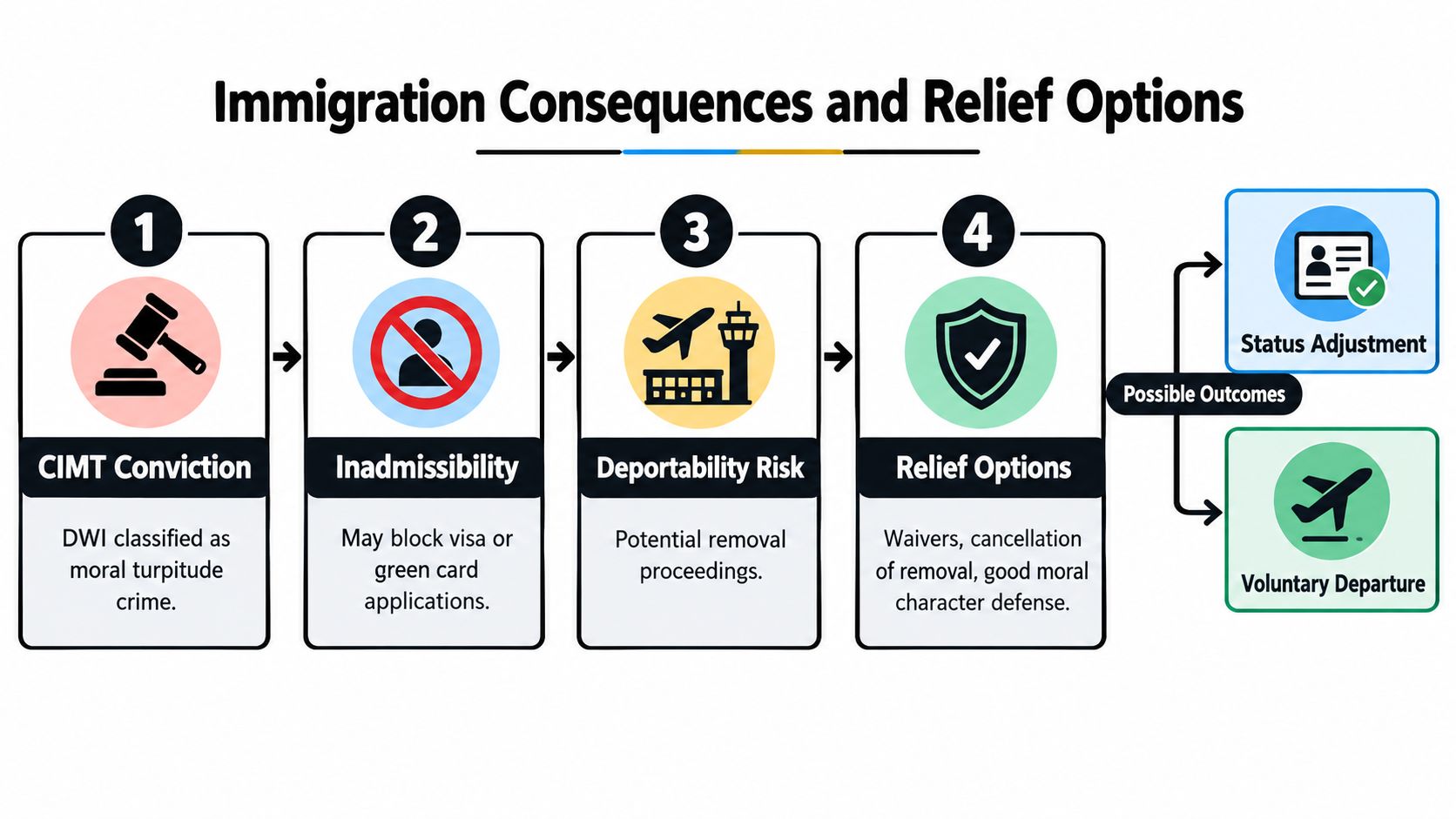
A CIMT finding may affect admissibility, removal exposure, or an application that requires good moral character. The result turns on the offense, sentence, timing, number of convictions, and immigration benefit at issue. A DWI label alone cannot answer whether deportation is possible. Counsel must identify the specific federal ground and examine the complete Texas conviction record, including how the plea was structured.
An offense that may qualify as a CIMT can still involve an exception. In Matter of Garcia-Hernandez, the BIA explained that a CIMT covered by the Immigration and Nationality Act's petty-offense exception does not make a person ineligible for cancellation of removal on the stated statutory grounds. The decision also recognized that a petty offense does not automatically defeat a good-moral-character finding under the relevant provision. Matter of Deanda-Romo shows why timing can matter when counsel evaluates the continuous-residence requirement for cancellation of removal. These decisions do not guarantee relief, but they demonstrate why the details of a Texas disposition matter. See the BIA decision discussing these exceptions and timing rules.
For a broader overview of removal risk, see our guide on DUI and deportation.
Why multiple convictions require a separate review
Repeated DUI or DWI convictions can create serious immigration exposure even if each alcohol-related driving offense is not categorically a CIMT. In Matter of Castillo-Perez, the Attorney General held that two or more DUI convictions during the relevant good-moral-character period establish a presumption that the person lacks good moral character. That rule matters in cancellation-of-removal cases requiring 10 years of good moral character. It operates through character analysis, rather than automatically treating every Texas DWI statute as a CIMT. Matter of Castillo-Perez explains that separate pathway.
Counsel should map every disposition by date, jurisdiction, sentence, and statutory elements. A suspended license, injury, death, child passengers, or refusal-related consequences may require additional review. State expunction or record-clearing relief also may not erase a conviction for federal immigration purposes.
Defense Strategies and Legal Protection
A Texas DWI defense with immigration consequences in mind must begin before any plea. A disposition that appears favorable in state court may still qualify as a conviction under federal immigration law once the court imposes a penalty or restraint. Deferred adjudication, a reduced charge, or another alternative resolution may protect immigration options only if the outcome satisfies federal requirements and avoids harmful admissions.
The criminal case and immigration analysis should develop together. Request the charging instrument, judgment, plea paperwork, and Texas statutory language in effect on the offense date. Immigration counsel can then determine whether the proposed disposition counts as a conviction, whether it includes facts tied to a CIMT, and whether the sentence or other restraint creates a separate problem. The Justice Department discussion of the categorical approach and DWI-related CIMT analysis explains why statutory elements may matter more than the arrest narrative.
The defense investigation may focus on:
- The traffic stop: Whether officers had lawful grounds to stop or detain you.
- Probable cause: Whether the arrest and requested testing rested on admissible evidence.
- Field sobriety testing: Whether instructions, conditions, medical issues, or recording quality affected the results.
- Chemical testing: Whether collection, handling, calibration, or interpretation can be challenged.
- Plea language: Whether the proposed offense requires an admission that increases immigration risk.
- Alternative dispositions: Whether a lawful resolution avoids or limits a problematic conviction.
The wording of the plea matters. A “deferred” result is not automatically safe because federal immigration law may treat the disposition differently from Texas law. Counsel should review the precise judgment, conditions, admissions, and sentence before acceptance.
The Law Office of Bryan Fagan, PLLC handles Texas DWI defense matters involving field sobriety and chemical-test challenges, ALR hearings, criminal proceedings, and potential alternative resolutions. Its attorneys can help organize the criminal record for an immigration-aware review. Immigration-specific advice should come from qualified immigration counsel when federal consequences require that analysis.
Next Steps and Getting Help
Start by protecting deadlines and preserving evidence. Don't discuss the facts with investigators before speaking with counsel, and don't enter a plea just because the charge appears routine. Gather your bond paperwork, DPS notice, charging document, prior criminal records, immigration documents, and any information about pending green card or naturalization applications.
A practical sequence looks like this:
- Request an ALR review promptly: Ask counsel whether a hearing deadline applies to your license notice.
- Address bond conditions: Understand travel, testing, driving, and reporting requirements.
- Preserve evidence: Save videos, receipts, medical records, witness information, and vehicle documents.
- Complete a conviction history: Include alcohol- or drug-related driving cases from every jurisdiction.
- Obtain a crimmigration review: Have counsel evaluate the proposed charge and plea before acceptance.

Whether you're facing a first DWI in Texas, a repeat allegation, or an offense involving injury, early advice can preserve options. A local defense team can investigate the stop, challenge unreliable evidence, manage the ALR process, and coordinate with immigration counsel before a plea affects your future.
The Law Office of Bryan Fagan, PLLC offers free consultations and Texas DWI defense for clients concerned about criminal penalties, ALR hearings, and immigration consequences. Visit Law Office of Bryan Fagan, PLLC to request a case evaluation and discuss a strategy to fight DWI Texas charges while protecting your rights and future.
