
A DWI arrest can be overwhelming, but you don't have to face it alone. Maybe you're at home after a felony DWI arrest, trying to understand what the charge means for your job, your license, or your family. Deferred adjudication for a felony charge may be one possible outcome in Texas, but it isn't automatic, and it doesn't make the arrest or its consequences vanish.
The right decision depends on the charge, the evidence, your history, and whether you can complete the court's conditions. Before accepting an offer, get a clear explanation of what happens if you succeed, what can happen if you violate supervision, and who may still see your record.
When a Felony Charge Meets the Idea of a Second Chance
You're facing a felony complaint in Harris, Dallas, Tarrant, or Bexar County, and the word “felony” may feel like a verdict about your future. It isn't. A charge is an accusation, and the State still has to prove its case. If the allegation is felony DWI, deferred adjudication may be one possible resolution, but whether it's available depends on the law and the facts of your case.
A driver accused of a third DWI, for example, should not assume the case will end in deferred adjudication. The Texas Department of Transportation lists a third DWI conviction as carrying two to ten years in prison, and enhancements or separate felony allegations can change the exposure. Those are potential consequences, not a prediction of what will happen in your case. Texas DWI penalties
Don't mistake an offer for a strategy
A prosecutor's first offer is not an independent assessment of whether the evidence is strong or the terms are workable. Your lawyer should examine the stop, the arrest, the test evidence, and the charge before advising you to plead. In a felony case, the difference between a conviction, deferred adjudication, a reduction, or a dismissal can follow you well beyond court.
Timing matters, but there is no universal deadline that makes the first offer the right one. Start building your defense as soon as you can, and don't agree to a plea before you understand its legal and practical consequences. A sound review considers what the State can prove and what a proposed resolution could mean for your license, employment, and record.
What Deferred Adjudication Means in Texas
Deferred adjudication is a statutory form of judge-ordered community supervision. In a felony case, you plead guilty or nolo contendere, the judge finds the evidence substantiates guilt, then defers entering that adjudication and places you on supervision under Chapter 42A of the Texas Code of Criminal Procedure. Texas deferred-adjudication statutes
Your plea is real, and so are the conditions. Complete the term and the court must dismiss the proceedings and discharge you without ever adjudicating guilt. Violate a condition and the judge can adjudicate guilt and sentence you within the full punishment range, as if the deferral never happened. Article 42A.102
That exposure is the price of the second chance.
| Feature | Deferred adjudication | Straight probation | Dismissal |
|---|---|---|---|
| Plea and finding | A guilty or nolo contendere plea is entered; the judge defers adjudication after finding the evidence substantiates guilt. | Typically follows a conviction, with a sentence suspended while the defendant is supervised. | No deferred plea-based supervision disposition; the case ends without a conviction. |
| Supervision | Court-ordered conditions apply for the supervision period. A felony term may be as long as 10 years under Article 42A.102. | Conditions apply under the sentence and community-supervision order. | No supervision under a deferred-adjudication order. |
| Final disposition | Successful completion leads to dismissal and discharge. | The conviction remains, even if the defendant completes supervision. | The case is dismissed, but record consequences depend on the circumstances and any separate relief. |
| Record afterward | Dismissal doesn't automatically erase the arrest or prosecution record. | A conviction remains part of the case history. | A dismissal doesn't, by itself, guarantee that every record disappears. |
Clients ask me the same question in every deferred case: is this a conviction or not? The answer depends on which stage you are in, because deferred adjudication produces four distinct legal statuses. While the charge is pending, you are presumed innocent. On active supervision, you live under court order, and a licensing board or employer may weigh that status on its own terms. Discharge ends the case in a dismissal, yet the arrest and the plea remain on your record. An order of nondisclosure, if you qualify, is the step that limits who can see it. A nurse renewing a license, a CDL driver covered by federal disqualification rules, and a noncitizen whose plea may still count as a conviction for immigration purposes each occupy a different stage. Advice that ignores your stage is advice you should disregard.
The practical distinction is straightforward: deferred adjudication can keep an adjudicated felony conviction off your record if you finish supervision, but the obligations are real and parts of the record stay visible until a court seals them.
Who Is Eligible and Who Is Locked Out
Eligibility is a statute question before it is a judge question. The charged offense, your history, and the limits written into Chapter 42A of the Code of Criminal Procedure control the answer. A sympathetic story and a clean record help at sentencing. They cannot reopen a door the Legislature closed.
Some exclusions hit hard. Offenses like intoxication manslaughter carry restrictions that make deferred adjudication unavailable or contested, and the exact penal code section controls. Have your lawyer read the exclusion list against your actual charge before anyone calls supervision a realistic outcome.
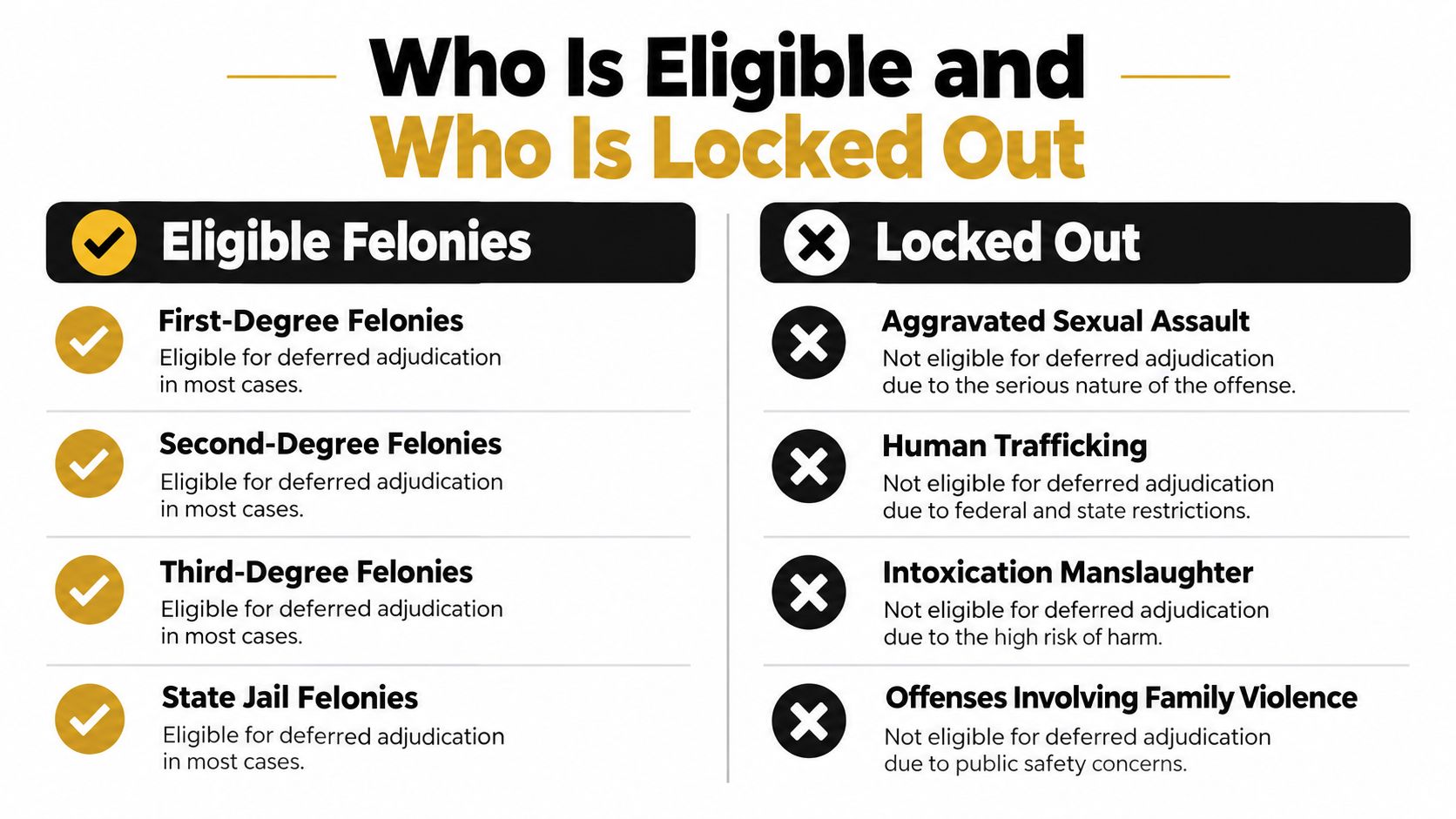
Look at the charge, the history, and the proposed terms
A felony DWI demands a case-specific review. An alleged intoxication assault or intoxication manslaughter is a different animal than a third DWI, and prior convictions can move a file from eligible to locked out. Your lawyer should identify the actual charge and check the restrictions instead of promising that a particular plea exists.
Eligibility also lands differently depending on your stage. A nurse on supervision answers to a licensing board on its own terms. A CDL driver faces federal disqualification rules that apply regardless of the Texas outcome, and a noncitizen must weigh whether the plea still counts as a conviction for immigration purposes. An eligible charge can still cost you your license.
The prosecutor holds half the keys. A judge willing to consider supervision cannot manufacture an offer the State refuses to make.
If you are weighing this in a DWI case, a Texas DWI Defense Lawyer handles defense for drivers charged under Texas Penal Code 49.04. Before you plead, get three answers: whether your offense qualifies, what conditions the court could impose, and what a violation would mean.
How the Process Moves From Arraignment to Discharge
Treat every setting as a decision point with consequences. A file can look calm for weeks, then one missed report, one bad test, or one unapproved trip turns a deferred offer into an adjudication hearing.
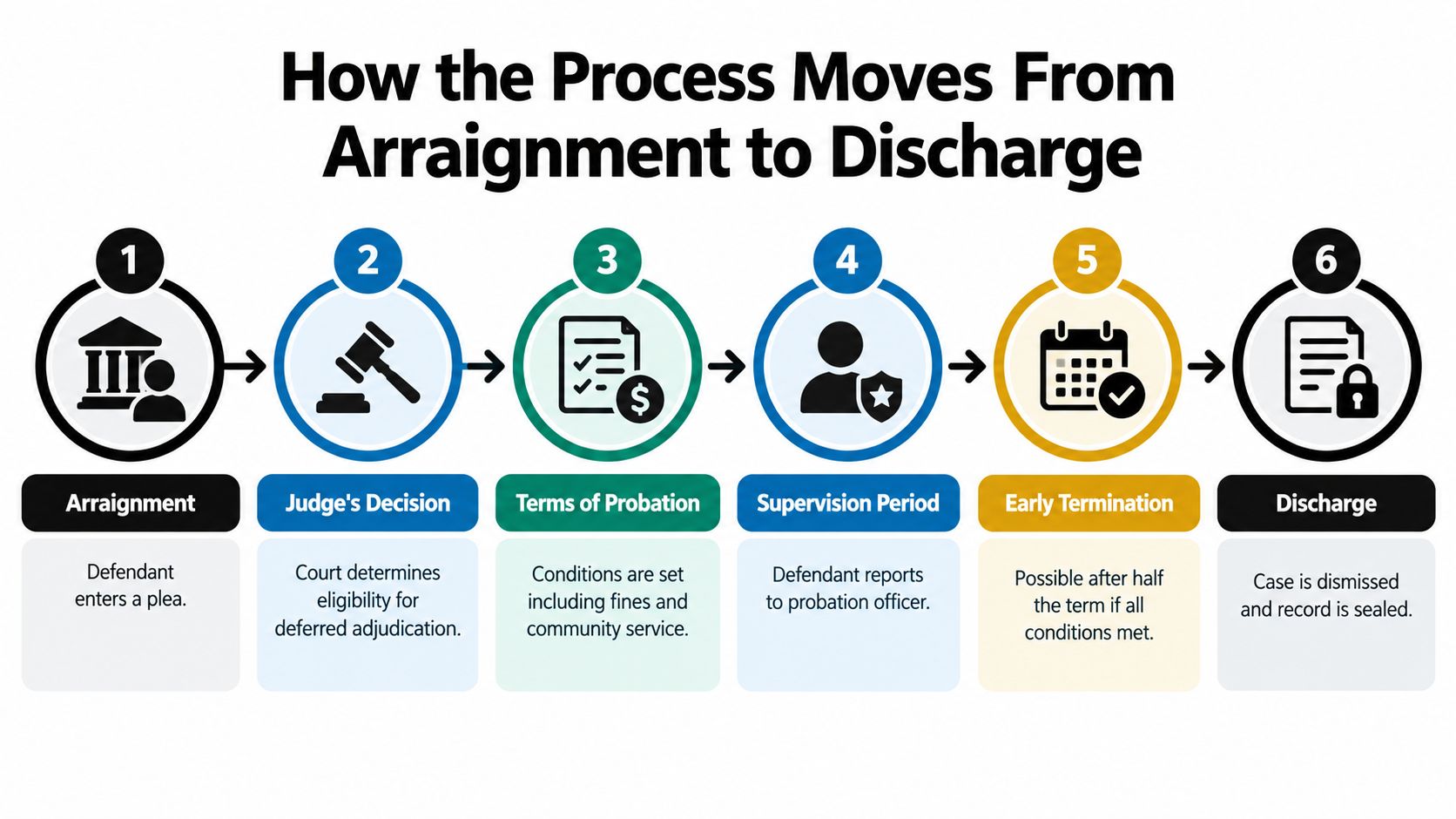
- Arraignment and plea. The court addresses the charge and plea. Ask what the State is offering, what the judge can legally do, and what rights you waive before you answer.
- Pretrial review. Your attorney examines the evidence and may challenge the stop, arrest, or testing through appropriate motions.
- Plea and evidence. To receive deferred adjudication, you enter a guilty or nolo contendere plea, and the judge must find the evidence substantiates guilt.
- Order and conditions. If the court defers adjudication, it sets supervision terms. These may include reporting, testing, treatment, payment obligations, travel restrictions, or other requirements.
- Supervision. You must follow the order and keep records of required appointments and payments. Ask before changing travel plans or assuming a condition doesn't apply.
- Discharge or violation proceedings. Successful completion can lead to dismissal and discharge. If the State alleges a violation, the judge may consider whether to proceed to adjudication. You have a right to be heard, and your lawyer can contest the allegation.
The same plea lands differently at each stage: a pending charge can trigger board or employer questions now, active supervision puts reporting duties under a microscope, discharge ends the case while leaving proof the arrest existed, and nondisclosure becomes a later fight over limited access. A licensed professional, a CDL driver, and a noncitizen should never hear “deferred” as the same outcome.
The violation risks are practical, not abstract. Missed reporting, a failed test, a new arrest, unpaid obligations, or travel without permission can give the State a path back to adjudication. If an allegation comes, call counsel fast and preserve receipts, messages, test results, and appointment records. Do not assume a violation is harmless. Do not assume the allegation automatically means adjudication either.
If the felony is a DWI, there is a parallel case over your license. The Texas DPS ALR program gives you a short window, generally 15 days after notice, to ask for the hearing; miss it and the suspension starts on the 40th day after service. Roadside exercises, the chemical result, and implied-consent warnings can matter in both forums, but the license case has its own deadlines and standards. The ALR outcome is separate from the criminal case, so a criminal agreement doesn't automatically end the license proceeding. For CDL drivers, that civil case can put a livelihood at risk while the felony is still pending.
Before signing, compare the proposed order with Texas felony probation in DWI cases and make your lawyer say which conditions are negotiable, which are boilerplate, and which ones threaten your job, license, or status. My rule is simple: never plead to a schedule you cannot keep.
What Actually Shows Up on Your Texas Criminal Record
The word “dismissed” doesn't answer every record question. Your case can move through distinct stages, and what a background check reveals can depend on the stage and the person or agency conducting it.
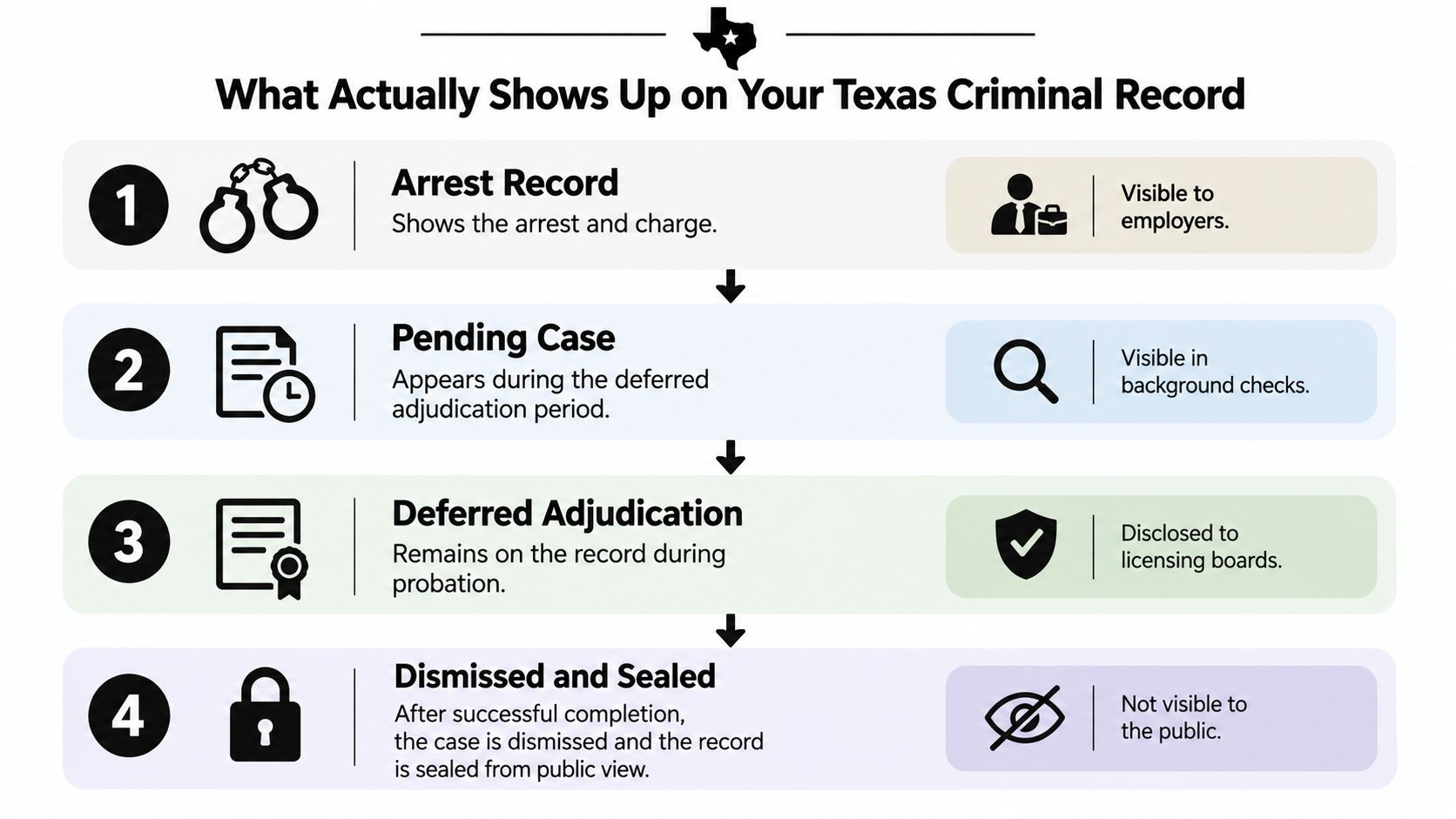
Four different record outcomes
- Pending charge. The case is open. The arrest and charge can appear in criminal-history information.
- Active supervision. The court has deferred adjudication, but you're still under supervision. Texas DPS includes deferred adjudications in its conviction-count statistics because state law treats them as public information for those reporting purposes. Texas DPS reporting statute
- Discharge and dismissal. Successful completion results in dismissal and discharge, but doesn't automatically remove every record of the arrest or prosecution.
- Nondisclosure. A separate legal remedy may restrict public access if you qualify. It doesn't erase the record, and criminal-justice agencies and certain regulators may still be able to access information.
For many felony cases, a nondisclosure petition may require a five-year waiting period after discharge and dismissal. Eligibility depends on the offense and criminal history, and certain licensing or regulatory authorities may still have access. Don't assume the same answer applies to every agency or background-check question. Texas courts' nondisclosure testimony
Practical rule: Before you accept a plea, ask what you may truthfully say on employment, licensing, immigration, and other applications at each stage. A dismissal and a nondisclosure order are not the same thing.
Get written, offense-specific advice about whether you may petition, when you can do so, and which audiences remain able to see the record. For more on the separate remedy, see this Texas order of nondisclosure resource.
Collateral Consequences That Follow a Felony Disposition
A disposition can affect more than the criminal case. The impact depends on your occupation, the terms of the outcome, and the rules that apply to the people reviewing your record.

A nurse or healthcare worker may need to address a record with a licensing authority even after discharge. A teacher or attorney faces a different regulator, with its own reporting rules and review process. Nondisclosure may limit public access, but it doesn't guarantee that a licensing board can't consider the matter. Get advice about your profession before you choose a plea, and don't assume a general background check answer settles a licensing question.
Think beyond the ordinary employment check
A CDL holder may face separate consequences under commercial-driving rules. A deferred disposition in criminal court doesn't by itself answer what a licensing or driving authority will do. Ask counsel to examine the criminal case and the commercial driving consequences together.
Immigration questions require particular care. A plea that seems favorable under Texas law may still have consequences under federal immigration rules, depending on the offense, plea, and record. If you're not a U.S. citizen or have immigration concerns, tell your criminal defense attorney before you enter any plea and ask for immigration-specific legal advice.
Housing, financial aid, and firearm-related concerns can also depend on the underlying charge and the rules of the decision-maker. Don't rely on a broad promise that deferred adjudication will protect every part of your life. Give your lawyer a complete picture of your work, license, driving status, and immigration concerns so the proposed outcome can be assessed against what matters to you.
Defense Strategies That Pursue Dismissal, Reduction, or Alternatives
Deferred adjudication shouldn't be the first and only strategy discussed. A defense lawyer should first test whether the State can prove the charge and whether it can use the evidence it plans to rely on. A strong challenge can create a path to dismissal or a reduced charge. If the evidence is persuasive, a carefully evaluated supervision offer may be the more practical choice.
Challenge the evidence before weighing the plea
For a DWI allegation, counsel may examine whether the officer had a lawful basis to stop you, whether the arrest was supported by probable cause, and whether the field sobriety procedures were properly conducted. A lawyer can also scrutinize breath or blood evidence, including how the sample was obtained, handled, and analyzed. If prior convictions increase the charge or potential punishment, verify that the State can prove and properly use them.
“Before you decide what you can live with, find out what the State can prove.”
A lawyer may consult a forensic expert when the chemical evidence or testing process warrants an independent review. The goal isn't to raise technical objections for their own sake. It's to identify specific weaknesses that could exclude evidence, undermine the State's case, or improve your position in negotiations.
Match the resolution to the evidence and your life
Pretrial diversion may be worth asking about if the local process and your case allow it, but don't confuse that with deferred adjudication. Mitigation can also help your lawyer present context, such as treatment enrollment, employment records, and support from people who know you.
If the evidence is weak, your lawyer should pursue dismissal or reduction where the facts and law support it. If deferred adjudication is the attainable route, review the proposed conditions closely. Reporting, treatment, testing, travel rules, and payment requirements must be manageable alongside your job and family responsibilities.
The Law Office of Bryan Fagan, PLLC handles DWI defense, including review of probable cause and efforts to challenge unlawfully obtained evidence. Ask any prospective lawyer how they'll investigate your case, what motions they may file, and how they'll evaluate each resolution rather than recommending only the first offer.
Choosing the Right Texas Felony Defense Attorney
You usually face several possible paths: dismissal, a reduced charge, deferred adjudication, or trial. The right option depends on the evidence, the law, the risks of supervision, and the consequences for your work and family. You need advice about your case, not a generic promise about what usually happens.
Bring specific questions to your consultation. Ask whether the lawyer has handled your type of felony DWI or other felony charge, how they'll review the stop and chemical evidence, and what they know about the local prosecutor's approach. Ask which motions may apply and whether they're prepared to litigate if the State's offer doesn't protect your interests.
Ask for the downside, not just the offer. Find out what happens if you violate supervision, what the record may show after discharge, and whether your occupation or immigration status changes the analysis.
A Houston DWI lawyer or Texas DUI attorney should be able to explain the criminal case and the separate risk of DWI license suspension in plain language. If you're comparing counsel, this guide to criminal defense attorneys in Texas can help you prepare questions for a consultation.
A felony charge is serious, but it isn't the end of your story. Talk with a Texas felony defense attorney before accepting a plea, and make sure the proposed outcome accounts for your evidence, record, license, and future.
The Law Office of Bryan Fagan, PLLC offers free consultations and case evaluations for Texans facing DWI and related felony charges, including guidance on deferred adjudication and license proceedings. Contact the Law Office of Bryan Fagan, PLLC to discuss your case with a Texas defense team and decide on a strategy before you accept an offer.
