
A DWI arrest can be overwhelming, but you don't have to face it alone. You may be reading this after a late-night traffic stop, while your child is finally home, or with a phone call from the county jail still fresh in your mind. Before you assume the worst, find out exactly what the officer alleged and put every document from the stop in one place.
The consequences for DUI under 21 in Texas depend on the charge, the evidence, and the separate action against your driver's license. Your first move shouldn't be to explain the arrest away or plead guilty to get it over with. It should be to protect your deadlines and get a clear defense plan.
What Happens When a Driver Under 21 Is Arrested in Texas
The words on the paperwork matter more than the label someone used during the phone call. Families often say “underage DWI” when the actual allegation is DUIA, meaning driving under the influence of alcohol by a minor. Those aren't interchangeable charges.
Texas has a zero-tolerance track based on detectable alcohol and an intoxication track based on evidence supporting DWI. Your attorney needs to identify the track before discussing punishment, driving privileges, or a plea.
Two Texas Tracks for Drivers Under 21
| Factor | Zero-Tolerance DUIA | Adult DWI Against a Minor |
|---|---|---|
| Central allegation | Detectable alcohol while operating in a public place | Legally defined intoxication while operating |
| Proof question | Was alcohol present during operation? | Does the evidence establish intoxication? |
| Typical classification | Class C misdemeanor for the ordinary first offense | Class B misdemeanor for ordinary DWI |
| Defense focus | Alcohol detection, operation, location, and timing | Intoxication evidence, testing, observations, and lawful police procedures |
| Practical concern | Criminal case and driving consequences | Greater criminal and conviction-related licensing exposure |
The official Texas Alcoholic Beverage Commission underage-drinking guidance explains the detectable-alcohol offense, while the intoxication allegation requires a different assessment. Don't assume a low reading means the entire case disappears. Don't assume an officer's use of “DWI” proves the more serious charge, either.
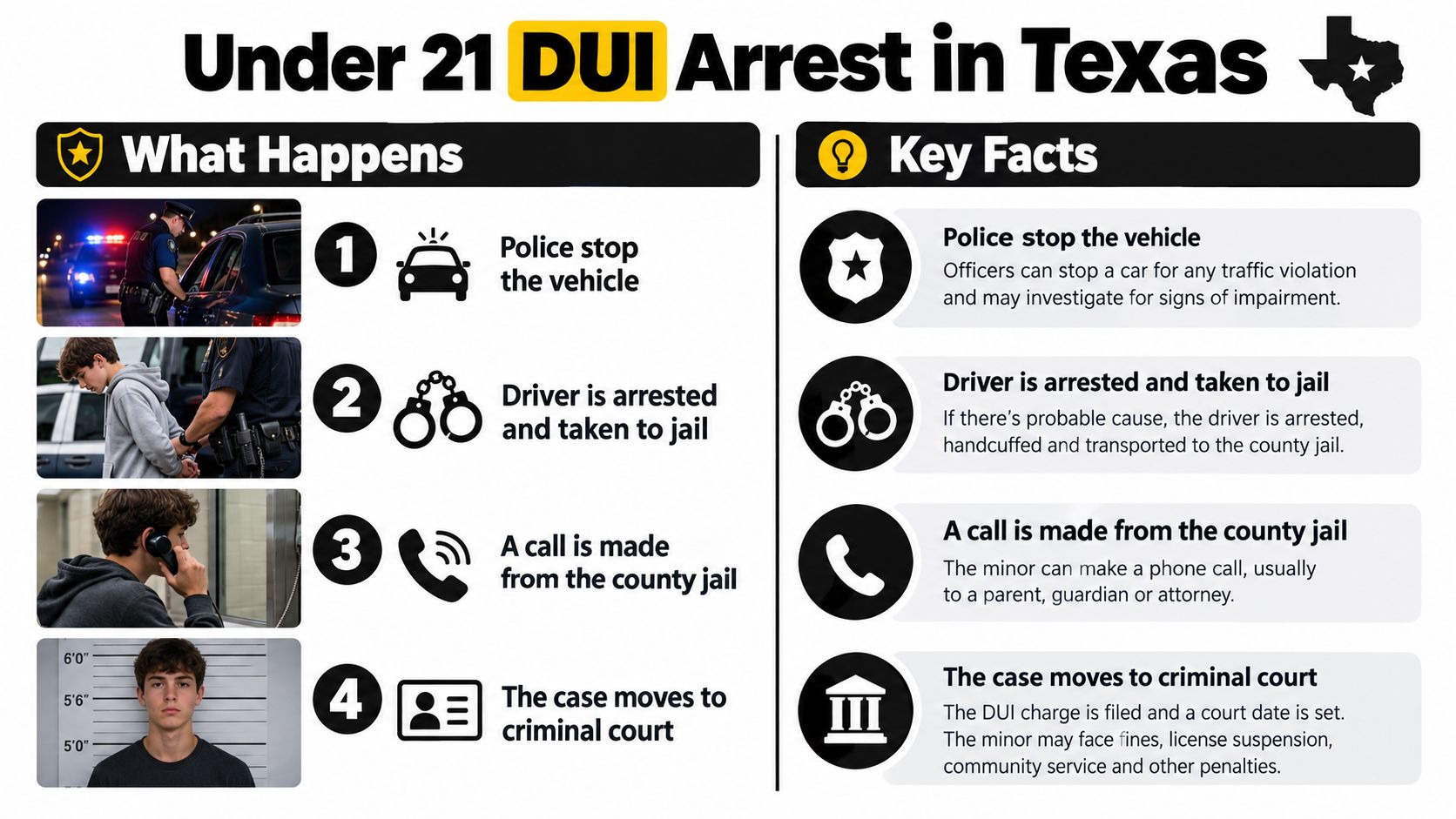
The process may involve arrest, booking, release conditions, and court proceedings, depending on the allegation and how authorities handle it. Keep the citation, release papers, test documents, and any suspension notice together.
Start With the Actual Allegation
Ask counsel to answer these questions:
- What charge appears on the paperwork? A roadside description isn't a substitute for reviewing the actual allegation.
- What evidence supports it? Look for test results, officer observations, video, and statements.
- Is there a separate license notice? Don't place it beneath the court papers and forget it.
Practical rule: Treat the charge and the license notice as separate problems until your attorney confirms how each applies.
An arrest isn't a conviction. Your job now is to preserve options, not decide the outcome at the kitchen table.
Texas Zero-Tolerance Rules and First-Offense Penalties
For a young driver, the adult BAC threshold is the wrong place to start. BAC, or blood-alcohol concentration, measures the amount of alcohol in the blood. Texas's zero-tolerance rule applies to drivers younger than 21 who operate a motor vehicle in a public place with any detectable alcohol. The ordinary 0.08% BAC threshold does not determine whether this minor-alcohol offense applies.
That is why an under-21 driver can face a charge without being legally intoxicated under the adult standard. Zero tolerance concerns detectable alcohol; an intoxication allegation follows a separate track.
The First-Offense Penalty Package
For an ordinary first DUIA-by-a-minor offense, consequences can include a Class C misdemeanor, a fine of up to $500, 20–40 hours of community service, an alcohol-awareness class, and a 60-day driver-license suspension. The TABC's underage-drinking guidance summarizes the first-offense and repeat-offense penalties.
Repeat offenses raise the consequences:
- Second offense. Texas Penal Code §106.02 provides for 40–60 hours of community service and a 120-day driver-license suspension.
- Third offense. A 180-day suspension applies, and deferred adjudication is unavailable under the guidance linked above.
- License classifications. Some first-offense classifications carry a 60–180-day suspension range, as described in Texas DPS alcohol-related offense guidance. Read the actual notice and confirm how the driver's age and classification affect the suspension.
Do not judge a proposed outcome by the fine alone. Check what it means for the driver's record, required education and community service, and any separate DPS action. Keep the court consequences and license consequences distinct.
A Low Reading Still Requires Reliable Proof
A low alcohol result does not automatically defeat the allegation. It does give the defense a reason to examine the evidence closely. The state must connect detectable alcohol to the driver's operation of a vehicle in a public place.
Have counsel compare the alleged driving time with the stop, sample collection, and testing records. A result taken later must be assessed in relation to the alleged operation, not treated as if both happened at the same time.
My recommendation is direct: challenge the proof before negotiating the punishment. A clean history may matter when evaluating available options, but it does not replace a careful evidence review.
When an Under-21 Driver Faces Full Adult DWI Charges
A driver can be under the drinking age and still face the ordinary DWI track. A driver 17 or older may face adult DWI allegations when the evidence supports intoxication, including a BAC of 0.08% or higher or other legally sufficient impairment evidence; the distinction is addressed in the firm's Texas DWI versus DUI explanation.
The important question isn't whether alcohol was detected. It's whether the state can establish the intoxication allegation.
Why the DWI Track Requires a Different Strategy
Ordinary DWI carries Class B misdemeanor exposure with at least 72 hours of confinement under the applicable statutory framework summarized in Texas DPS alcohol-related offense materials. That is materially different from the ordinary minor DUIA penalty structure.
A minor convicted of DWI generally faces a one-year license suspension; subsequent alcohol-related offenses may produce an 18-month suspension, according to Texas DPS conviction-related suspension guidance.
Those consequences make the initial evidence review especially important. Your attorney should examine the video, the basis for the stop, the officer's observations, and the chemical-testing records before advising you about a plea.
A field sobriety test is a roadside assessment in which an officer observes your performance on physical or attention-based tasks. It isn't a BAC measurement. Counsel should evaluate what the test shows, how the officer administered it, and whether the recording supports the written report.
Reinstatement Is a Separate Obligation
For the minor DWI suspension addressed by DPS, reinstatement requires completion of the suspension, SR-22 financial-responsibility coverage for two years, and a $100 reinstatement fee; failure to complete a required 12-hour alcohol-education course can add a 180-day suspension and another $100 fee, according to DPS reinstatement and education requirements.
SR-22 is documentation of required financial-responsibility coverage. Don't assume paying the court or finishing supervision automatically restores your license.
A sentence, a suspension, and reinstatement requirements are different obligations. Get each one explained before accepting a resolution.
If this is your first DWI in Texas, ask counsel to explain the proposed result in writing: the criminal disposition, license consequences, education requirements, and reinstatement conditions. A plea decision should account for all of them, not just the next court date.
License Suspension and the ALR Hearing Timeline
Your criminal court date isn't necessarily your earliest deadline. An administrative license suspension is a civil action by DPS against driving privileges, separate from the criminal case.
Implied consent refers to the legal framework under which operating a vehicle subjects a driver to chemical-testing requirements after a qualifying arrest. Refusing a requested test isn't a consequence-free shortcut. A refusal or qualifying failed test may support an ALR action, and counsel should review the request, warnings, and circumstances.
Preserve the Hearing Opportunity
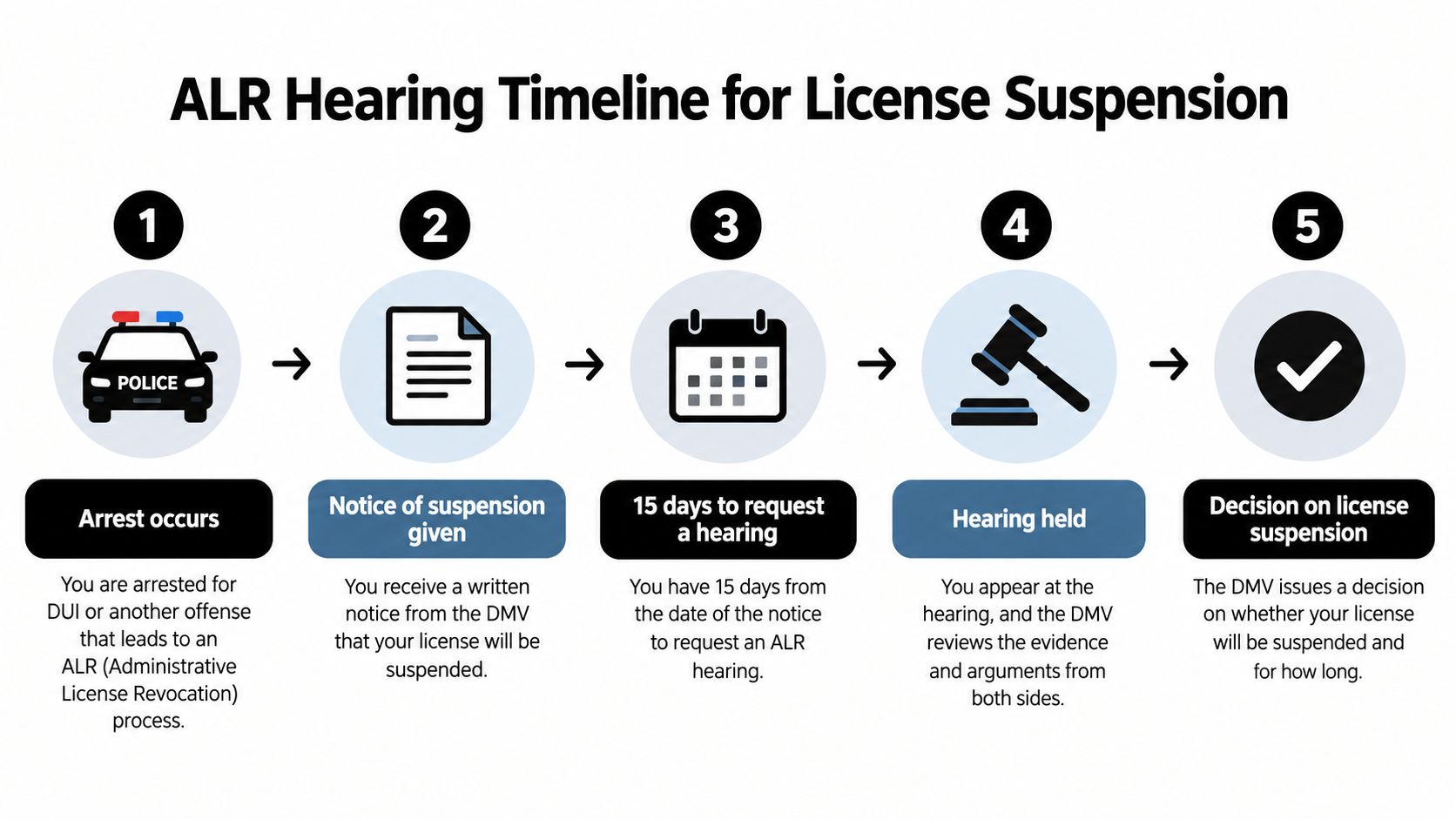
Texas DPS says a driver generally has 15 days after service of notice to request an ALR hearing; hearings proceed through the State Office of Administrative Hearings, and scheduling may take up to 60 days, according to the DPS Administrative License Revocation program.
The service date matters. Don't assume the deadline runs from your release, your first court appearance, or the day you hire an attorney.
A timely hearing request gives your defense an opportunity to contest the relevant suspension issues:
- Lawful police grounds. What justified the stop and arrest?
- Statutory warnings. Were the required warnings properly given?
- Testing or refusal evidence. Does DPS have legally sufficient proof for the suspension it seeks?
Missing the deadline can lead to denial of the hearing request. Act on the notice immediately rather than waiting for the prosecutor's office to contact you.
Keep the License Tracks Separate
DPS explains that the same arrest can produce both an ALR suspension and a conviction-related suspension in its minor alcohol-offense licensing guide. Don't assume resolution of the criminal charge resolves every licensing issue, or that different suspension periods add together without further analysis.
A qualifying court-ordered interlock supervision arrangement may permit a 90-day suspension, but driving then requires an interlock-restricted license, according to Texas DPS interlock-related licensing guidance. An interlock is a vehicle device that requires a breath sample before permitting operation.
The firm's Texas ALR hearing process guide can help you understand the administrative proceeding. Have counsel build a license plan around your actual notices and orders, not a generic online suspension calculator.
Collateral Consequences Beyond the Courtroom
A worried parent often asks about college before asking about punishment. A young adult may be more concerned about keeping a job or entering a licensed profession. Those concerns belong in the defense discussion from the beginning.
The CDC's teen-driver risk guidance documents the serious safety concerns surrounding youth alcohol-related driving. That context helps explain strict enforcement, but it doesn't determine your individual case or justify assuming every possible collateral consequence will happen.
Protect School, Work, and Insurance
Insurance consequences can include higher premiums or coverage difficulties. A conviction and a license action may raise different questions, so obtain accurate case information before discussing renewal or changes with your insurer.
School discipline, scholarships, and financial aid require a separate policy review. Don't assume an alcohol-related arrest automatically ends federal Title IV aid eligibility. School rules, scholarship terms, and federal aid requirements aren't interchangeable, and you shouldn't withdraw from school based on a rumor.
Use the firm's DWI scholarship consequences guide to frame questions, then have counsel review the documents that govern your situation.
- Professional credentials. Nursing, education, real estate, and law applicants should identify the relevant board's disclosure questions and rules.
- Employment. Read the actual reporting policy, especially if driving is part of your job.
- Commercial driving. A CDL holder should obtain a specific disqualification assessment, including whether a personal-vehicle incident affects commercial eligibility.
A defense lawyer shouldn't promise that a dismissal, reduction, or deferred result solves every outside concern. Different institutions may ask about arrests, charges, convictions, or license actions.
Age at Court Doesn't Replace Age at the Incident
For intoxication allegations, a driver under 17 generally encounters juvenile-system procedures, while a 17-to-20-year-old may face adult criminal processing. Minor DUIA handling requires its own court-jurisdiction review rather than assuming every underage alcohol case follows the same path.
Turning 21 before court or conviction doesn't automatically erase zero-tolerance exposure because the relevant age is generally tied to the alleged violation, as explained in the Texas DPS guide to minor alcohol violations.
Birthday checkpoint: Put your birthday on the timeline, but don't treat it as a dismissal date.
Tell your attorney about school applications, professional deadlines, employment reporting rules, and commercial driving before negotiations begin. The most useful resolution is one evaluated against your actual future plans.
What to Do After an Under-21 DUI Arrest
Make a timeline while the events are fresh. Include the stop, arrest, service of any license notice, birthday, court settings, disposition, and reinstatement requirements. Keep the criminal and licensing dates in separate columns.
From the Stop to the First Court Appearance
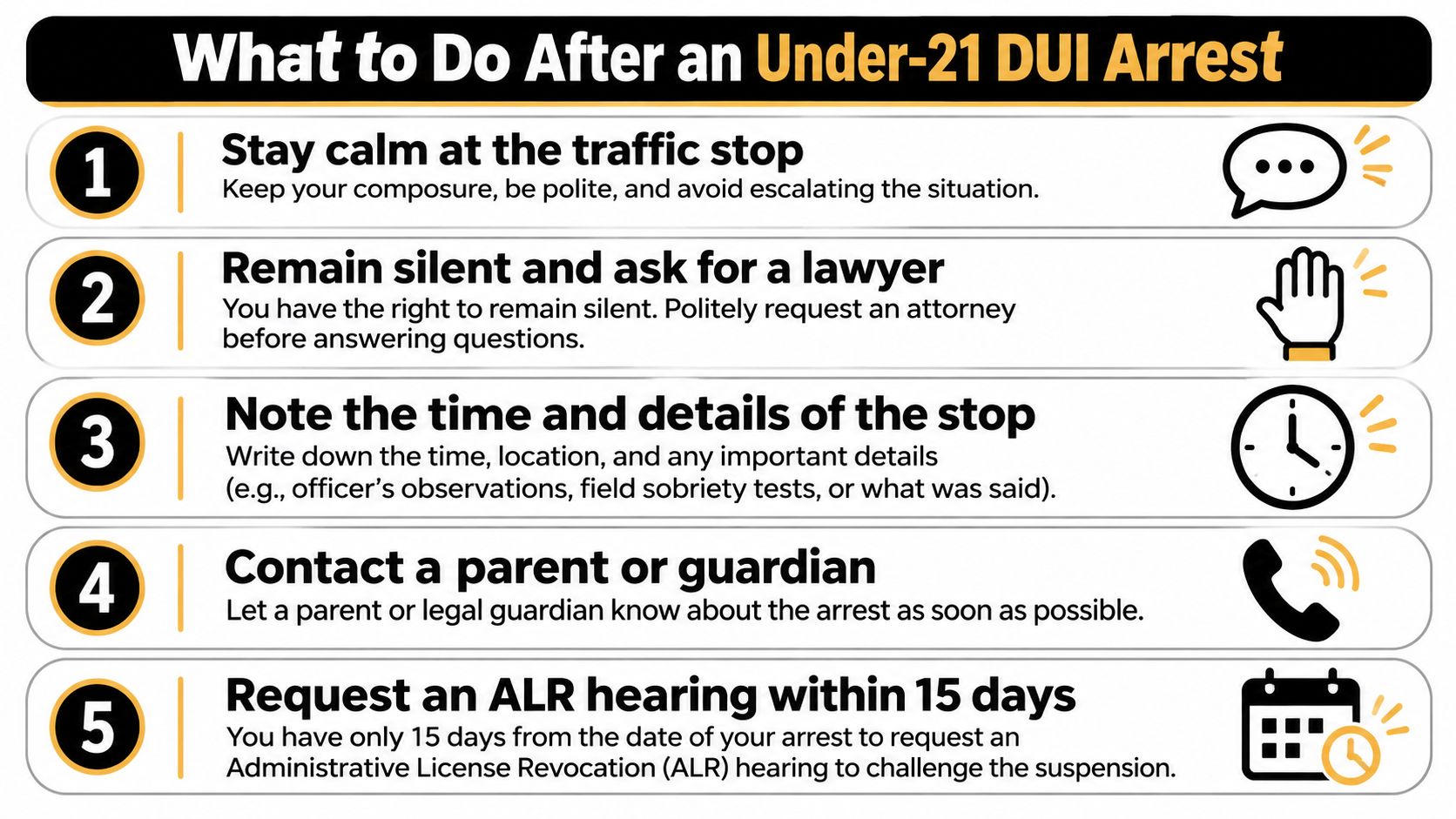
- Stay calm and avoid roadside explanations. Provide required identification, follow lawful safety directions, and don't guess about drinking times or quantities. You can clearly state that you want to remain silent and speak with a lawyer.
- Preserve the details. Write down what happened, save paperwork, and identify passengers or other witnesses. Don't post an account on social media or delete potentially relevant material.
- Address the ALR notice. The general 15-day hearing-request deadline comes from Texas DPS ALR guidance, not the criminal court calendar.
- Review release and court obligations. If you're released on bond, follow its conditions and attend required appearances. Counsel can review the evidence, evaluate legal challenges, discuss negotiations, and prepare for trial if the case remains contested.
Plan Driving and Compliance Before You Need Them
Ask whether occupational driving privileges are available and what restrictions apply. For a first minor DUIA offense, the driver generally can't obtain an occupational license during the first 30 days, according to the DPS minor-offense licensing guide.
If your resolution requires education, complete the correct course and preserve proof. If reinstatement requires financial-responsibility documentation, arrange it before applying to restore driving privileges.
Don't treat a post-arrest calendar milestone as permission to remove an interlock. The qualifying shorter suspension discussed earlier isn't a universal interlock end date. Read the court order and DPS restrictions before changing equipment or driving.
The firm's ALR process resource addresses the license proceeding, while its DWI defense practice addresses criminal allegations, including first-time cases. A Houston DWI lawyer or Texas DUI attorney should help you coordinate both, not handle the court case while leaving your driving deadlines unattended.
Defense Strategies That Can Reduce the Consequences
A strong defense starts with records, not assurances. The officer's report matters, but so do the recordings, dispatch information, testing documents, and exact sequence of events.
Ask counsel what evidence is available, what still needs to be obtained, and which legal issues could change the case. That's more useful than asking for a dismissal prediction before anyone has reviewed the file.

Examine the Stop and the Alcohol Evidence
Productive defense questions include:
- Grounds for police action. What justified the initial stop, continued investigation, and arrest? Those are distinct questions.
- Driving and sample timing. Does the evidence connect the alcohol finding to the alleged operation?
- Testing reliability. Review methodology, instrument maintenance and calibration records, sample handling, and laboratory documentation.
- Operation and public place. Does the evidence establish who operated the vehicle and where the alleged conduct occurred?
Chain of custody means the documented handling of a sample from collection through testing. Counsel should examine whether the records establish whose sample was tested, how it was stored, and whether handling raises a meaningful reliability issue. A missing entry deserves investigation, but it doesn't automatically guarantee exclusion.
These inquiries reflect the evidence concerns identified in Texas minor-alcohol enforcement guidance and the procedural issues addressed by DPS in ALR proceedings.
Evaluate Outcomes Without Promising Them
Depending on the evidence and legal eligibility, counsel may investigate dismissal, a reduction to a non-alcohol offense, deferred disposition, or later expunction. Expunction is a legal process for removing eligible records, not an automatic benefit of being young or having no prior arrests.
Deferred disposition and deferred adjudication aren't interchangeable terms. Ask which procedure applies to your actual charge and whether the proposed outcome meets your record-protection goals.
If you're searching “fight DWI Texas,” focus on the work behind that phrase: obtain the records, test the state's proof, and evaluate each proposed resolution against its licensing and collateral effects. Strategic defense can improve your options, but no responsible attorney should guarantee the result before examining the evidence.
Next Steps and How the Law Office of Bryan Fagan Can Help
You don't need to resolve every question before contacting counsel. Bring your citation, release papers, suspension notice, and known dates so an attorney can identify urgent deadlines and explain the possible defense paths.
The firm's Underage DWI and DUI in Texas practice addresses alcohol-related driving allegations against young drivers. Its Texas DWI Defense Lawyer practice covers drivers charged under Texas Penal Code 49.04, and the DWI-versus-DUI comparison linked earlier helps distinguish the allegations.
The firm serves Houston, Dallas–Fort Worth, Austin, San Antonio, and surrounding counties, with free consultations and 24/7 support. Ask for a confidential case evaluation focused on your criminal charge, license notice, and future plans. An underage arrest doesn't have to define your future, and prompt legal review can help you protect the choices still available.
Law Office of Bryan Fagan, PLLC offers defense for underage DUI and DWI charges, administrative license proceedings, and related criminal cases. Request a free, confidential consultation and bring your arrest paperwork and suspension notice so the team can identify deadlines, protect your rights, and work to minimize the consequences.
